
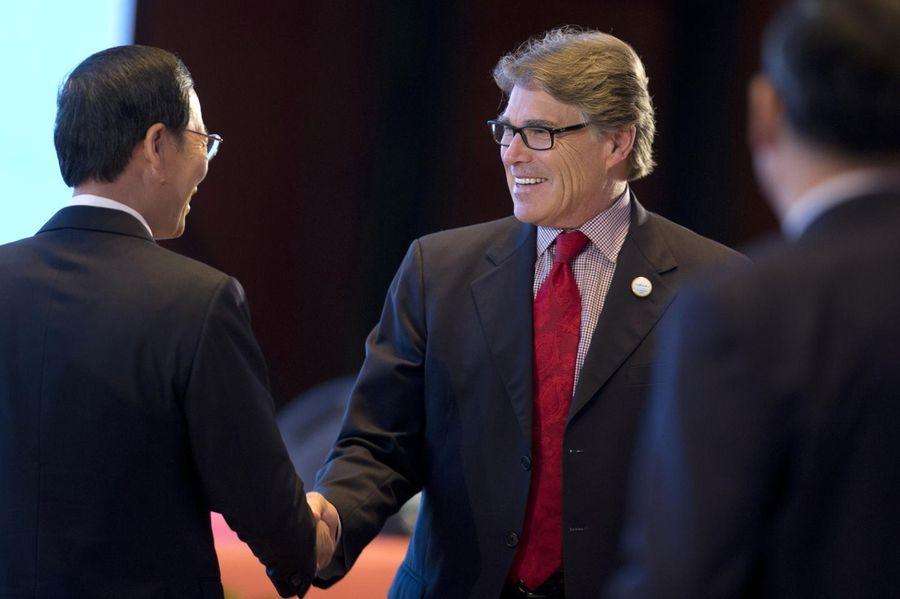
Chinese Vice Premier Zhang Gaoli, left, shakes hands with U.S. Energy Secretary Rick Perry during the opening ceremony of an international clean energy conference in Beijing Wednesday, June 7, 2017. China in recent years overtook the U.S. as the world leader in renewable power development. But it has also struggled to integrate its sprawling wind and solar facilities into an electricity grid still dominated by coal-fueled power plants. (AP Photo/Ng Han Guan)
Perry: Trump Is Revving Up U.S. Energy Potential
Published June 27, 2017 • Read time: 5m
Join the Conversation
0It is “energy week” at the White House, which turns out to be less about detailed policy and more about thematic aspirations.
White House advisers -- eager to counter-program President Trump’s preoccupation with the Russia investigations and the bumpy GOP efforts to fashion a health care bill -- decided June would showcase a series of weekly presidential initiatives tied to jobs and the economy.
That’s how an “energy dominance” concept described by Energy Secretary Rick Perry entered the lexicon Monday, following earlier weeks devoted to gauzy ambitions for infrastructure, worker apprenticeships, and technology.
“The lecturing is over,” Perry said of Trump’s energy agenda, with a swipe at the Obama administration. “It’s now time to listen.”
The department head, speaking to reporters at the White House Monday, sounded a lot like the Obama administration on at least two fronts. Perry borrowed a phrase often used by President Obama and his Cabinet when he heralded “a broad, all-of-the-above energy portfolio.”
And he boasted, as did his predecessor in the job, that the United States is “on the brink” of becoming a net exporter of energy.
But Perry quickly pointed to stark differences between the previous administration’s approach and Trump’s. Market forces, not federal edicts, will guide policy, he added.
The former Texas governor and unsuccessful presidential candidate said the 45th president is focused on deregulating the energy sector, pushing exports of coal, liquefied natural gas and nuclear power technologies, and showing allies that while the United States pulled out of the Paris climate change accord, it “leads the world” in lowering greenhouse gas emissions.
Senate Heads Toward Approval of Keystone XL Pipeline Bill
GOP Senators Make Case for Keystone; Scott Walker Off To N.H.; FDR on Baseball
New GOP Senators Make Economic Case for Keystone
GOP Stays Stubborn About Climate Change
“We’ve done this through innovation and technology, not signing on to agreements,” Perry said. “Instead of preaching about clean energy, this administration will act upon it.”
Among those innovations, he noted enthusiastically, are hydraulic fracturing and horizontal drilling. The Trump administration seeks to boost U.S. exports of natural gas to Europe and Asian markets, he added.
Perry expressed no qualms about selling U.S. technologies to China and said he’d leave discussions about national security risks to the State Department. If the United States and U.S. companies are is not in the nuclear marketplace, China and Russia “will fill that void,” the secretary said. “I want it to be America.”
Asked where wind and solar and other renewable energy sources fit into the Trump portfolio, Perry said his department is conducting a study of the U.S. electric power grid “to analyze where we are” on national security, reliability, and economic benefits. He declined to be more specific, except to say his experience in Texas taught him that diversity in energy sources is “really wise.”
Texas, known for its oil, now leads the nation in wind power.
But LNG, which Perry touted as “very clean burning,” and coal – an industry championed by Trump during his 2016 campaign – dominated the secretary’s discussion on the third floor of the Eisenhower Executive Office Building.
Following meetings Monday with India’s Prime Minister Narendra Modi at the White House, Trump said his team continues to negotiate the terms of what he hopes will be long-term natural gas contracts with India. “Trying to get the price up a little bit,” he said in the Rose Garden.
The administration offered no specifics, numbers or policy details.
In keeping with the “energy week” theme, Trump is scheduled to lead a meeting Wednesday at the White House with governors and tribal leaders. He will deliver a speech at the Energy Department Thursday following panel discussions that will feature energy company and labor representatives, as well as Perry and the president’s key advisers.
Trump is a climate-change skeptic who questions the science behind the developed world’s urgent focus on global warming and its man-made causes.
He has rejected the Obama administration’s Paris commitment, forged among nearly 200 nations, including India and China, which calls on signatories to cut greenhouse gases to zero in the second half of this century. Trump announced on June 2 he would withdraw the United States from the agreement, but the United States remains legally in the pact for at least another year.
Although Obama sought to transition the U.S. energy sector away from fossil fuels by using cleaner sources of energy and renewables, coupled with federal mandates and incentives, Trump has embraced petroleum, the flagging coal industry, advanced nuclear power plants, and the construction of more oil and gas pipelines.
Perry said the administration’s upcoming tax plan, which is in limbo pending Congress’s action on health care this summer, would include federal incentives to support Trump’s energy priorities. The secretary added, however, that the administration’s deregulatory posture was perhaps more valuable to energy producers than incentives built into the tax code. He declined to add specifics, noting he didn’t want to get ahead of the president.
Two years ago, Obama said his approach “when it comes to fracking, drilling, U.S. energy production of oil or natural gas has remained consistent throughout: I believe that we are going to have to transition off of fossil fuels … in order to prevent climate change.”
As part of Trump’s “America first” focus on jobs and the economy, the administration believes the private marketplace will determine whether and how greenhouse gases factor into state-based and private-sector energy decisions.
"I was elected by the citizens of Pittsburgh," Trump said early this month, "not Paris."

Congress Doesn’t Need Another Blame Game. It Needs To Find What’s Broken
Jarrod Bernstein • RealClearPolitics
Democrats Won the Midterms. Common Sense Won, Too
Jordanne Kemper • RealClearPolitics
The 120th Congress Shapes Up
Carolina Lumetta • RealClearPolitics
Flooding GOP Primaries With Democrats
Robert Natelson • RealClearPolitics
Washington Keeps Rewarding Oracle—Veterans Keep Paying the Price
Darin Gaub • RealClearPolitics
The Seeds of Unrestricted Warfare
John Teichert • RealClearPolitics
RCP Today
Top stories on RealClearPolitics
The Takeaway
Polling intelligence and analysis delivered to your inbox
World News
Featuring the latest world news
Policy
Featuring the latest policy news
Support Our Mission
As part of RealClearPolitics, authors aim to provide balanced, non-partisan analysis by presenting top reporting and commentary from all sides of the political spectrum.
Trusted by policymakers and citizens alike since 2000