
New GOP Senators Make Economic Case for Keystone
Published Jan. 22, 2015 • Read time: 4m
Job creation has been one of the chief arguments for building the proposed Keystone XL pipeline in recent debates in the new Congress. But a group of Republican Senate newcomers on Thursday made an economic case for Keystone beyond just its role in job creation.
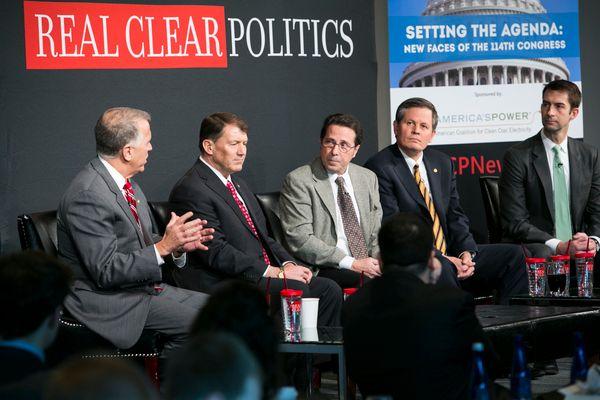
Republican Sens. Tom Cotton of Arkansas, Steve Daines of Montana, Mike Rounds of South Dakota and Thom Tillis of North Carolina all spoke fervently in favor of the politically contentious pipeline at an event hosted by RealClearPolitics at the Newseum in downtown Washington Thursday.
“Long term, the pipeline works and it’s necessary,” Rounds said. “The pipeline is a more efficient way to deliver, and I believe a safer way to deliver, oil from those locations in our continent, Canada and North Dakota and Montana, down into specific refineries that were designed to take heavy crude.”
The Keystone pipeline has been caught in political crosshairs for six years, with Republicans in Congress anxious for it to be built while the Obama administration has threatened to veto any pipeline legislation that crosses the president's desk. The House passed a bill approving its construction earlier this month, but the Senate has been caught up in a long process of voting on amendments to the bill.
Two senators from states along the proposed Keystone XL path, Daines of Montana and Rounds of South Dakota, argued at the event that the pipeline would help their states’ local economies.
There’s strong disagreement across the aisles about how many jobs the pipeline would create. Republicans say building Keystone would add more than 40,000 new jobs, but Democrats argue the majority would be temporary. Democrats say the pipeline would lead to fewer than 50 permanent new jobs.
Rounds said that South Dakotans are eager to see the pipeline built because oil is being moved by train there, which is slowing down the transportation of grains to markets. He said it “comes directly out of our farmers’ and ranchers’ pockets.”
Daines said $80 million in tax revenues from the pipeline would directly benefit poor counties in eastern Montana. He also said the electricity provided for the pipeline would help to lower electric prices for those in the surrounding area.
“There’s a missed opportunity for the president to connect the dots in the Keystone pipeline and the middle class,” he said. “There’s a lot of folks fighting month to month to make ends meet and those are the folks that live near where that pipeline will go through.”
A number of senators cautioned that while oil prices are currently low, that’s unlikely to be a long-term trend. Oil prices tend to fluctuate, they said, and the pipeline decision shouldn’t be determined simply because prices are currently on the low end of the spectrum.
Because oil is a global commodity, Cotton said that increased production from U.S. allies is a benefit as well. He said he was “surprised” by arguments from the administration against Keystone because it’s a Canadian company and mostly Canadian oil.
“Canada’s an ally. We should want to help Canada because they help us,” Cotton said. “The president always likes to act like congressmen and senators are so parochial and nearsighted, that the president should be ascending and thinking about national interests, and he would be the last leader that would say, ‘Oh it’s just a Canadian company,’ as opposed to being the first one to say Canada’s an ally and any time we can help them and also help ourselves … that we should do that.”
Tillis said most of the public supports building the pipeline, and that that support would only increase if people knew more of the facts. He argued that if private companies want to take on the financial risk of the pipeline, government shouldn’t stand in the way.
“If the energy prices go down to a point to where they’re not going to fulfill the capacity of the pipeline, that’s a risk that a private company is willing to make,” Tillis said. “They’re willing to put $8 billion on the line, create 40,000 jobs. And for people to say well, it’s not ready yet, I trust the private sector to make those sorts of decisions, and TransCanada is prepared to make it.”




RCP Today
Top stories on RealClearPolitics
The Takeaway
Polling intelligence and analysis delivered to your inbox
World News
Featuring the latest world news
Policy
Featuring the latest policy news
Support Our Mission
As part of RealClearPolitics, authors aim to provide balanced, non-partisan analysis by presenting top reporting and commentary from all sides of the political spectrum.
Trusted by policymakers and citizens alike since 2000