
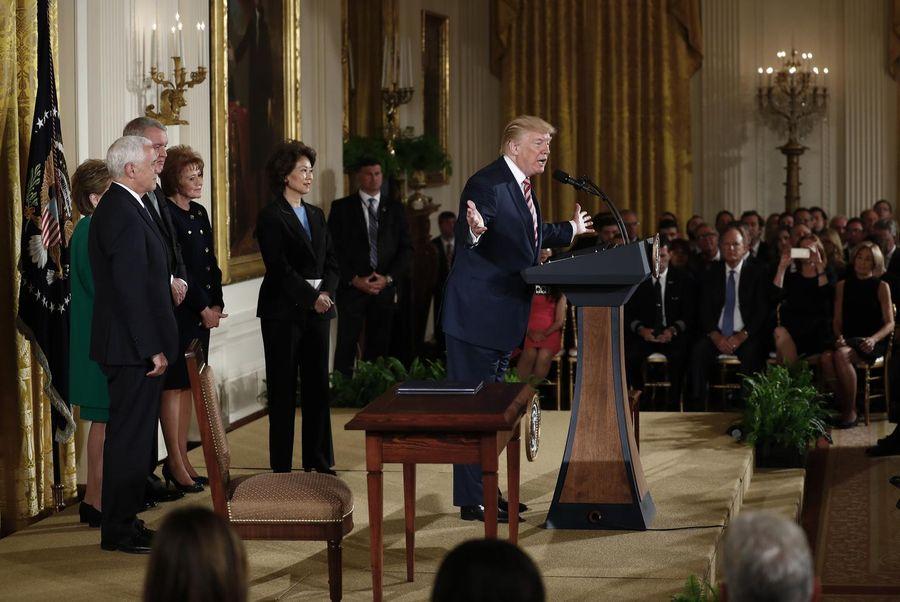
President Donald Trump speaks in the East Room of the White House in Washington, Monday, June 5, 2017, to announce the Air Traffic Control Reform Initiative. Behind the president from left are Vice President Mike Pence, former Secretary of Transportation Elizabeth Dole, former Secretary of Transportation James Burnley, former Secretary of Transportation Mary Peters, and Secretary of Transportation Elaine Chao. (AP Photo/Carolyn Kaster)
Trump Targets Air Traffic System in Infrastructure Kickoff
Published June 5, 2017 • Read time: 5m
Join the Conversation
0President Trump on Monday revived a decades-long debate about modernizing the U.S. air traffic control system, seeking to shift much of the existing federal responsibility for civilian aviation into a new, not-for-profit entity that Congress would have to approve.
The president’s embrace of existing House GOP legislation was designed to be a curtain-raiser leading toward a collection of administration proposals, still in development, to improve the nation’s roads, bridges, waterways, and other core infrastructure needs, by tapping financial help from the private sector.
Trump spoke of infrastructure improvements during his presidential campaign as a bipartisan plank in his platform.
Administration officials said Trump’s goal is to secure passage of his infrastructure initiatives in Congress this year, along with his agenda to repeal and replace the Affordable Care Act, and substantially overhaul the corporate and individual tax codes.
Lawmakers and interest groups say enactment of the president’s ambitious to-do list before the 2018 midterm year begins will be a tall order, even with GOP control of both ends of Pennsylvania Avenue.
House and Senate Republicans are not of like mind about corporatizing the air traffic system, for example, despite studies and blue ribbon panels dating back to 1974 that repeatedly identified technology hurdles and budgetary drawbacks within the Federal Aviation Administration.
“After billions and billions of tax dollars spent and the many years of delays, we're still stuck with an ancient, broken, antiquated, horrible system that doesn't work,” Trump said during an East Room event, during which he signed a letter and list of “principles,” while surrounded by representatives of the airline industry, Transportation Secretary Elaine Chao, and GOP lawmakers.
BART Is Not a Homeless Shelter
Thank Gridlock for Economic Turnaround
Infrastructure Is Not the Problem
Take the Public-Private Road to Efficiency
The administration believes a non-governmental, not-for-profit entity with a 13-member board could transition current responsibilities away from the FAA and in the process move to a user-fee system bolstered by outside borrowing.
The plan, if adopted, would shift more than 30,000 federal employees (including 14,000 controllers) out of the government and permit hiring, firing, procurement, financing and transfer of existing federal assets owned by taxpayers to a new, non-governmental air-traffic-control entity. The administration describes the projected results as a plus for up-to-date technologies, improved safety, on-time travel, and federal savings.
In a report last month, the Congressional Research Service assessed some of the recurring hurdles in Congress as air-traffic-control improvements were debated over many decades, either in the guise of privatization or corporatization.
“Proposals to replace or augment U.S. aviation taxes with user fees linked to air traffic services have met with considerable opposition,” CRS noted.
Congress cares a lot about its turf and oversight, as well as the budgetary impact, which for scoring purposes would theoretically erase federal revenues derived from transportation taxes.
Trump lauded the corporate model as cutting-edge elsewhere in the world, a verdict backed up by the General Accounting Office, which found that non-governmental entities were able to move more swiftly to innovate and at lower costs than governmental agencies, such as the FAA.
CRS noted that the federal government has already moved to hybrid public-private aviation models over the years, but has not shifted its radar control operations for air traffic out of FAA into independent hands. Trump argues the technology is old and should be replaced with GPS systems.
The president’s air-traffic proposal, an adaptation of legislation supported by Rep. Bill Shuster, chairman of the House Transportation and Infrastructure Committee, envisions a three-year transition overseen by the transportation and defense secretaries. Shuster’s bill emerged on Capitol Hill two years ago, and has not progressed in either chamber.
Asked why the president turned to air-traffic-control to kick off his vision to invest $200 billion over 10 years in infrastructure and leverage up to $1 trillion in outside investments in roads, bridges and water systems, a White House adviser said it was a nod to “low-hanging fruit” in a nation’s capital now controlled by the GOP.
“This is the first time that you've had a Republican White House, Republican House, Republican Senate [tackle infrastructure]… and our hope is that [the] unified nature of the politics will help us move this through, where that wasn't the case last year,” D.J. Gribbin, special assistant to the president for infrastructure at the White House National Economic Council, told reporters.
Trump is scheduled to travel to Ohio on Wednesday to showcase ideas to improve waterways for commercial and transport purposes.
The administration wants to enact the president’s infrastructure initiatives this year, but aides said the details of his entire plan are still being worked out with stakeholders, including mayors, governors, and investors. A major piece of the puzzle is speedier government permitting for projects that investors could accomplish in just a few years. Faster returns on investments attract the private sector to back infrastructure projects that would take years of effort and construction under the existing model, Trump’s aides said.
“There's no shortage of capital that wants to invest in U.S. infrastructure,” said Reed Cordish, White House special assistant to the president for intragovernmental and technology initiatives.

Congress Doesn’t Need Another Blame Game. It Needs To Find What’s Broken
Jarrod Bernstein • RealClearPolitics
Democrats Won the Midterms. Common Sense Won, Too
Jordanne Kemper • RealClearPolitics
The 120th Congress Shapes Up
Carolina Lumetta • RealClearPolitics
Flooding GOP Primaries With Democrats
Robert Natelson • RealClearPolitics
Washington Keeps Rewarding Oracle—Veterans Keep Paying the Price
Darin Gaub • RealClearPolitics
The Seeds of Unrestricted Warfare
John Teichert • RealClearPolitics
RCP Today
Top stories on RealClearPolitics
The Takeaway
Polling intelligence and analysis delivered to your inbox
World News
Featuring the latest world news
Policy
Featuring the latest policy news
Support Our Mission
As part of RealClearPolitics, authors aim to provide balanced, non-partisan analysis by presenting top reporting and commentary from all sides of the political spectrum.
Trusted by policymakers and citizens alike since 2000