
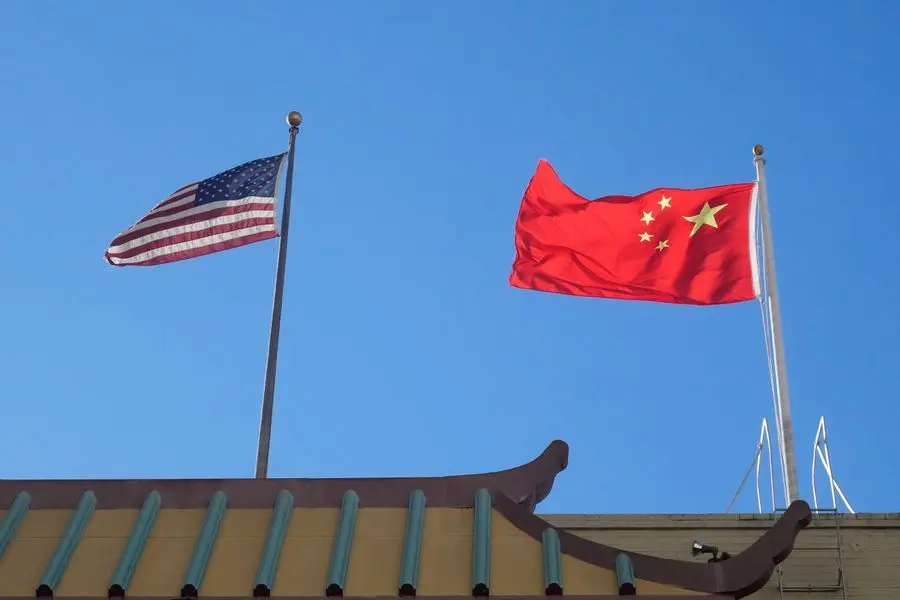
China US
The Seeds of Unrestricted Warfare
COMMENTARY
Published Nov. 18, 2026 • Read time: 4m
Nvidia CEO Jensen Huang apparently fell into one of the oldest competitive traps known to man – he was reportedly seduced by an attractive woman with a hidden agenda. While it’s personally embarrassing to Huang and harmful to the Nvidia brand, if reporting on public intelligence is to be believed, it’s also ruthlessly and consistently aligned with an intentional, comprehensive, systematic national strategy by the Chinese Communist Party to undermine the United States of America.
With another meeting between President Trump and Chairman Xi Jinping on the horizon, American leaders must acknowledge and actively counter the threat posed by a regime that has considered itself at war with the United States since the dawn of the 21st century.
This conflict has not become a shooting war, but plenty of insidious shots have already been fired, many successfully striking their targets. It’s all unfolding as part of a carefully crafted strategy that began nearly three decades ago.
In 1999, two Chinese colonels published a thesis describing a strategy of unrestricted warfare against the United States. Its first rule: “there are no rules, with nothing forbidden.” The strategy boldly claims that “the battlefield will be everywhere” – in the markets, in minds, in the media, in medicine, in the monetary system, in manufacturing, and even in the male libido. Over the years, seduction and corruption have been exploited for massive strategic gain and a notable competitive advantage.
Importantly though, unrestricted warfare has not just been unleashed against high end capabilities – advanced weapons, semiconductors, artificial intelligence, and quantum computing. It has also targeted energy, telecommunications, infrastructure, health care, transportation, and banking. Through unrestricted warfare, the CCP has even trained its sights on a small biotech company in America’s heartland.
InVitria was formally launched in 2007 in Junction City, Kansas, stemming from a novel idea first planted and germinated several years earlier at the University of California at Berkeley. That idea has grown into a thriving concept that uses rice as a stable, scalable, consistent, responsive, and low-cost host for proteins used in gene and cell therapy, T-cell immunotherapy, vaccine production, and antibody creation. Yet from some of its earliest days, InVitria has been on the receiving end of unrestricted warfare.
Several years ago, one of InVitria’s senior scientists left the company suddenly, returning to China. Two months later, he filed his first Chinese patent, an exact match of the core technology that undergirds InVitria’s product line developed over many years. It was intellectual property that InVitria values at nearly $100 million. With nearly a half a billion dollars of CCP-supported funds, that Chinese senior scientist grew his company utilizing predatory pricing and lawfare. Tellingly, that company still enjoys access to the U.S. supply chain.
As a part of a systemic attack that matches the precepts of unrestricted warfare, another employee attempted to smuggle advanced rice seeds from InVitria’s laboratory to China. That employee was caught before those seeds were able to leave the country, charged and convicted by a federal jury, and sentenced to over 10 years in federal prison.
Yet, the attacks continue. The original employee, now in China and protected by the CCP from U.S. legal action, brought his own legal action against InVitria claiming patent infringement. He eventually withdrew his claims, but not before InVitria was forced to spend millions of dollars in legal fees. The ploy also manipulated the legal process and InVitria was forced to reveal key elements of its newest trade secret intellectual property through predatory litigation discovery.
It’s a textbook example of a Chinese strategy where the battlefield is everywhere and nothing is forbidden. It is unrestricted warfare in action, buoyed by an “unprecedented campaign of state-sponsored industrial espionage.”
This isn’t just competition and must not be conceptualized nor excused as benign. It’s ruthless; it’s persistent; it’s ubiquitous. It is a malignant cancer that is hollowing out “America’s technological edge in a zero-sum contest for power.”
Unrestricted warfare is stealing from the pocketbooks of everyday Americans, costing as much as $600 billion a year. Each mom and dad, son and daughter in the United States is swindled out of nearly $2,000 annually while the CCP’s activities reduce the number of high-value jobs for Americans at companies like InVitria. The U.S. is facing an adversary whose form of conflict is hitting hard in America’s homes and deep into the heartland.
Unrestricted warfare is striking everywhere at all times, even in Junction City, Kansas. Its strategic seeds have been planted throughout American society and around the world. In meetings like the upcoming APEC Summit, leaders must stand up for the American people before the U.S. fully reaps what the Communist Chinese Party has sown.
Support Our Mission
The Internet provides an endless stream of content. Not all of it is worth your time. That's why, every day, RealClearPolitics curates the most essential news and information—from all sides and across mediums. The links, videos, and podcasts curated here are the product of human judgment, not algorithms or AI. Please help power our mission of presenting a thoughtful, balanced public discourse through a tax-deductible donation.
Would you consider supporting us today?
Contributing to RealClear Politics through the RealClear Media Foundation supports essential initiatives that drive meaningful change.




RCP Today
Top stories on RealClearPolitics
The Takeaway
Polling intelligence and analysis delivered to your inbox
World News
Featuring the latest world news
Policy
Featuring the latest policy news
Support Our Mission
As part of RealClearPolitics, authors aim to provide balanced, non-partisan analysis by presenting top reporting and commentary from all sides of the political spectrum.
Trusted by policymakers and citizens alike since 2000