
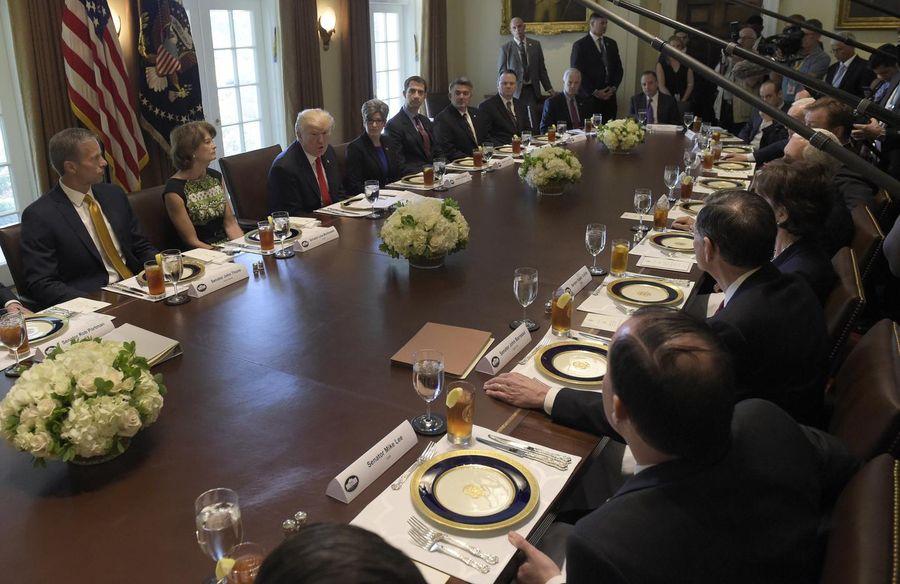
President Donald Trump speaks before having lunch with Republican Senators and White House staffers in the Cabinet Room of the White House in Washington, Tuesday, June 13, 2017. (AP Photo/Susan Walsh)
Americans Need Relief From Obamacare
Published June 29, 2017 • Read time: 4m
Let’s state the obvious: The Senate’s Better Care Reconciliation Act (BCRA) is not full repeal of Obamacare. Any momentum for a clean repeal effort fell by the wayside earlier this year, leaving a divided Republican Party to debate both how much of Obamacare to repeal and what should take its place, if anything.
As this week’s delayed Senate vote demonstrates, that process was always going to be difficult. Many conservatives are justifiably frustrated with the obstinance of their more moderate colleagues. That frustration is no more an excuse to blindly oppose any legislative product than it is one to casually ‘move on’ to other priorities. Instead, President Trump and Republican Senators should seize on this delay as an opportunity to make an imperfect bill better.
Conservative demands for a “freedom option” -- essentially allowing insurance companies to sell plans that do not comply with Obamacare so long as they sell plans that do comply -- have fallen on deaf ears thus far. That should change if leadership hopes to secure conservative votes. Another option, which already exists in current law but can be clarified, are “excepted benefits” policies like indemnity insurance and the lightly regulated “short term limited duration” market. The Obama Administration sought, often without clear statutory authorization, to regulate these markets out of existence, denying consumers lifeboats away from Obamacare’s imploding exchanges. The Senate might make all sides happy without further changes to the 1332 waiver process merely by clarifying federal law to defend these Obamacare alternatives, which already represent a de facto version of the “freedom option” sought by conservatives, from regulatory assault.
President Calls Drug Addiction a Health Problem
Lawmakers Hail New Opioid Rules -- But Call for More
No Opiates for the Masses?
Obamacare's Tax-Time Torment
Senate leaders would also do well to consider other ideas raised by Senator Cruz, such as allowing individuals to pay insurance premiums out of health savings accounts (HSA), which could complement other reforms to expand HSA use even outside the context of high deductible insurance plans. Or other proposals, such as Senator Paul’s request for changes to improve the viability of association health plans. Or expanding the range of issues currently on the table in this stalemate, perhaps by seeking mechanisms to promote pricing transparency.
Those ideas, or variants of those ideas, would be meaningful changes to a bill that already improves upon the status quo of Obamacare. And conservatives should not dismiss the many merits of the bill as it already stands. The BCRA plants the seed of generational reform of Medicaid, a program with out-of-control costs that poorly serves the most vulnerable in our society. It lifts the burden of several of Obamacare's most misguided regulations, such as its 3-to-1 age bands, while allowing wide latitude for state experimentation with countless others with its reformed 1332 waiver process, a mechanism in many ways more flexible than the MacArthur-Meadows House waivers. It repeals the law's taxes, tweaks the law's subsidies to encourage consumer-driven coverage, and strengthens health savings accounts. These are victories that are worth defending against attacks from the left or against alterations proposed by moderate Republicans, as Senator Pat Toomey has done in fighting to preserve the bill’s Medicaid reforms. But such a defense is impossible if conservatives do not even acknowledge their significance.
No one should be under the illusion this is the best possible bill. No one should excuse moderate Republicans’ reluctance to keep their promise to repeal Obamacare. But the restraints imposed by Republicans’ current governing coalition will take years, not weeks, to overcome. The long term work of righting that ship need not and cannot prevent Republicans from governing in the here and now under those constraints.
By suggesting full repeal is possible now, or will be after the 2018 midterm elections, some of the Senate bill’s most vocal conservative critics are not being honest with themselves regarding the long-term nature of this challenge.
Regardless of what happens later this summer, one thing is certain: Democrats will not stop in their quest for a nationalized, single-payer scheme. Conservatives cannot cede the playing field despite justified disappointment with the current process. Conservatives are right to fight to improve this bill where we can. But we must also evaluate the legislation before us on its own merits, not merely as a broken promise but also for the meaningful reforms it contains. Conservatives don’t have to like that reality, but we do have to live with it.
Michael A. Needham is chief executive officer of Heritage Action.

Congress Doesn’t Need Another Blame Game. It Needs To Find What’s Broken
Jarrod Bernstein • RealClearPolitics
Democrats Won the Midterms. Common Sense Won, Too
Jordanne Kemper • RealClearPolitics
The 120th Congress Shapes Up
Carolina Lumetta • RealClearPolitics
Flooding GOP Primaries With Democrats
Robert Natelson • RealClearPolitics
Washington Keeps Rewarding Oracle—Veterans Keep Paying the Price
Darin Gaub • RealClearPolitics
The Seeds of Unrestricted Warfare
John Teichert • RealClearPolitics
RCP Today
Top stories on RealClearPolitics
The Takeaway
Polling intelligence and analysis delivered to your inbox
World News
Featuring the latest world news
Policy
Featuring the latest policy news
Support Our Mission
As part of RealClearPolitics, authors aim to provide balanced, non-partisan analysis by presenting top reporting and commentary from all sides of the political spectrum.
Trusted by policymakers and citizens alike since 2000