
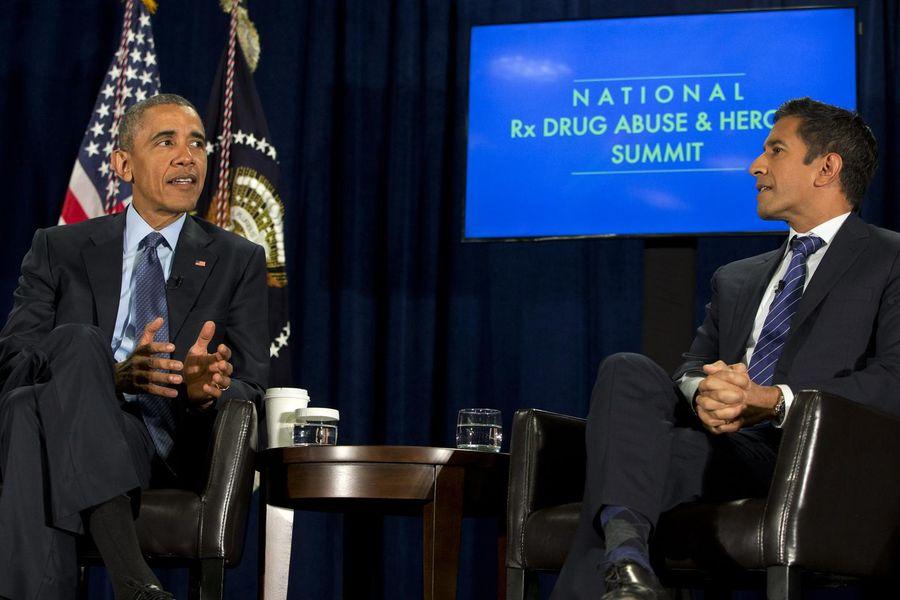
Moderator Sanjay Gupta listens as President Barack Obama speaks during a panel discussion at the National Rx Drug Abuse & Heroin Summit at AmericasMart in Atlanta, Tuesday, March 29, 2016. (AP Photo/Jacquelyn Martin)
President Calls Drug Addiction a Health Problem
Published March 29, 2016 • Read time: 4m
President Obama advocated changing the way society views drug addiction as a means of combating it during an appearance at the National Rx Drug Abuse and Heroin Summit in Atlanta on Tuesday.
“We’re staying on cutting off the pathways for these drugs coming in, but what we have to recognize is, in this global economy of ours, that the most important thing we can do is to reduce the demand for drugs,” Obama said. “And the only way that we reduce demand is if we’re providing treatment and thinking about this as a public health problem and not just a criminal problem.”
He also noted that part of the reason it has been difficult to change the way people look at drug addiction is because the populations most affected have been stereotypically poor, minority communities.
“As a consequence, the thinking was ‘It is often a character flaw in those individuals who live in those communities, and it’s not our problem,’” he said. “'They’re just being locked up.’”
This view is starting to change, he said. However, the problem is underfunded, especially in rural areas. In about 85 percent of counties in America there are few or no mental health and drug treatment facilities available for those in need.
“For all the good work that Congress is doing, it’s not enough just to provide the architecture or the structure for treatment,” the president said. “There has to be actual funding for the treatment.”
He proposed a $1.1 billion plan in February to increase access to treatment, which is awaiting a vote by Congress. Earlier this month the Senate passed the Comprehensive Addiction and Recovery Act (CARA), which would help combat the opioid and heroin abuse epidemic, and it is now awaiting a vote in the House. But the Senate rejected an amendment to include $600 million in emergency funding for the bill. Some Senate Republicans argued money had already been appropriated in the budget.
Sens. Rob Portman of Ohio and Kelly Ayotte of New Hampshire have been particularly vocal on the issue because the problem is especially prevalent in both their states. Both face tough re-election campaigns this year.
“While many of the ideas announced by the White House don’t go as far as the Senate’s recently passed CARA bill, I welcome the president’s interest in combating the heroin epidemic and support a number of these proposals,” Portman said in a statement.
“After the overwhelming passage of the bipartisan Comprehensive Addiction and Recovery Act to kick-start the federal response to the heroin and prescription opioid abuse epidemic, I am pleased that the administration is also taking important steps that will support efforts to reverse the heroin and prescription opioid abuse crisis,” Ayotte said. “CARA includes similar strategies, and I am particularly glad to see the White House pushing for measures like expanding availability and coverage of treatment and funding for law enforcement and first responders.”
Portman said he would have taken some of the president’s proposals a step further, noting that Obama increased the current patient limit for doctors who can prescribe buprenorphine, a medication to combat opioid drug addictions, from 100 to 200.
“This change has taken far too long and I am disappointed this change is not as expansive as legislation recently considered in the Senate, which would raise the cap to 500 and also allow nurse practitioners to prescribe medication for treatment,” Portman said. “These changes are needed to meaningfully increase access to treatment for those who need it most.”
This month the Centers for Disease Control and Prevention issued new guidelines to help health-care professionals better prescribe pain relievers, and the U.S. Food and Drug Administration mandated that labels be placed on opioid medication bottles warning consumers of the risks of taking the medication.
Tuesday morning, the White House released a presidential memorandum regarding the new Mental Health and Substance Use Disorder Parity Task Force, which would be led by the director of the Domestic Policy Council alongside several other governmental department heads.
The task force would help enforce Obama’s guidelines so that people with mental health issues and drug addictions would be treated the same as those with other medical concerns and could be covered by their insurance.
“I want to make sure that there’s sufficient coverage everywhere,” Obama said. “Part of what I think our goal is, is to make sure that we have in counties all across the country at least some resources that can get things started.”






RCP Today
Top stories on RealClearPolitics
The Takeaway
Polling intelligence and analysis delivered to your inbox
World News
Featuring the latest world news
Policy
Featuring the latest policy news
Support Our Mission
As part of RealClearPolitics, authors aim to provide balanced, non-partisan analysis by presenting top reporting and commentary from all sides of the political spectrum.
Trusted by policymakers and citizens alike since 2000