
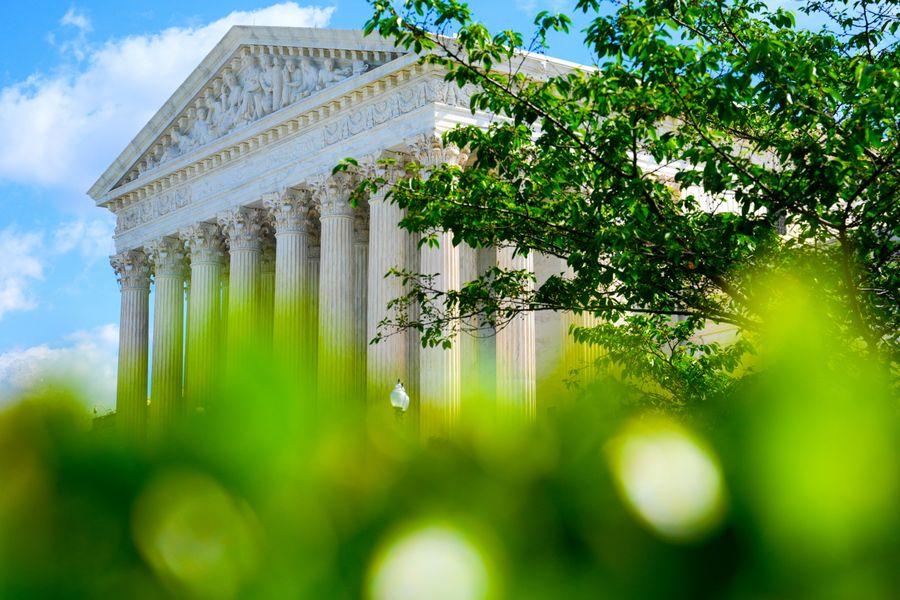
Supreme Court
Doubling Down on 'No More Souters'
COMMENTARY
Published April 24, 2026 • Read time: 5m
In 1990, George H.W. Bush, listening to then-White House Chief of Staff John H. Sununu, nominated David Souter to the U.S. Supreme Court. Sununu, who as governor of New Hampshire had nominated Souter to the Granite State's supreme court in 1983, assured Bush that Souter would be a "home run" for the conservative cause.
That's not what happened.
Souter quickly lurched leftward, joining the 1992 court majority in Planned Parenthood v. Casey that upheld the core abortion "right" holding of Roe v. Wade. By the time of his retirement in 2009 -- a decision that paved the way for Barack Obama's nomination of Sonia Sotomayor -- Souter had established himself as a reliable vote for the court's liberal bloc. The conservative legal movement, which was ascendant at the time, responded with a unifying rallying cry: "No more Souters."
That cri du coeur means more than "no more liberals." For conservatives, what it means -- or at least what it once meant -- is no more "stealth" selections to the nation's highest court. There will be no more simply taking the John Sununus of Washington at their word. Rather, a nominee must have a demonstrable track record of integrity, courage, intellectual consistency and across-the-board excellence.
It's unclear whether conservatives have ever learned their lesson. George W. Bush gave us the superb Samuel Alito, but he also gave us the fickle John G. Roberts. In his first term, Donald Trump made three picks to the high court; none are (yet) a Souter-like betrayal, but they are also not stalwarts like Alito and Clarence Thomas.
He's Mean, But Is He at Least Bright?
Supreme Hypocrisy
It's Time to End ALL Lame-Duck Sessions
The Court Fight Is About Democracy
This summer, conservatives may have yet another opportunity to prove they have finally learned their lesson. If the opportunity arises, they better not blow it.
There is a very real chance Thomas or Alito retires after the current Supreme Court term ends (and there is an outside chance it could be Roberts). In gaming through the likelihood of a conservative nominee being confirmed by the Senate, keep in mind that that chamber is very much up for grabs this November. Democrat recapture of the Senate this fall would force the court's conservative senior statesmen to hold onto their jobs for a few more years, placing a high-stakes wager on Republicans maintaining the White House and retaking the Senate in 2028.
That's quite a gamble.
Given the abysmal historical track record of Republican judicial nominations, going all the way back to Dwight D. Eisenhower's 1956 nomination of William Brennan and Richard Nixon's 1970 nomination of Harry Blackmun, Alito and Thomas would be forgiven for harboring skepticism about the desirability of an unforced retirement. But the retirement rumors throughout the conservative legal movement are swirling. Alito, who just turned 76, is generally viewed as the likeliest to step aside.
If there is a high court vacancy, the single best pick would be the man for whom I once clerked: James C. Ho of the U.S. Court of Appeals for the 5th Circuit. There is no one else on the federal judiciary who has Ho's track record of integrity, courage, intellectual consistency and across-the-board excellence -- the very traits conservatives have claimed to most highly value in recent decades as they've committed themselves, at least rhetorically, to "no more Souters." Multiple times, Ho has stood alone on the conservative-leaning 5th Circuit for taking the boldest possible stance on an issue of great importance, such as in-state tuition for illegal aliens or Texas' declaration of an "invasion" at the southern border. He is bold, fearless and unwavering.
The common knock on Ho is that he is too conservative and perhaps too "strident." It's not necessarily that the votes in the Senate aren't there, the critics say, but that he'd alienate the court's moderate bloc if he were to be confirmed. It's difficult to take this stated objection seriously. For decades, conservatives have argued for the importance of nominating justices "in the mold of Antonin Scalia and Clarence Thomas." Being able to best mollify the likes of a Sandra Day O'Connor or an Amy Coney Barrett is not -- and must not be -- a part of the job description. Pick the best person for the job and let the interpersonal justice relationship chips fall where they may.
One frequently mentioned court hopeful is Ho's 5th Circuit colleague, Andrew Oldham. Oldham has the symbolic status of being a former Alito clerk, and he is widely perceived as coveting the seat. But Trump deliberately left Oldham off his 2020 Supreme Court list, and he did so because Oldham's track record -- even at that time -- was somewhere between spotty and outright troubling. In 2010, he cosigned a letter to the Obama White House recommending that Elizabeth Warren be named the initial director of the Consumer Financial Protection Bureau. Since becoming a federal judge, it's gotten considerably worse: Oldham has ruled against conservatives on crucial issues as wide-ranging as abortion, vaccine mandates, gender ideology and illegal immigration.
This track record shouldn't pass the laugh test. If Alito does retire, and if the Beltway powers do (foolishly) deem it necessary to pick a former Alito clerk, then Steven Menashi of the U.S. Court of Appeals for the 2nd Circuit would be a much more inspired selection.
Clarence Thomas and Samuel Alito are both heroes of the American republic. For conservatives, that has the effect of raising the stakes even more, if one were to retire. Messing this up would be a catastrophic blunder, risking a generation of weak judicial rulings. This vacancy, if it arises, would be the time to double down like never before on "no more Souters." And that means Justice James C. Ho.
COPYRIGHT 2026 CREATORS.COM
Support Our Mission
The Internet provides an endless stream of content. Not all of it is worth your time. That's why, every day, RealClearPolitics curates the most essential news and information—from all sides and across mediums. The links, videos, and podcasts curated here are the product of human judgment, not algorithms or AI. Please help power our mission of presenting a thoughtful, balanced public discourse through a tax-deductible donation.
Would you consider supporting us today?

Congress Doesn’t Need Another Blame Game. It Needs To Find What’s Broken
Jarrod Bernstein • RealClearPolitics
Democrats Won the Midterms. Common Sense Won, Too
Jordanne Kemper • RealClearPolitics
The 120th Congress Shapes Up
Carolina Lumetta • RealClearPolitics
Flooding GOP Primaries With Democrats
Robert Natelson • RealClearPolitics
Washington Keeps Rewarding Oracle—Veterans Keep Paying the Price
Darin Gaub • RealClearPolitics
The Seeds of Unrestricted Warfare
John Teichert • RealClearPolitics
RCP Today
Top stories on RealClearPolitics
The Takeaway
Polling intelligence and analysis delivered to your inbox
World News
Featuring the latest world news
Policy
Featuring the latest policy news
Support Our Mission
As part of RealClearPolitics, authors aim to provide balanced, non-partisan analysis by presenting top reporting and commentary from all sides of the political spectrum.
Trusted by policymakers and citizens alike since 2000