
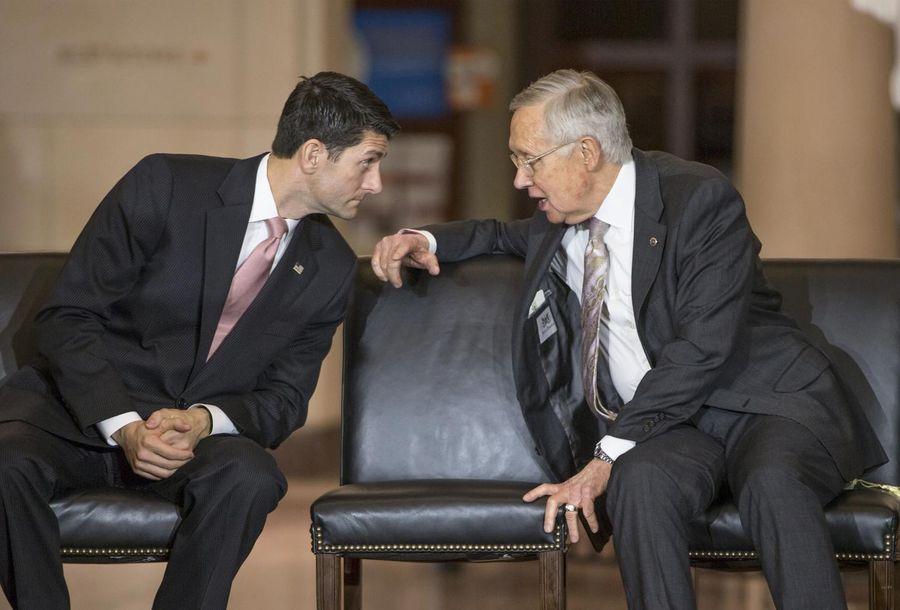
House Speaker Paul Ryan of Wis., left, and talks with Senate Minority Leader Harry Reid of Nev., on Capitol Hill in Washington, Wednesday, Feb. 24, 2016, during a tribute to civil rights leader Rep. John Lewis, D-Ga. Congressional Republicans and Democrats have been in a standoff since Senate Majority Leader Mitch McConnell, R-Ky., announced the Senate will take no action on anyone President Barack Obama nominates to fill the Supreme Court vacancy. (AP Photo/J. Scott Applewhite
It's Time to End ALL Lame-Duck Sessions
Published March 26, 2016 • Read time: 4m
Politicians, as everyone knows, can be hypocrites. It’s practically a job requirement. But it is never more obvious than when they invoke their “highest principles” to justify yet another opportunistic, self-serving stance. That is exactly what they are doing in the debate over scheduling a Senate vote on Merrick Garland, President Obama’s nominee to succeed Antonin Scalia on the Supreme Court.
It’s not only time to call out the hypocrisy. It’s time to consider what is really at stake here, beyond a tie-breaking vote on the high court.
“The American people are perfectly capable of having their say on this issue, so let's give them a voice,” says Senate Majority Leader Mitch McConnell. “The Senate will appropriately revisit the matter when it considers the qualifications of the nominee the next president nominates.” House Speaker Paul Ryan says the same thing. So does Senate Judiciary Chairman Charles Grassley and most Republicans on Capitol Hill. It’s all about their highest principles, of course.
Bull, say the Democrats. “In the name of fairness and our Constitution,” thunders Dick Durbin, the second-ranking Senate Democrat, “the Senate Republican majority must do its job and give Judge Garland a public hearing and a timely vote.”
Those statements are pretense masquerading as principle. They are real life imitating the movie “Casablanca,” where police Captain Renault is “shocked, shocked” that gambling is taking place as he pockets his payoff from the house croupier. Renault is the true voice of McConnell, Grassley, Durbin, Ryan—as well as President Obama and Vice President Biden.
How do we know? Because both parties and their leaders took exactly the opposite stances in 1988, when President Reagan was completing his second term and the issue was his nominee for the high court. It was the Republicans who righteously demanded votes, and the Democrats, led by then-Sen. Biden, who invoked their highest principles to oppose them. Today, when Republicans piously cite the “Biden Rule” to block a vote, they do it partly to justify their position, partly to humiliate the vice president. If such a thing is possible.
Amid this mud wrestling, there really is a principle at stake. But it is not the one Democrats and Republicans are fighting over. The principle is that lame-duck sessions—all of them—are profoundly anti-democratic. In a representative government like ours, they should only be held if there is a national emergency.
Once there were good reasons for regular lame-duck sessions. Before trains, planes, and super highways, travel was slow and arduous. The new president was not sworn in until March. (In 1932, the inauguration was changed to January.) Without lame-duck sessions, there would be no way to pass legislation for months.
The reasons for lame-duck sessions have disappeared—forever. The only exceptions should be national emergencies. No one doubts that Congress should meet in December when Pearl Harbor is attacked. What cannot be justified is Congress meeting after the election to vote on trade bills, highway funding, or Supreme Court nominees. Those are not emergencies. They can wait.
There are three good reasons to wait two months. First, defeated and retiring representatives can still vote in lame-duck sessions because they are still in office. Just because they can doesn’t mean they should. That’s the reason dogs lick themselves. Second, lame-duck sessions allow representatives to cast their votes as far as possible from the next election. The goal is to bury those votes, to keep them from becoming electoral issues. That may be good for incumbents, but it is fundamentally anti-democratic.
The third reason is the most serious. Lame-duck sessions could give legislators and presidents from the same party a fleeting window to pass major legislation before their rivals take office. They would have every incentive to rush through bills their party favors, the other party opposes, and the voters rejected. There’s no reason, then, why a Democratic president and Congress could not pass trillion-dollar health care bills, no reason why a Republican president and Congress could not revamp immigration laws after losing control but before their successors take over.
Could today’s Republicans use my arguments to prevent a vote on Garland? Yes, but not with a straight face. How can you tell if they are hypocrites? See if they are willing to consider other legislation, where the same arguments should apply. See if they want to prohibit all future lame- duck sessions—or just this one.
No need to look too hard. This is not rarified principle. This is raw politics. Both parties are just saying they are “shocked, shocked” to find voting going on. Meanwhile, the croupier is handing them campaign funds.




RCP Today
Top stories on RealClearPolitics
The Takeaway
Polling intelligence and analysis delivered to your inbox
World News
Featuring the latest world news
Policy
Featuring the latest policy news
Support Our Mission
As part of RealClearPolitics, authors aim to provide balanced, non-partisan analysis by presenting top reporting and commentary from all sides of the political spectrum.
Trusted by policymakers and citizens alike since 2000