
Dems, GOP Weigh Investment in Alabama Senate Race
Published Oct. 6, 2017 • Read time: 7m
On the heels of a divisive and expensive Republican primary and with polls showing a potentially tight race, national Democrats and Republicans are grappling with the same question: whether, and how much, to invest in the special election for the Alabama Senate seat vacated when Jeff Sessions became attorney general.
The race is pivotal in the near and long term -- Republicans are desperate to retain the seat, as a loss would will cut their narrow majority in half, making it more difficult to secure legislative victories despite total control of Washington. A Democratic victory in deep red Alabama would also provide a major morale boost to the party after failing to win any of the House special elections in Republican territory this spring.
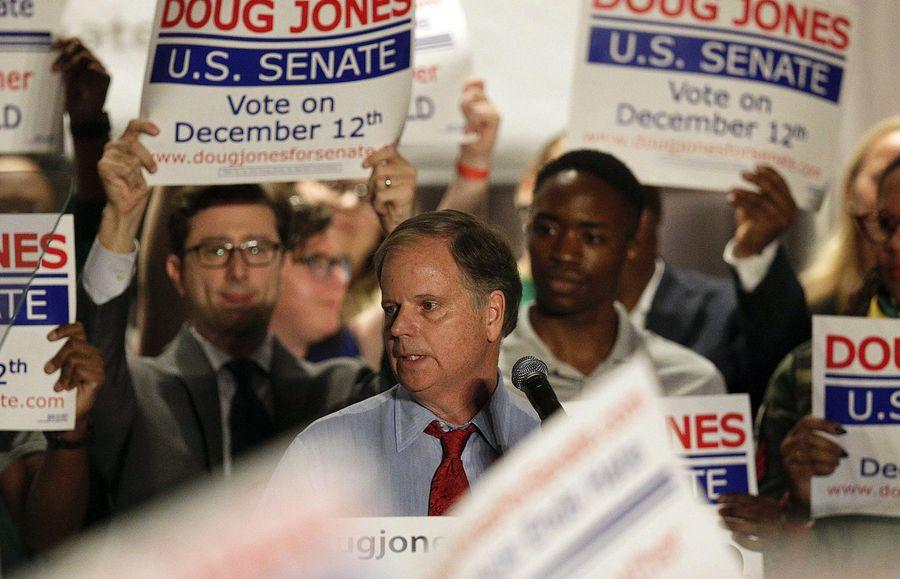
The December general election is between Republican Roy Moore, a controversial but well-known former state Supreme Court justice who defeated appointed incumbent Sen. Luther Strange in the primary, and Democrat Doug Jones, a civil rights lawyer and former U.S. attorney.
Democrats in Washington insist that Jones has a chance in the race -- often pointing to Moore’s second state Supreme Court race in 2012, when he won just under 52 percent of the vote despite Mitt Romney carrying the state with more than 60 percent. Two public polls released after last week’s primary showed a single-digit race -- one with Moore leading by five percentage points, the other with him up by eight.
But they’re also hesitant to commit financially or to raise expectations, as Alabama remains heavily Republican and President Trump defeated Hillary Clinton there by nearly 30 percentage points.
Portman-Strickland Senate Race Finally Set in Ohio
Portman Wastes No Time Attacking Strickland
Strickland Skirts Primary Debates in Ohio Senate Race
Senate Says Climate Change Is Real
“We think we have a decent shot in Alabama. We know it’s tough territory, but there are unique circumstances there now,” said Sen. Chris Van Hollen, chairman of the Democratic Senatorial Campaign Committee. Asked if the DSCC would back Jones financially, he said, “We’ll look at all our options.”
Still, Jones does have strong supporters within the party, most of whom emphasize his past work as a civil rights attorney. Former Vice President Joe Biden, a longtime friend, campaigned with him earlier this week. Georgia Rep. John Lewis, a leader from the civil rights movement, said he planned to travel to Alabama to campaign with Jones, though details of the trip had not yet been worked out.
Sen. Tim Kaine, the party’s 2016 vice presidential nominee and himself a former civil rights attorney, said he’d likely help the campaign, though it was unclear whether that would involve a trip to Alabama for Kaine or an event in Washington.
Rep. Gregory Meeks, the chairman of the Congressional Black Caucus PAC, said his group was eager to help Jones, but is taking its guidance from Rep. Terri Sewell, a member of the CBC and the only Alabama Democrat in Congress.
“We need to get on the ground in Alabama for the sake of our country,” Meeks said.
The Jones campaign isn’t shying away from the support. Joe Trippi, a longtime Democratic strategist advising Jones, said they’ll accept whatever help they get. But he emphasized that early in the general election, opposition to Moore is playing an outsize role.
“It’s been striking in the first days since their run-off that he seems to drive a lot of energy our way without us having to depend on or rally institutional Democrats,” Trippi said. “In the end, I don’t think this race is going to be fought so much on ideology as on character, integrity and being able to actually work, yes to change Washington, but to get things done there.”
Despite those positive early signs, Democrats acknowledge that the stars will have to align to pull off the upset in deep red territory. Yet Republicans aren’t necessarily bullish on the race. Allies of Majority Leader Mitch McConnell spent millions of dollars backing Strange in the primary, concerned that Moore, who was twice removed from the state Supreme Court and has a history of controversial statements, would be a lackluster general election candidate.
Moore hasn’t necessarily worked to rebuild those burned bridges. He was in Washington this week to meet with Steve Bannon, the former White House chief strategist who helped fuel support for his primary challenge, and members of the Alabama congressional delegation. But he didn’t meet with McConnell or the state’s senior senator, Richard Shelby. He met with Sen. Cory Gardner, the chairman of Senate GOP campaign committee, according to a Republican with knowledge of the meeting, but it appeared to have been hastily arranged -- Gardner told reporters Wednesday afternoon he didn’t know if they would meet, and that he’d heard Moore was in Washington from news reports.
Like his Democratic counterpart, Gardner wouldn’t address whether the party apparatus would spend on the race.
“I’m not worried about Alabama,” Gardner said. “The people of Alabama know that somebody who represents big government, big taxes doesn’t reflect the values of Alabama. [Jones is] not going to win.”
Brett Doster, a media consultant for the Moore campaign, said they are "taking nothing for granted" in preparing for a tight race. "But our opponent is a hardcore liberal, and we are confident that once again, the voters will choose Roy Moore, a voice for Alabama, as opposed to Doug Jones, a voice for Chuck Schumer and Nancy Pelosi."
Despite the divisive nature of the primary, allies of Moore were calling on McConnell and other establishment figures to help cover the bill for the general election. Ed Rollins, lead strategist for Great America PAC, a group aligned with Bannon that backed Moore, called for the Senate Leadership Fund, a McConnell-aligned outside group, to spend on his behalf in the general election.
“Does Mitch McConnell and the Senate Leadership Fund truly care about defeating Democrats and promoting President Trump’s ‘America First’ agenda as they claim or do they really just care about protecting McConnell’s power in Washington?” Rollins said in a statement Wednesday. “If they’re unwilling to spend as much to defeat a Democrat as they were willing to waste smearing a fellow Republican, then it will be clear that it’s the latter.”
A spokesperson for the fund declined to comment.
Eric Beach, a strategist for Great America, told RCP in a separate interview that the group hadn’t outlined its own spending plan for the general election, though it would probably be in the “mid-six figures, maybe seven figures,” well short of what establishment groups spent in the primary. He said the focus would mainly be on digital advertising, robo-calls and grassroots turnout efforts.
It’s unclear whether Moore, who campaigned heavily against McConnell and criticized the outside group, would welcome the help. In a fundraising email earlier this week, he said Biden had “declared war on me and my campaign” but later added: “Unfortunately, after our hard-fought run-off against Mitch McConnell, my campaign coffers are running low.”
Doster, the campaign's media consultant, said, "It would be a nice change to see all Republicans investing in electing conservatives and beating liberals instead of investing in protecting special interests and the status quo."
Sen. John Cornyn, the second-ranking Senate Republican and a former chairman of the campaign committee, brushed off concern about the race, but also noted that if Democrats invested heavily, Republicans would have to follow suit.
“I think the bigger question is whether Democrats are going to waste their money there,” Cornyn told RCP. “Obviously if they decide to spend some money, we’re going to have to spend some money.”

Congress Doesn’t Need Another Blame Game. It Needs To Find What’s Broken
Jarrod Bernstein • RealClearPolitics
Democrats Won the Midterms. Common Sense Won, Too
Jordanne Kemper • RealClearPolitics
The 120th Congress Shapes Up
Carolina Lumetta • RealClearPolitics
Flooding GOP Primaries With Democrats
Robert Natelson • RealClearPolitics
Washington Keeps Rewarding Oracle—Veterans Keep Paying the Price
Darin Gaub • RealClearPolitics
The Seeds of Unrestricted Warfare
John Teichert • RealClearPolitics
RCP Today
Top stories on RealClearPolitics
The Takeaway
Polling intelligence and analysis delivered to your inbox
World News
Featuring the latest world news
Policy
Featuring the latest policy news
Support Our Mission
As part of RealClearPolitics, authors aim to provide balanced, non-partisan analysis by presenting top reporting and commentary from all sides of the political spectrum.
Trusted by policymakers and citizens alike since 2000