
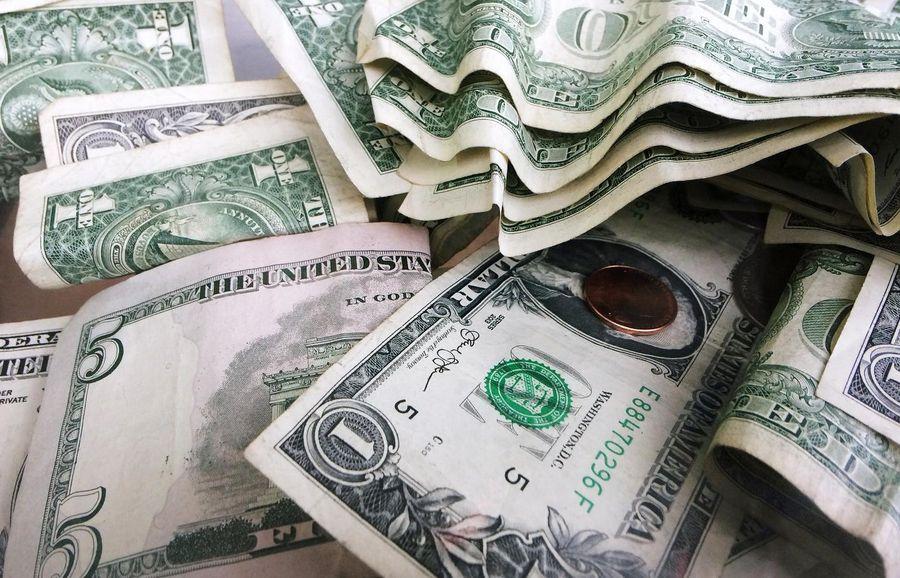
FILE- This Sept. 6, 2017, file photo shows a tip jar with one dollar and five dollar bills and a penny in New York. Despite an ultra-low 3.9 percent unemployment rate, about one-third of U.S. adults faced financial insecurity last year and often struggled to pay unexpected expenses, according to a Federal Reserve survey. (AP Photo/Mark Lennihan, File)
Will Inflation Kill the Economy?
Published Aug. 16, 2018 • Read time: 4m
WASHINGTON -- Inflation is back. What do we do about it? For starters: Don't ignore it.
The latest consumer price index (CPI) -- the government's best-known inflation indicator -- reported a 2.9 percent increase from July 2017. The last time the year-over-year gain was higher was in December 2011. Though hardly a cause for panic, it suggests intensifying price and wage pressures in an economy straining at its productive capacity. The Trump administration and its critics should be watching closely.
Consider. Rents rose 3.6 percent from a year earlier; hospital prices increased 4.6 percent, gasoline 25 percent and eating out 2.8 percent. Still, some price increases were small or nonexistent, offsetting some gains. New vehicle prices edged up a mere 0.2 percent, electricity was down 0.8 percent and airline fares dropped 4.1 percent.
The reason for paying attention to inflation is that, once it accelerates, it's hard to stop. That's what happened in the 1960s and 1970s. The quest to reduce unemployment led to easy money that spawned double-digit inflation. CPI inflation went from about 1 percent in 1960 to 6 percent in 1969 to 13 percent in 1979. It was crushed only in the early 1980s when the Federal Reserve raised interest rates sharply.
This searing episode taught many important lessons, but we're in danger of forgetting them because a majority of today's Americans didn't experience the high inflation. (In 2017, the U.S. population was 326 million; roughly two-thirds weren't alive or were too young to understand the high inflation.) Here are four significant takeaways.
The FBI Gained Access; We'd Already Lost Our Privacy
Is Trump Right About NATO?
Arizona's Voting Rights Fire Bell
U.S. Officials Say 2 Americans Died in Brussels Attack
(1) Don't buy into the argument -- made often in the late 1960s and early 1970s -- that a "little bit more inflation" won't be harmful and will help reduce unemployment. Superficially, this sometimes seemed true, but "a little bit more inflation" led to "a little bit more" and then "a little bit more." Soon, there was a lot of inflation, which created an inflationary psychology. Expecting more inflation, companies and workers tried to get ahead of the process by preemptively raising wages and prices.
(2) High inflation is ultimately harmful to the economy, because it subverts both stability and growth. From 1969 to 1982, there were four recessions (1969-70, 1973-75, 1980 and 1981-82) as the Federal Reserve vacillated between fighting inflation and joblessness. Both got worse. Monthly unemployment peaked at 10.8 percent in 1982. Even before adjusting for inflation, the stock market stagnated from the mid-1960s to the early 1980s.
(3) People hated high inflation. For most of the 1970s, Americans listed high inflation as the nation's No. 1 problem. High and rising inflation created enormous uncertainty. People had more trouble planning for the future. They didn't know whether their incomes would keep up with their expenses; there was (or so it seemed) a random redistribution of income among groups, depending more on luck or political clout than any economic logic. In a post-election interview with journalist Theodore H. White, President Carter singled out inflation as a crucial factor in his defeat.
(4) Productivity matters. As is now understood, high productivity growth -- efficiency -- makes it easier for firms to avoid raising prices. Gains in efficiency cut costs; the savings can be passed along to workers in higher wages, shareholders in higher profits or consumers in lower prices. Prices need not be boosted. Unfortunately, U.S. productivity growth languished in the 1970s; the same is true today. This makes it harder to contain inflation.
Since late 2015, the Fed has been gradually raising interest rates in hope of heading off future inflation increases. This focus is surely justified. But it's not clear whether the Fed's moves amount to too little too late, or too much too soon. The Fed's forecasting record is at best spotty. If we get this wrong, it could kill the economy.
(c) 2018, The Washington Post Writers Group

Congress Doesn’t Need Another Blame Game. It Needs To Find What’s Broken
Jarrod Bernstein • RealClearPolitics
Democrats Won the Midterms. Common Sense Won, Too
Jordanne Kemper • RealClearPolitics
The 120th Congress Shapes Up
Carolina Lumetta • RealClearPolitics
Flooding GOP Primaries With Democrats
Robert Natelson • RealClearPolitics
Washington Keeps Rewarding Oracle—Veterans Keep Paying the Price
Darin Gaub • RealClearPolitics
The Seeds of Unrestricted Warfare
John Teichert • RealClearPolitics
RCP Today
Top stories on RealClearPolitics
The Takeaway
Polling intelligence and analysis delivered to your inbox
World News
Featuring the latest world news
Policy
Featuring the latest policy news
Support Our Mission
As part of RealClearPolitics, authors aim to provide balanced, non-partisan analysis by presenting top reporting and commentary from all sides of the political spectrum.
Trusted by policymakers and citizens alike since 2000