
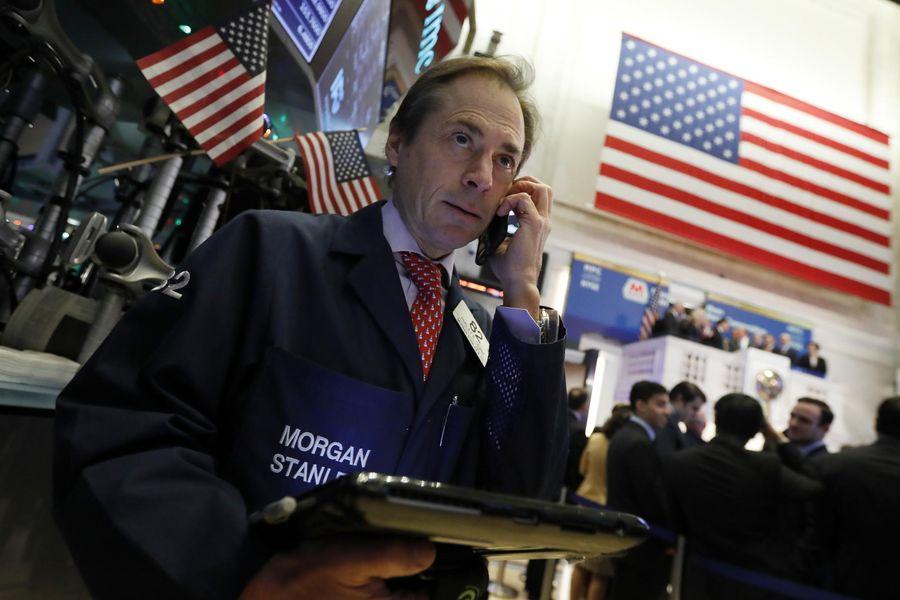
Trader Dudley Devine works on the floor of the New York Stock Exchange, Monday, Dec. 3, 2018. Stocks are opening sharply higher on Wall Street, following gains in overseas markets after the U.S. and China struck a 90-day truce in their trade dispute. (AP Photo/Richard Drew)
The Stock Market Decline Means ... What?
Published Dec. 5, 2018 • Read time: 3m
WASHINGTON -- The stock market giveth; the stock market taketh away.
With Wednesday a federal holiday to honor former President George H.W. Bush, the U.S. stock market will be closed until Dec. 6. But there's no moratorium on wondering what the effects of Tuesday's dramatic market sell-off -- almost 800 points on the Dow, or more than 3 percent -- might be.
Here are some key questions and tentative answers.
Q. Does the selloff signal a recession?
A. Maybe, but most investors and economists seem to think otherwise. Growth of the economy (gross domestic product, or GDP) has been strong, averaging nearly 4 percent at an annual rate over the last two quarters. That's higher than estimates of long-term growth potential of about 2 percent annually. The usual explanation for the stock sell-off is that investors were confused by the U.S.-China agreement to resume trade negotiations.
Q. So, will the Federal Reserve's main policy-making body (the Federal Open Market Committee, or FOMC) still raise interest rates when it meets later this month?
A. That seems to be the consensus. Since December 2015, the FOMC has raised short-term interest rates, then near zero, eight times, with another increase indicated for December. Stocks' big decline makes this harder, if only because it seems contradictory to raise rates when the stock market is falling. But, says economist Mark Zandi of Moody's Analytics, "Trump would have to actually declare war for the Fed not to raise rates." They're needed, Zandi says, to prevent the economy from overheating. At 3.7 percent, the unemployment rate is already lower than many economists consider "full employment."
The FBI Gained Access; We'd Already Lost Our Privacy
Is Trump Right About NATO?
Arizona's Voting Rights Fire Bell
U.S. Officials Say 2 Americans Died in Brussels Attack
Q. But won't the drop in stocks automatically curb the economy through the so-called "wealth effect" -- consumers and investors spending more when they feel richer and spending less when they feel poorer?
A. This would probably require further stock-market declines. True, Tuesday's plunge amounted to a paper loss of about $1 trillion, or about 3.4 percent, according to Wilshire Associates. But despite this loss, stocks remain roughly where they were at the beginning of 2018.
Q. What about the "yield curve" -- a relationship between short-term and long-term interest rates?
A. Banks and other financial institutions make their money by borrowing short at lower rates and lending long at higher rates. When the yield curve is "inverted," meaning short rates exceed long rates, the process begins to break down. Although most rates aren't inverted yet, they're getting closer. In a memo to clients, Capital Economics -- an advisory group -- says the possibility justifies "our downbeat view of the prospects for the U.S. economy."
Q. So what's the bottom line?
A. Put everything together, and it's this: There's more uncertainty, greater risk of an economic slump and a greater threat to Donald Trump's approval ratings. But for the moment, the status quo prevails.
(c) 2018, The Washington Post Writers Group

Congress Doesn’t Need Another Blame Game. It Needs To Find What’s Broken
Jarrod Bernstein • RealClearPolitics
Democrats Won the Midterms. Common Sense Won, Too
Jordanne Kemper • RealClearPolitics
The 120th Congress Shapes Up
Carolina Lumetta • RealClearPolitics
Flooding GOP Primaries With Democrats
Robert Natelson • RealClearPolitics
Washington Keeps Rewarding Oracle—Veterans Keep Paying the Price
Darin Gaub • RealClearPolitics
The Seeds of Unrestricted Warfare
John Teichert • RealClearPolitics
RCP Today
Top stories on RealClearPolitics
The Takeaway
Polling intelligence and analysis delivered to your inbox
World News
Featuring the latest world news
Policy
Featuring the latest policy news
Support Our Mission
As part of RealClearPolitics, authors aim to provide balanced, non-partisan analysis by presenting top reporting and commentary from all sides of the political spectrum.
Trusted by policymakers and citizens alike since 2000