
Obama Orders Sanctions; House Backs Ukraine Aid
Published March 7, 2014 • Read time: 5m
President Obama, embroiled in a Ukrainian political and territorial standoff, raced to stay ahead of events Thursday as he authorized U.S. sanctions aimed at Moscow and urged Russian President Vladimir Putin during a phone call to retreat from Crimea.
Obama pointed to international condemnations of Russia’s use of military forces in Ukraine, even as European allies, nervous about potential economic repercussions at home, stopped short of replicating America’s sanctions.
After months of disagreements over domestic issues, Obama found bipartisan backing in Congress this week for the administration’s efforts to aid Ukraine and punish Russia.
As the United States and Moscow remained at loggerheads, Obama signed an order imposing economic sanctions. But his executive action was framed as a ramped-up warning rather than as a fait accompli, since it did not identify specific targets whose property and holdings would be blocked.
The State Department also revoked unidentified Russian and Ukrainian travel visas, even as the president appealed once again to the Kremlin to channel support for Crimea through international monitors, rather than via Russian military operating in another country.
Obama spoke by phone with Putin for the second time in five days, reiterating his view during their hour-long conversation that Russia had violated international law and should pursue a proposed diplomatic alternative as a way to safeguard Moscow’s interests in the Russian-speaking peninsula of Crimea. There was no indication the two men made progress in resolving the escalating impasse.
The FBI Gained Access; We'd Already Lost Our Privacy
Is Trump Right About NATO?
Arizona's Voting Rights Fire Bell
U.S. Officials Say 2 Americans Died in Brussels Attack
Obama told Putin that Secretary of State John Kerry would continue ongoing talks with his Russian counterpart, Foreign Minister Sergey Lavrov.
Administration officials said the United States does not recognize any referendum or vote in Crimea to join the Russian Federation, since the government of Ukraine objects and a regional vote to break from Kiev violates Ukraine’s constitution.
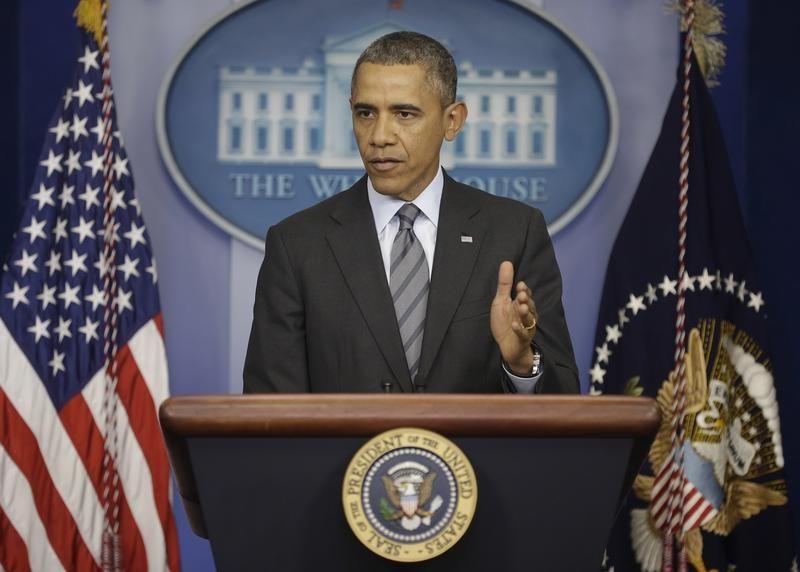
Appearing in the White House briefing room at midday, Obama said “any discussion about the future of Ukraine must include the legitimate government of Ukraine. In 2014, we are well beyond the days when borders can be redrawn over the heads of democratic leaders.”
He said his aim through sanctions was to “impose a cost on Russia and those responsible for the situation in Crimea.” He suggested that using executive authority rather than sanctions legislation offered “flexibility to adjust our response going forward based on Russia's actions.”
The president said he authorized sanctions in coordination with European allies, and he urged Congress to approve legislation to assist Ukraine.
While congressional Republicans have criticized the president’s decision-making abroad -- for instance, Sen. John McCain blamed the Ukraine crisis on the administration’s “feckless” foreign policy, and Sen. Lindsey Graham appended the Benghazi controversy to the discussion -- there is bipartisan agreement to help Ukraine and congressional enthusiasm for tough sanctions to punish Putin.
The House on Thursday voted 385-23 to approve up to $1 billion in loan guarantees for Ukraine, to be channeled through the State Department. The administration had proposed a similar package, but available through the International Monetary Fund.
The Senate is drafting a similar Ukraine assistance bill, expected to be marked up Tuesday in the Foreign Relations Committee, said ranking member Sen. Bob Corker. The Tennessee Republican did not rule out that the Senate measure would include language to impose sanctions on Moscow. Senate Majority Leader Harry Reid said he anticipated that aid to Ukraine and potential sanctions would follow separate Senate tracks.
Following the conclusive House bipartisan vote, Speaker John Boehner said the loan guarantees were the beginning of “fulfilling our commitment to provide the president as many tools as needed to keep President Putin in check and protect the sovereignty of Russia’s neighbors.” He said he backed Obama’s executive order to impose sanctions.
Sens. Graham and Kelly Ayotte advocated getting tougher with Russia. They urged the administration and allies to suspend its membership in global economic summits, and proposed that the next Group of Eight gathering, scheduled for Sochi in June, take place elsewhere. The administration earlier announced it has suspended U.S. preparations for the annual meeting, which rotates locations each summer.
Boehner and other lawmakers, seeking additional punishments that would be felt in Moscow while boosting U.S. interests, asked Obama to allow more U.S. natural gas exports to Ukraine and countries in Europe. Administration officials said the Department of Energy has some leeway on a “case-by-case” basis.
“Russia has an energy stranglehold on much of Europe and has been using it to its own advantage,” Boehner told reporters Thursday. “And there is growing consensus that ending this de facto export ban would not only keep Putin in check, but help our economy … and help our allies in Europe.”
Some GOP lawmakers said they feared Obama’s sanctions would ultimately prove ineffective.
“I think we learn from history: They invaded Georgia, and then they continue to occupy Georgia. I think that's very instructive as to the Ukraine experience,” said Rep. Mike McCaul, chairman of the Homeland Security Committee. “I'm concerned that the same thing that happened in Georgia will now happen in Ukraine. And I don't know if these sanctions will stop that. That's my biggest concern.”
The scheduled May elections in Ukraine figured in Capitol conversations Thursday. House Foreign Affairs Committee Chairman Ed Royce, whose panel held a hearing with State Department officials Thursday on Ukraine, announced he will lead a congressional trip there to support fair elections. Royce’s committee introduced a resolution condemning Russia and urging Putin to withdraw Russian forces from Ukraine.

Congress Doesn’t Need Another Blame Game. It Needs To Find What’s Broken
Jarrod Bernstein • RealClearPolitics
Democrats Won the Midterms. Common Sense Won, Too
Jordanne Kemper • RealClearPolitics
The 120th Congress Shapes Up
Carolina Lumetta • RealClearPolitics
Flooding GOP Primaries With Democrats
Robert Natelson • RealClearPolitics
Washington Keeps Rewarding Oracle—Veterans Keep Paying the Price
Darin Gaub • RealClearPolitics
The Seeds of Unrestricted Warfare
John Teichert • RealClearPolitics
RCP Today
Top stories on RealClearPolitics
The Takeaway
Polling intelligence and analysis delivered to your inbox
World News
Featuring the latest world news
Policy
Featuring the latest policy news
Support Our Mission
As part of RealClearPolitics, authors aim to provide balanced, non-partisan analysis by presenting top reporting and commentary from all sides of the political spectrum.
Trusted by policymakers and citizens alike since 2000