
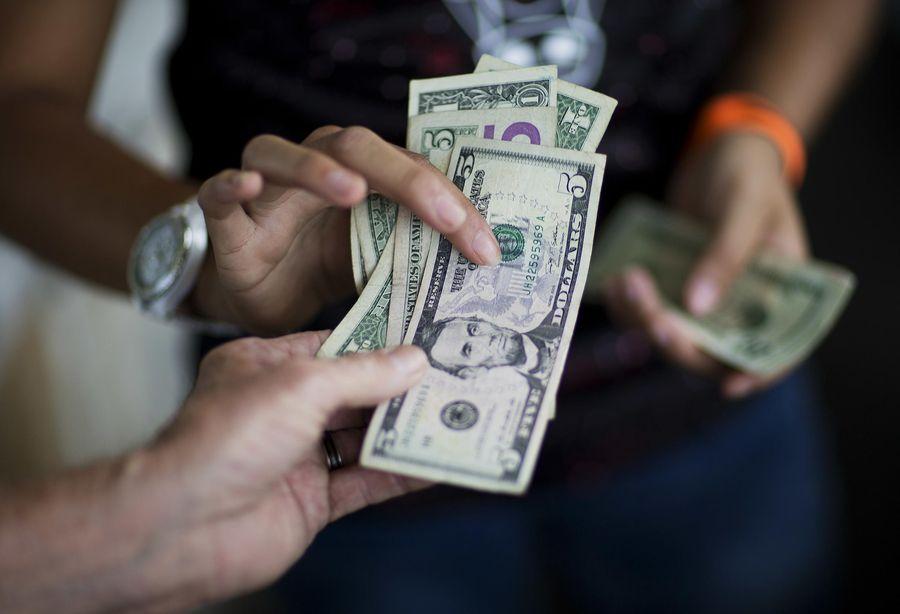
FILE - In this June 6, 2015, file photo, a customer, bottom, pays for goods while shopping at the Atlanta Farmers Market in Atlanta. President Barack Obama came in amid horrendous recession, since then has had 75 months straight months of job growth. But wage growth has been slow. (AP Photo/David Goldman, File)
More Data Exposing the Income Stagnation Myth
Published Dec. 10, 2018 • Read time: 5m
WASHINGTON -- We in the media have a problem. Actually, it's a big problem for all of us. We have become addicted to the notion that, except for the top 1 percent or the top 10 percent, the incomes of most Americans have stagnated for decades. The problem is that, at best, this is an exaggeration and, at worst, an untruth.
A few weeks back, I wrote about a new study from the Congressional Budget Office (CBO). It convinced me that, although typical incomes are rising slowly, they are still rising and that, over long periods, the increases are significant. To cite one statistic from that column: Average inflation-adjusted household incomes for the middle fifth of Americans (by income) rose from $56,400 in 2000 to $64,700 in 2015. That's a 15 percent gain.
What I didn't know then was that the Urban Institute, a well-known think tank, was finishing a complementary report by economist Stephen J. Rose. The report, now available, compares various income estimates and reaches a similar conclusion: Most Americans have realized small annual increases that ultimately cumulated into meaningful gains.
The problem is to replace the simplistic conventional wisdom with this messy reality. It will be tough, because the status quo is more politically appealing. The story line is pointed: "The ultra-rich are destroying the middle class."
What complicates matters is that much of the conventional wisdom about the wealthy is true. Compared to most Americans, their gains have soared. From 1979 to 2015, the before-tax income of the top 1 percent, expressed again in inflation-adjusted dollars, roughly tripled to $1.8 million, says the CBO.
The FBI Gained Access; We'd Already Lost Our Privacy
Is Trump Right About NATO?
Arizona's Voting Rights Fire Bell
U.S. Officials Say 2 Americans Died in Brussels Attack
Confusion arises because a multitude of studies purport to measure the same thing -- the change in Americans' incomes over time -- and get widely different results. In theory, the task seems easy: Correct incomes for inflation (inflation erodes money's purchasing power) and then see if incomes are rising, falling or stagnating.
In practice, it's harder, Rose explains. To measure inflation, for instance, many choices need to be made, with each affecting the results. There are a variety of price indexes. The best known are the consumer price index (CPI) and the personal consumption expenditure deflator (PCE). The PCE is considered superior by many economists and shows slightly less inflation than the CPI. Studies based on the PCE tend to report less inflation and more growth.
Similar details plague much of the estimating process. Another adjustment involves taxes and government welfare programs ("transfer" programs such as Social Security, Medicare and the like). It matters whether a study is pre-tax or after-tax and whether it includes transfers. If you ignore taxes, you overstate the incomes of the wealthy; if you ignore transfers, you understate the incomes of the poor.
Likewise, the inclusion or exclusion of employer-paid health insurance determines people's true incomes, even if workers rarely see any cash. Also, adjusting for the population's age -- incomes vary by life stage -- affects the results.
Different assumptions lead to different conclusions. In his report, economist Rose examined seven studies. Two of them (the annual Census Bureau report on median incomes and a 2003 study by economists Emmanuel Saez and Thomas Piketty) relied mainly on pre-tax incomes and limited transfers.
It was the Saez-Piketty analysis that suggested economic stagnation for the masses, because -- with the effect of taxes and transfers muted -- the economy's income gains seemed to flow disproportionally to the rich. A new study by Piketty, Saez and economist Gabriel Zucman qualifies this result. When the effect of taxes and many transfers were included, the top 10 percent didn't capture all the gains. The median income jumped 33 percent from 1979 to 2014.
"We think the new study provides better and more meaningful numbers," Saez said in an email.
None of this means that we should stop debating inequality. Who gets what and why are inevitable subjects for examination in a rich democratic society. By contrast with many advanced societies, income and wealth are indisputably more concentrated in the United States.
But to be useful, debate must reflect solid realities, not politically convenient sound bites. This is a challenge, because many Americans embrace the stagnation myth.
There are many reasons for this: (a) Wage gains in any year are so small that they don't register -- stagnation seems vindicated; (b) people don't count employer-or-government-provided health insurance -- a big part of their compensation -- because they rarely see the money; (c) political partisans of both parties have a vested interest in emphasizing stagnation -- it's a good campaign issue; and (d) income advances today are much slower than in the past for most Americans.
Economist Rose hopes the facts will change opinions, but he's skeptical. "People are very closed minded," he says, "even though it's so obvious that people have more and better things -- especially with the whole computer-IT revolution."
(c) 2018, The Washington Post Writers Group

Congress Doesn’t Need Another Blame Game. It Needs To Find What’s Broken
Jarrod Bernstein • RealClearPolitics
Democrats Won the Midterms. Common Sense Won, Too
Jordanne Kemper • RealClearPolitics
The 120th Congress Shapes Up
Carolina Lumetta • RealClearPolitics
Flooding GOP Primaries With Democrats
Robert Natelson • RealClearPolitics
Washington Keeps Rewarding Oracle—Veterans Keep Paying the Price
Darin Gaub • RealClearPolitics
The Seeds of Unrestricted Warfare
John Teichert • RealClearPolitics
RCP Today
Top stories on RealClearPolitics
The Takeaway
Polling intelligence and analysis delivered to your inbox
World News
Featuring the latest world news
Policy
Featuring the latest policy news
Support Our Mission
As part of RealClearPolitics, authors aim to provide balanced, non-partisan analysis by presenting top reporting and commentary from all sides of the political spectrum.
Trusted by policymakers and citizens alike since 2000