
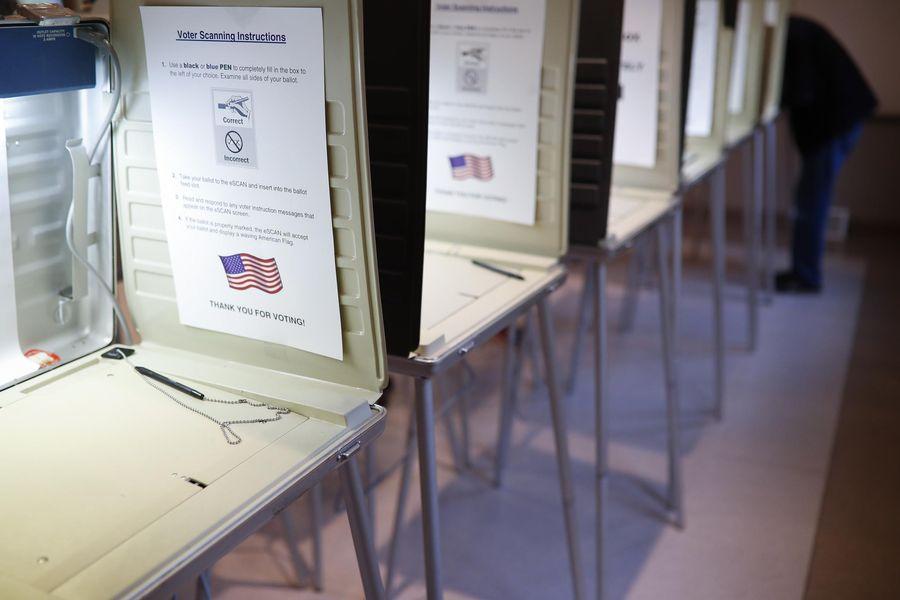
FILE- In this Nov. 8, 2016, file photo a lone voter fills out a ballot alongside a row of empty booths at a polling station in the Terrace Park Community Building on Election Day in Cincinnati. An expert panel of the National Academy of Sciences called for fundamental reforms to ensure the integrity of the U.S. election system. The report calls for replacing rickety voting machines with more-secure voting systems that use paper ballots or equivalents, and other measures such as a particular form of postelection audit aimed at spotting fraud. (AP Photo/John Minchillo, File)
Five States Face Federal Lawsuit Over Inaccurate Voter Registrations
Published Jan. 7, 2020 • Read time: 6m
In 378 U.S. counties, voter registration rates exceed 100% of the adult population, meaning there are more voter registrations on file than the total voting-age population, according to a new analysis by the conservative watchdog group Judicial Watch.
Based on data the federal Electoral Assistance Commission released last year, the new analysis indicates that a minimum of 2.5 million voter registrations are wrongly listed as valid. It suggests widespread lack of compliance with the National Voter Registration Act (NVRA), which requires states to remove people who have died, moved, or are otherwise ineligible to vote from the rolls. While having excess registrations isn’t proof of voter fraud, voter integrity advocates note that it does create opportunities for deception, such as allowing people to vote twice in different precincts or submit invalid absentee ballots.
Last week, Judicial Watch sent letters to election officials in 19 counties in five states – California, Colorado, North Carolina, Pennsylvania, and Virginia – warning that they could face a federal lawsuit for their failure to update voter rolls.
Eleven of the 19 counties are located in California, which has had habitual problems updating its voter rolls. Last year, Los Angeles County settled a lawsuit and agreed to clean up its voter rolls after Judicial Watch revealed that it had 1.6 million more voter registrations on file than the eligible voting population in the county. As of last year, the entire state of California had a voter registration rate of 101%.
The FBI Gained Access; We'd Already Lost Our Privacy
Is Trump Right About NATO?
Arizona's Voting Rights Fire Bell
U.S. Officials Say 2 Americans Died in Brussels Attack
It doesn’t appear that California counties have fixed the problem. San Diego County removed 500,000 voter registrations from its rolls last year following Los Angeles’ settlement, but according to Judicial Watch’s analysis of federal data, San Diego still has a registration rate of 117% – one of the highest in the country.
While the majority of the 19 counties singled out by Judicial Watch have voter registration rates exceeding 100%, some have voter registration rates exceeding 90%, which is improbably high if not impossible. But in every county, Judicial Watch asserts that there’s a demonstrable failure to keep voter rolls accurate.
The four counties singled out by Judicial Watch in Pennsylvania – Allegheny, Chester, Bucks, and Delaware – have voter registration rates ranging between 96% and 98%. Judicial Watch notes that the number of voter registrations removed from the rolls in each county the previous two-year period is 72, eight, five, and four, respectively.
“If few or no voters were removed . . . the jurisdiction is obviously failing to comply. . . . States must report the number of such removals to the [Electoral Assistance Commission],” said Robert Popper, former deputy chief of the Voting Section in the Civil Rights Division of the Department of Justice, who now works on voting issues for Judicial Watch, in a press release.
With more than 1.2 million residents, Allegheny County is the second most populous in Pennsylvania. Invalidating only 72 voter registrations is “an absurdly low figure for a county of this size,” notes Judicial Watch’s letter to the Allegheny County Council and the Pennsylvania secretary of state. “If this figure is accurate, it establishes beyond any dispute that the County is not complying with the NVRA.” Census data confirms that more than one in 10 Americans move every year, and there were obviously more than 72 deaths in the Pittsburgh area over the last two-years.
Another issue raised by Judicial Watch is the number of inactive registrations, such as when a voter hasn’t voted in successive elections or has failed to respond to state inquiries asking them to confirm their address and otherwise validate their registration.
In its letter to Orange County, California Judicial Watch notes that the county has a voter registration rate of 96%. However, Judicial Watch’s letter notes that there are about 380,000 inactive voter registrations on the county’s rolls, or about one in every five registrations – another strong indication that the voting rolls aren’t being systemically updated. (Additionally, Orange County, with a population of 3.2 million, has the distinction of reporting that it did not remove a single voter registration from its rolls over the previous two years.)
The issue of cleaning up voter rolls has become acute over the last year in part due to a 2018 Supreme Court decision, Husted v. A. Philip Randolph Institute. While the decision upheld the state of Ohio’s specific provisions for determining which voter registrations are inactive or invalid, the high court’s decision also clarified the intent of the NVRA’s provisions to keep voter rolls accurate.
Previously some states had relied on questionable interpretations of the law to avoid cleaning up voter rolls. In 1998, California got authority from Clinton administration Attorney General Janet Reno to reinterpret the NVRA enforcement provisions, an interpretation that the Supreme Court determined was a misreading of the law in Husted.
Partisan considerations aside, one factor in the sorry state of America’s voter rolls is the cost. Last year after Judicial Watch also threatened a federal lawsuit over Kentucky’s inability to keep accurate voter rolls, the office of Kentucky Secretary of State Alison Lundergan Grimes blamed a lack of “proper funding” and “budget shortfalls” for why the state had fallen behind.
The upshot is that after decades of neglect, hundreds of counties in this country have millions upon millions of inaccurate voter registrations – and the problem is widespread in Republican “red” and Democratic “blue” counties alike. Some critics see legal action by the judiciary as the best way to force the legislative and executive branches of government to do their duty to ensure the integrity of the nation’s elections process. Judicial Watch says its decision to send letters to five states representing a small fraction of the 378 counties in apparent violation of federal law may only be a first step in its efforts to clean up voter rolls in the coming year.
“The litigation is complex so filing five lawsuits would be significant,” Judicial Watch President Tom Fitton told RealClearPolitics. “The other counties are also on our radar and will not escape scrutiny.”

Congress Doesn’t Need Another Blame Game. It Needs To Find What’s Broken
Jarrod Bernstein • RealClearPolitics
Democrats Won the Midterms. Common Sense Won, Too
Jordanne Kemper • RealClearPolitics
The 120th Congress Shapes Up
Carolina Lumetta • RealClearPolitics
Flooding GOP Primaries With Democrats
Robert Natelson • RealClearPolitics
Washington Keeps Rewarding Oracle—Veterans Keep Paying the Price
Darin Gaub • RealClearPolitics
The Seeds of Unrestricted Warfare
John Teichert • RealClearPolitics
RCP Today
Top stories on RealClearPolitics
The Takeaway
Polling intelligence and analysis delivered to your inbox
World News
Featuring the latest world news
Policy
Featuring the latest policy news
Support Our Mission
As part of RealClearPolitics, authors aim to provide balanced, non-partisan analysis by presenting top reporting and commentary from all sides of the political spectrum.
Trusted by policymakers and citizens alike since 2000