
Defending Bangladesh's Election
COMMENTARY
Published Feb. 23, 2019 • Read time: 4m
It has become accepted wisdom that if a political party in a far-flung country wins an election overwhelmingly, the election must have been stolen. A healthy democracy should have competitive elections and governments that lack competition must be dictatorships.
But what if the opposition party craters and offers little or nothing in new ideas or attractive candidates? What if the opposition’s history is to produce violence rather than debate? And what if the winning party has done a remarkable job improving its citizens’ lives?
That’s what happened in Bangladesh. The result was a landslide election late last year that unfortunately has been widely misunderstood.
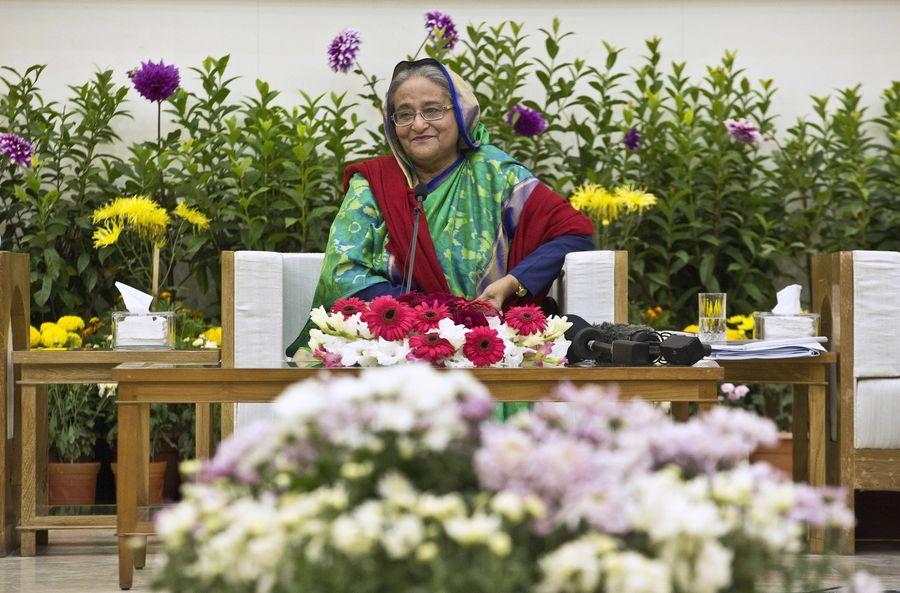
The decisive victory of Prime Minister Sheikh Hasina and her Awami League party was signaled well in advance. Various public opinion polls, including one by the U.S.-based Democracy International, predicted the outcome for months. The Awami League’s own pre-election poll showed that it had 66 percent support. When the election was held December 30, the Awami League earned 72 percent of the vote and 52 percent of registered voters.
No one should have been surprised. But, predictably, some in the international media raised the prospect that Bangladesh, one of the world’s largest democracies, was turning into an authoritarian state. After all, former Soviet bloc countries have become infamous for holding elections in which their strong man leaders routinely garner gigantic majorities, often more than 90 percent of the vote.
The FBI Gained Access; We'd Already Lost Our Privacy
Is Trump Right About NATO?
Arizona's Voting Rights Fire Bell
U.S. Officials Say 2 Americans Died in Brussels Attack
First, the Awami League didn’t win by that large a margin. But, second, it did face what turned out to be only nominal opposition. The Bangladesh Nationalist Party (BNP) barely made an effort last year, in the end partnering with other weak parties to form an opposition coalition. It didn’t put up much of a fight.
The BNP did not have established party leaders on the ballot. This situation wasn’t created by the governing party, as critics have alleged. In February 2018, an anti-corruption court independent of the government found former Prime Minister Khaleda Zia, a top BNP leader, guilty of stealing more than $250,000 that had been donated for orphans. She was sentenced to five years in prison, constitutionally preventing her from running for public office. She faces other criminal charges as well, also from independent prosecutors.
Zia’s son, Tarique Rahman, the BNP’s senior vice chairman, is living in exile in London having been convicted of masterminding a 2004 grenade attack in Dhaka, Bangladesh’s capital, that left 24 dead.
Without Zia and Rahman, the BNP was left without brand-name leaders. But its shortcomings were also policy-related. Its agenda, called a manifesto, calls for rapid economic growth, but doesn’t detail how that might happen. Indeed, the document’s only clear message is to “attack the Awami League.” That’s not much to campaign on.
In addition, BNP leaders provided no assurances to religious minorities as the Awami League did. Worse, the BNP allied itself with a known extremist organization, Jamaat-E-Islami. As Sam Westrop, a director of Islamist Watch, noted at a scholarly event in Washington: “It has escaped nobody’s notice that Jamaat-e-Islami runs the show and where it runs the show, terrorists emerge.” In addition, the BNP itself has been called a terrorist organization and some of its candidates were linked to terrorism.
The BNP and its allies instigated violence in past elections, a fact not forgotten by voters. After winning the 2001 general election, the BNP and Jamaat-E-Islami attacked opposition parties and minority communities. Nearly 25,000 people were killed. Deaths and injuries resulted during the last two national elections as well, perpetrated by BNP coalition members. Last year, the government sent troops around the country to keep the peace. Critics who say this was to intimidate voters simply misunderstand Bangladesh’s history.
Most important of all, the Awami League has provided citizens with tangible improvements in their lives. For nearly a decade, Bangladesh's economy has enjoyed an average annual growth rate of 6 percent, reaching 7.86 percent in 2018. Since 2009, 15.8 million people were lifted out of poverty, driving the poverty rate down from 31.5 percent to 21.8 percent. Per capita income has risen nearly threefold.
Enrollment of girls in primary school rose from 57 percent in 2008 to 95.4 percent in 2017. The female-to-male high school enrollment ratio now tips in favor of women. Women are entering the workplace in record numbers.
Bangladesh has become the rising star of South Asia. Bangladeshis know who is responsible for this progress: Prime Minister Hasina and the Awami League. That’s why they were returned to office so convincingly.
Tahseen Ali holds a doctorate specializing in the history of South Asia. He is currently a member of the full-time faculty in the Houston Community College-System.

Congress Doesn’t Need Another Blame Game. It Needs To Find What’s Broken
Jarrod Bernstein • RealClearPolitics
Democrats Won the Midterms. Common Sense Won, Too
Jordanne Kemper • RealClearPolitics
The 120th Congress Shapes Up
Carolina Lumetta • RealClearPolitics
Flooding GOP Primaries With Democrats
Robert Natelson • RealClearPolitics
Washington Keeps Rewarding Oracle—Veterans Keep Paying the Price
Darin Gaub • RealClearPolitics
The Seeds of Unrestricted Warfare
John Teichert • RealClearPolitics
RCP Today
Top stories on RealClearPolitics
The Takeaway
Polling intelligence and analysis delivered to your inbox
World News
Featuring the latest world news
Policy
Featuring the latest policy news
Support Our Mission
As part of RealClearPolitics, authors aim to provide balanced, non-partisan analysis by presenting top reporting and commentary from all sides of the political spectrum.
Trusted by policymakers and citizens alike since 2000