
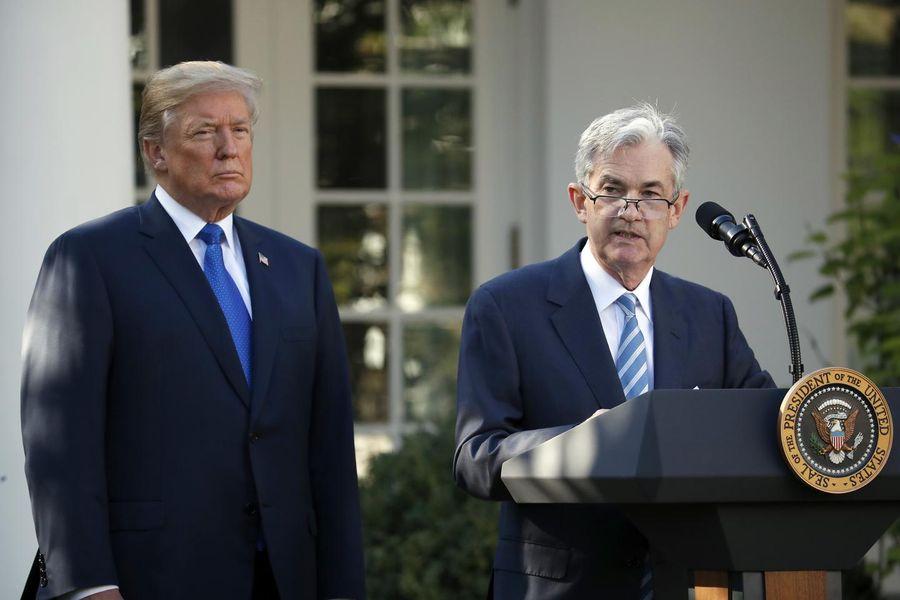
Federal Reserve board member Jerome Powell speaks after President Donald Trump announced him as his nominee for the next chair of the Federal Reserve in the Rose Garden of the White House in Washington, Thursday, Nov. 2, 2017. (AP Photo/Alex Brandon)
Trump vs. the Fed
Published Dec. 3, 2018 • Read time: 4m
WASHINGTON -- President Trump, do yourself a favor. Stop attacking the Federal Reserve and its chairman, Jerome Powell (yes, the same Powell you nominated). The result would be better for you, better for Powell and -- most important -- better for the country.
Unfortunately, Trump can't seem to restrain himself. The Fed has been raising short-term interest rates since late 2015 and is reportedly considering another increase in December. Trump is livid at the prospect. Here is his latest anti-Fed outburst from a Nov. 27 interview with The Washington Post:
"I will tell you, at this moment in time I am not at all happy with the Fed. ... They're making a mistake because … my gut tells me more sometimes than anyone else's brain can ever tell me. ... I'm not even a little bit happy with my selection of Jay. Not even a little bit."
Until recently, there seemed to be a crude consensus among economists that the Fed should continue its gradual increases in interest rates to pre-empt higher inflation. The economy seems strong enough to tolerate tighter credit. The unemployment rate of 3.7 percent is the lowest since the 1960s; inflation is around 2 percent; consumer confidence is high.
But the consensus may be fraying. There are signs of weakness. The stock market has fallen; housing sales and prices have softened; the trade war between the United States and China continues. Perhaps the Fed should delay further increases in interest rates? When Powell obliquely suggested that last week in a speech, the stock market staged a brief, huge rally.
Volcker, Reagan & History
Preserving Their Monopoly on Monopoly Money
Prophets and Losses
Bernanke's Speech on Monetary Policy And It's International Implications
The Wall Street Journal recently illustrated the disagreement. On Nov. 27, the paper ran an op-ed piece by Harvard economist Martin Feldstein, a chairman of the Council of Economic Advisers under President Reagan, urging the Fed to raise rates. The next day, the Journal ran an op-ed piece by Harvard economist Jason Furman, chairman of the CEA under President Obama, counseling delay.
Who do we want making these technically demanding and politically crucial decisions? The choice is between politicians in Congress and the White House, who are focused on the economy's near-term performance; or Fed economists and officials who are exercising their "independent" judgment about the best policy.
The Fed isn't infallible and never will be. Over the years, it's made some colossal errors. But it beats the alternative of politically driven policies sensitive to every whim from the Capitol or 1600 Pennsylvania Ave. One danger for Trump is that the Fed, seeking to prove its "independence," will deliberately oppose what the president prefers.
It is in this sense that Trump would be better off if he had emulated most of his recent predecessors and not advertised his displeasure publicly. Going public risks feeding a prolonged feud between Trump and Powell. Inevitably, economic uncertainty would increase, while confidence would decrease.
"President Trump has gone completely off the rails with his criticism of Fed Chair Powell," says economist Mark Zandi of Moody's Analytics. "[He] is using the Fed as a scapegoat for anything that goes wrong in the stock market and the economy."
In Trump's defense, he is not the first president to try to control the Fed and corrupt its "independence." Lyndon Johnson lambasted then-Fed Chairman William McChesney Martin in the mid-1960s for raising interest rates against his wishes. Richard Nixon pressured Arthur Burns, Martin's successor, to keep rates low. Likewise, President Truman pushed the Fed to maintain easy money and credit.
But these and other cases occurred mainly behind closed doors. Trump's brash innovation has been to take his complaints public; the apparent aim is to intimidate the Fed into doing his bidding. If the Fed resists, Trump might propose legislation curbing its powers. That would signal a real state of war between Trump and the Fed, with what consequences for financial markets and the economy it's hard to know.
It is true that the Fed's "independence" is a term of art more than a strict legal standard, as Sarah Binder and Mark Spindel note in their recent book on the Fed, "The Myth of Independence." It's also true that attacking the Fed has long been standard operating procedure for members of Congress of both parties.
"Congress depends on the Fed both to steer the economy and absorb public blame when the economy falters," write Binder and Spindel. A lot of this criticism is political theater, designed to impress voters but not to do much else. What's not familiar is for the president to be leading the charge.
(c) 2018, The Washington Post Writers Group

Congress Doesn’t Need Another Blame Game. It Needs To Find What’s Broken
Jarrod Bernstein • RealClearPolitics
Democrats Won the Midterms. Common Sense Won, Too
Jordanne Kemper • RealClearPolitics
The 120th Congress Shapes Up
Carolina Lumetta • RealClearPolitics
Flooding GOP Primaries With Democrats
Robert Natelson • RealClearPolitics
Washington Keeps Rewarding Oracle—Veterans Keep Paying the Price
Darin Gaub • RealClearPolitics
The Seeds of Unrestricted Warfare
John Teichert • RealClearPolitics
RCP Today
Top stories on RealClearPolitics
The Takeaway
Polling intelligence and analysis delivered to your inbox
World News
Featuring the latest world news
Policy
Featuring the latest policy news
Support Our Mission
As part of RealClearPolitics, authors aim to provide balanced, non-partisan analysis by presenting top reporting and commentary from all sides of the political spectrum.
Trusted by policymakers and citizens alike since 2000