
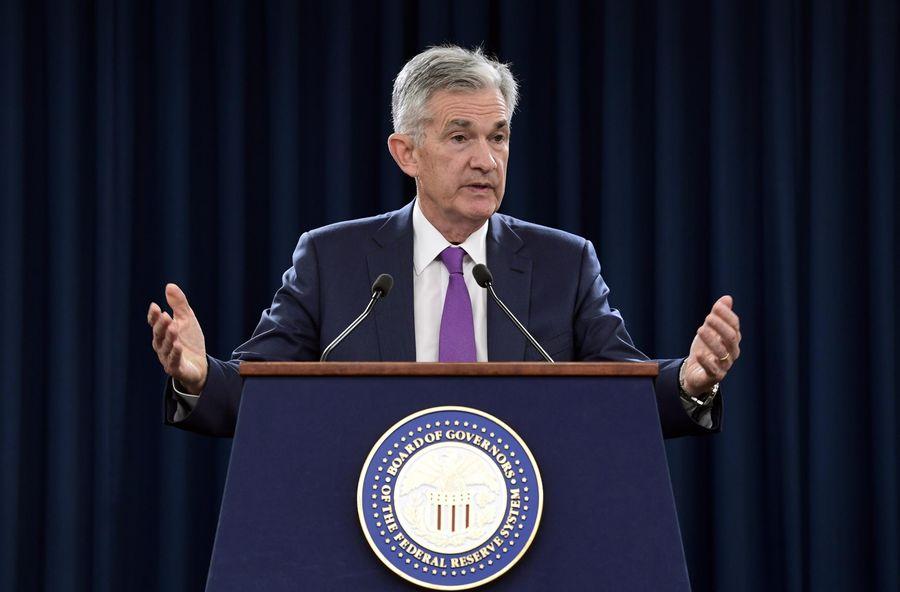
Federal Reserve Chairman Jerome Powell speaks during a news conference in Washington, Wednesday, Sept. 26, 2018. The Federal Reserve has raised a key interest rate for the third time this year in response to a strong U.S. economy and signaled that it expects to maintain a pace of gradual rate hikes. (AP Photo/Susan Walsh)
Trump Needs a Fed Chair Who Won't Ride the Brakes
COMMENTARY
Published Nov. 1, 2018 • Read time: 4m
President Trump has said the Federal Reserve has “gone crazy.” He might not be too far off the mark. Chairman Jerome Powell’s threat to raise interest rates one more time this year after already increasing them three times is certainly ill-advised.
The U.S. economy is humming along. Third-quarter GDP growth was a faster-than-expected 3.5 percent. This follows 4.2 percent growth in the second quarter. September’s unemployment rate was 3.7 percent, the lowest in nearly a half-century, and it’s expected to go lower. The Trump tax cut fueled business investment earlier in the year.
As National Economic Council Director Larry Kudlow has said, we have “the hottest economy in the world.”
After years of slow growth, we need to let the economy roll. But the Federal Reserve Bank seems to have other ideas. It addition to this year’s federal funds rate increases, it’s further suggesting that by the end of 2019 the rate could rise to 3 percent, and then to 3.4 percent in 2020.
Trump is right to criticize Powell. Steeper rates will only cool off the economy. When combined with the Fed’s slow sell-off of its $4.5 trillion bond portfolio, which it accumulated during the Obama years to stimulate the paralyzed economy, the negative effects will be multiplied. This is a lot like putting your foot on the brakes while pulling the parking brake at the same time.
In fact, Powell has already thrown ice water on our growing prosperity. On Oct. 3, he said that “extremely accommodative low interest rates that we needed when the economy was quite weak” are no longer required. Three weeks later, the Dow Jones Industrial Average had fallen from 26,828 to 25,000, a 6.8 percent tumble. Over the same period, the S&P dropped from 2,925 to 2,700, a 7.7 percent fade, and the Nasdaq slumped 9 percent, from 8,025 to 7,300. Charles Payne of Fox Business Network called it the “Powell Plunge.”
Volcker, Reagan & History
Preserving Their Monopoly on Monopoly Money
Prophets and Losses
Bernanke's Speech on Monetary Policy And It's International Implications
The equity markets have not fully recovered. Meanwhile, other signs that our hot economy might be cooling have been popping up.
Fear that an expanding economy will cause inflation typically drives the Fed to raise rates. But inflation anxiety can’t be the factor behind the rush to increase rates. The Federal Open Market Committee said after a meeting in August that, “on a 12-month basis, both overall inflation and inflation for items other than food and energy remain near 2 percent” and that “indicators of longer-term inflation expectations are little changed, on balance.”
So if the economy is in the initial stages of slowing, and inflation is moderate -- it’s at 2.3 percent over the last 12 months and falling; in recent years has often been well below 2 percent; and on many occasions even crept below 1 percent -- why is Powell signaling a move toward more restrictive policy?
At 2.2 percent, the federal funds rate is essentially idling in neutral. It is neither accommodative, nor restrictive. Leave it where it is before taking a step that will slow down an economy that needs to complete its recovery and then grow to new heights.
Our central bank has an important role in our economy. But the Fed, which wields enough power to be the fourth branch of the federal government, too often acts in ways that put a drag on growth. Our confidence in its judgments are further undermined by the fact that its decisions are made in a not-so-transparent way. This needs to change. It’s time to overhaul the Federal Reserve Bank. It must be more open, more accountable, and fully accessible for independent audits. This country needs a central bank focused on giving the economy room to run to make up for eight years of slow growth during the previous administration, not a secret society operating behind closed doors.
Donald Trump was elected to drain the swamp in Washington. He has done a credible job of that since he’s been in office. He would be justified in continuing the process by replacing Powell with his reported preferable choice, Stanford economist John Taylor. The Fed is part of the swamp, too, and it’s just as murky as the rest of Washington, if not more so.

Congress Doesn’t Need Another Blame Game. It Needs To Find What’s Broken
Jarrod Bernstein • RealClearPolitics
Democrats Won the Midterms. Common Sense Won, Too
Jordanne Kemper • RealClearPolitics
The 120th Congress Shapes Up
Carolina Lumetta • RealClearPolitics
Flooding GOP Primaries With Democrats
Robert Natelson • RealClearPolitics
Washington Keeps Rewarding Oracle—Veterans Keep Paying the Price
Darin Gaub • RealClearPolitics
The Seeds of Unrestricted Warfare
John Teichert • RealClearPolitics
RCP Today
Top stories on RealClearPolitics
The Takeaway
Polling intelligence and analysis delivered to your inbox
World News
Featuring the latest world news
Policy
Featuring the latest policy news
Support Our Mission
As part of RealClearPolitics, authors aim to provide balanced, non-partisan analysis by presenting top reporting and commentary from all sides of the political spectrum.
Trusted by policymakers and citizens alike since 2000