
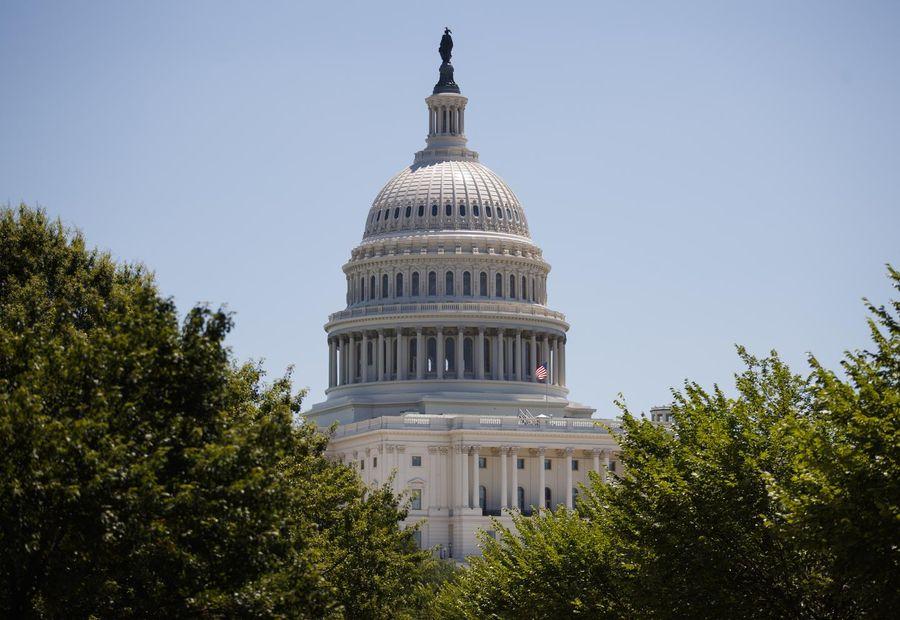
FILE- In this July 9, 2018, file photo, the U.S. Capitol dome is seen in Washington. Microsoft has uncovered new hacking attempts by Russia targeting U.S. political groups ahead of the midterm elections. The company said Tuesday, Aug. 21, that a group tied to the Russian government created fake websites that appeared to spoof two American conservative organizations: the Hudson Institute and the International Republican Institute. Three other fake sites were designed to look as if they belonged to the U.S. Senate. (AP Photo/Carolyn Kaster, File)
Alfred E. Neuman's Law of Deficits
Published Feb. 6, 2019 • Read time: 4m
WASHINGTON -- Let's coin a new law of politics. Call it Neuman's Law after Alfred E. Neuman of Mad magazine fame, whose philosophy is, "What, me worry?" Neuman's Law postulates that there is never a good time to raise taxes or cut federal spending. This explains why, since 1961, the annual federal budget has been in deficit 52 times and in surplus only five times (1969 and 1998-2001). Unsurprisingly, all the surpluses occurred at the end of economic booms that automatically raised tax revenues and curtailed spending.
The latest champions of Neuman's Law are Lawrence Summers, Treasury secretary under President Clinton and director of the National Economic Council under President Obama; and Jason Furman, the last chairman of the White House Council of Economic Advisers under Obama. Both are economists; both teach at Harvard.
Writing in Foreign Affairs -- published by the Council on Foreign Relations -- Summers and Furman discuss the budget outlook in great detail, throwing hordes of facts and figures at readers. But their conclusion corroborates Neuman's Law.
"Deficits ... should not cause policymakers much concern, at least for now," they write. "It's time for Washington to put away its debt obsession," they conclude.
"Obsession"? They must be kidding. This inverts the truth. If Washington feared debt, Congress would long ago have tamed budget deficits. (Deficits are the annual gap between federal revenues and spending. Debt is the accumulation of all past deficits.)
What both Democrats and Republicans actually fear are the highly unpopular steps -- spending cuts or tax increases -- they might have to take to reduce or eliminate the deficits, which are huge. The Congressional Budget Office's latest "baseline" estimate for 2019 is nearly $900 billion. This equals 4.2 percent of the economy (gross domestic product) and 20 percent of federal spending.
The Brute Force of Government Spending on Autopilot
Please Lie to Us
Soaking the Rich: A Primer
Obama's 180 on 529 Plans Explained Here
So why bother? ask Furman and Summers. Deficits aren't now doing the economy much harm. Interest rates are low and may well stay that way. If deficits are cut too abruptly, the present economic expansion could falter. These are possibilities, but doing nothing also poses dangers, as even Summers and Furman concede.
Higher debt levels could make it hard for future governments "to stimulate the economy in a downturn," they say. If escalating debt raises interest rates, it could crowd out private investment, undermining the economy's long-term growth potential. Or some sort of financial crisis might occur if investors become sated with U.S. Treasury bonds.
Curiously, Furman and Summers say that we can't simply borrow indefinitely as much as we'd like. "The debt cannot be allowed to grow forever," they write. "The government cannot set budget policy without any limiting principles or guides as to what is and what is not possible or desirable," they say at one point. At another, they warn: "Sooner or later, government spending has to be paid for."
But what are the "limiting principles"? And when and how might government spending be paid for? They don't say. Their promises are vague, rhetorical throwaway lines that, in isolation, have no credibility.
To be fair, there is brief mention of a proposal to accept the existing increases in government debt but insist that any new spending or tax cuts not raise the debt further. Details are few, and this provides little restraint. In 2018, the federal debt held by the public was 78 percent of GDP, more than double the 35 percent in 2007. The CBO projects that under present policies it will be 93 percent of GDP in 2029 -- and rising.
No one really knows the long-term effects of these continuously large deficits. But there is a crude analogy in the recent past that provides a warning: double-digit inflation. Consumer prices went from about 1 percent in 1960 to 13 percent in 1980. Many economists argued then that a little more inflation wouldn't harm the economy, but a little more soon became a lot more, and only the harsh 1980-82 downturn (peak unemployment: 10.8 percent) brought it under control.
It's doubtful that Summers and Furman will be much impressed by Neuman's Law. But they are living proof of its power. The message that a reasonable person would take from their essay is that the government can borrow unlimited amounts for the foreseeable future. This also seems to be the position of the Trump administration.
The essay's true purpose seems to be to provide intellectual support for what self-interested politicians would do in any case: enjoy present pleasures and postpone any future unpleasantness. Let someone else worry about the future. That's Neuman's Law, and it's mad.
(c) 2019, The Washington Post Writers Group

Congress Doesn’t Need Another Blame Game. It Needs To Find What’s Broken
Jarrod Bernstein • RealClearPolitics
Democrats Won the Midterms. Common Sense Won, Too
Jordanne Kemper • RealClearPolitics
The 120th Congress Shapes Up
Carolina Lumetta • RealClearPolitics
Flooding GOP Primaries With Democrats
Robert Natelson • RealClearPolitics
Washington Keeps Rewarding Oracle—Veterans Keep Paying the Price
Darin Gaub • RealClearPolitics
The Seeds of Unrestricted Warfare
John Teichert • RealClearPolitics
RCP Today
Top stories on RealClearPolitics
The Takeaway
Polling intelligence and analysis delivered to your inbox
World News
Featuring the latest world news
Policy
Featuring the latest policy news
Support Our Mission
As part of RealClearPolitics, authors aim to provide balanced, non-partisan analysis by presenting top reporting and commentary from all sides of the political spectrum.
Trusted by policymakers and citizens alike since 2000