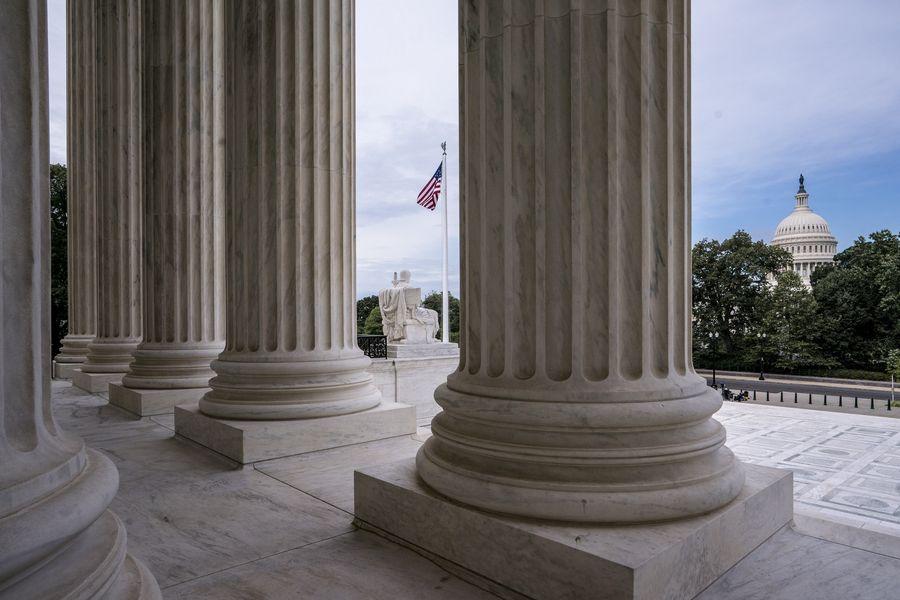
FILE - In this June 15, 2020, file photo the columns of the Supreme Court are seen with the Capitol at right, in Washington. Democrats flooded Twitter and email inboxes this week with praise for the watershed Supreme Court decision shielding gay, lesbian and transgender people from job discrimination. (AP Photo/J. Scott Applewhite, File)
Supreme Court Steps Up Where Congress Fails
COMMENTARY
Published July 11, 2020 • Read time: 4m
Americans nationwide are consumed with concern over COVID-19, near-Depression-level economic hardship and protests-turned-riots over racism. In the meantime, federal policymakers in Congress are largely failing to address these issues – ever consumed by ramifications for the coming election.
But there, almost in the background, the Supreme Court in its most recent term has quietly achieved something better in the sticky realm of religious freedom and LGBTQ equality: bridging ideological divides and interpreting law with competence and courage.
Faced with a tough legal question about the scope of anti-discrimination law, the court recently ruled that LGBT individuals should enjoy broad anti-discrimination protections in their jobs. This is a common- sense idea that receives broad public support, but federal lawmakers have proven incapable of finding the kind of compromise necessary to enact law in America.
Additionally this term, the court protected religious individuals from being singled out for discrimination by state constitutional provisions, and churches from attempts to use discrimination law to decide who gets to teach religion. It also protected selfless religious efforts to serve the most vulnerable Americans – such as nuns who dedicate themselves to caring for poor senior citizens – from unreasonable government mandates.
The justices decided these cases on their individual merits. But even if unintended, these rulings, as a body, resemble what courage and leadership in Congress might have accomplished: protecting both the LGBTQ and religious communities. They also transcended ideological differences: In all but one of these cases, multiple conservative justices combined with several liberal justices to reach the majority ruling.
He's Mean, But Is He at Least Bright?
Supreme Hypocrisy
It's Time to End ALL Lame-Duck Sessions
The Court Fight Is About Democracy
Th courage in some form is necessary for such decisions is revealed by the equal-opportunity condemnation the rulings received from ideological extremes on both the political left and right (each side decrying different rulings, of course). Despite this often-intense criticism, the court’s rulings advanced the common good by offering protections for both LGBTQ and religious individuals.
Not to be ignored, of course, is the unfortunate state of our politics that forces unelected judges to make these decisions. It would be better – and what our Constitution intended – if Congress showed the political courage to forge principled policy compromises. Lawmakers have had ample opportunity and reason to find consensus on these issues from individual proposals to advance LGBTQ equality or religious freedom. Whether lawmakers are Republican or Democrat, such an approach would benefit many of the very constituents they claim to represent.
Instead, lawmakers shrink from compromise for fear that it will fuel a competitive primary challenger from the progressive left or populist right. They remain in the relative political comfort and lucrative fundraising found in simply continuing a never-ending policy fight.
When Congress fails in its duty to protect fundamental rights in employment and faith, it is no surprise to see the courts step up in its place. In this case, rights are protected. But it is a cautionary tale.
The Supreme Court’s recent body of rulings on religious freedom and LGBTQ equality also represent competent law. They create workable, if not comprehensive, solutions. Here in Utah, we have lived under such competence for years, since embracing a combination of new legal protections for the rights and freedoms of LGBTQ and religious individuals and institutions known as the “Utah Compromise.” In an area of social and economic issues where every policy decision draws a wave of legal challenges, Utah’s compromise has progressed largely free of lawsuits. That is what competent policy looks like.
Much of the nation will, for now, continue in a futile attempt to achieve complete victory over “the other side.” But the Supreme Court’s rulings on LGBTQ equality and religious freedom, simultaneously protecting both, reveal a better way.
People are entitled to representation that seeks principled compromise with a commitment to arrive at workable solutions. Together, we can find the legislative solutions that the Supreme Court rulings in these cases pointed toward.
It begins with congressional courage and competence.

A RealClear Thanksgiving: Investing in a Better Future
David DesRosiers • RealClearPolitics
Trump’s Newsom Problem: Antagonist-in-Chief
Carolina Lumetta • RealClearPolitics
America’s Free Spirit
John Maxwell Hamilton • RealClearPolitics
The GOP Majority Should Go Out in Glory
Daniel McCarthy • RealClearPolitics
Republican Majorities Could Return Sooner Than Expected
J.T. Young • RealClearPolitics
The Danger Before the Attack
Leslie J. Sullivan • RealClearPolitics
RCP Today
Top stories on RealClearPolitics
The Takeaway
Polling intelligence and analysis delivered to your inbox
World News
Featuring the latest world news
Policy
Featuring the latest policy news
Support Our Mission
As part of RealClearPolitics, authors aim to provide balanced, non-partisan analysis by presenting top reporting and commentary from all sides of the political spectrum.
Trusted by policymakers and citizens alike since 2000