
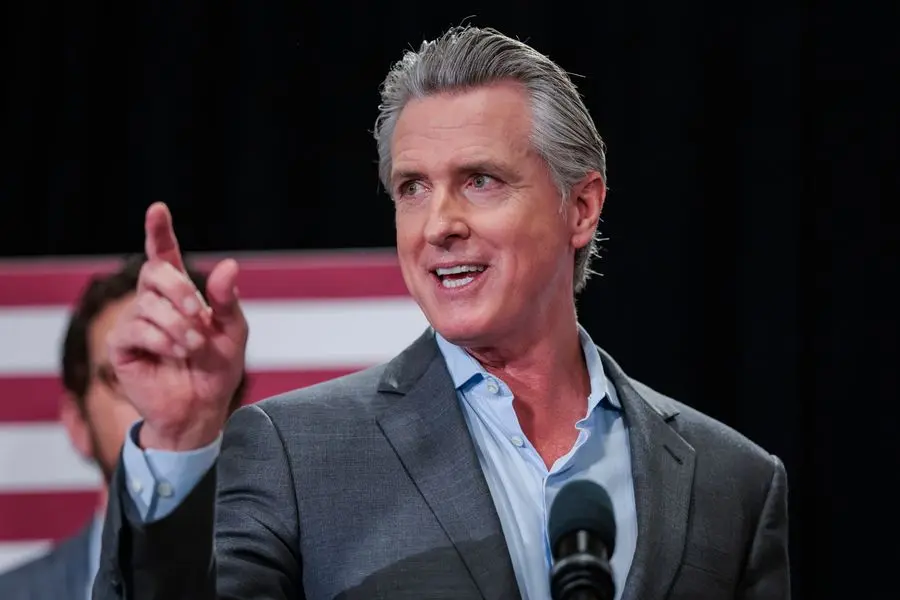
Trump’s Newsom Problem: Antagonist-in-Chief
Published Nov. 25, 2026 • Read time: 8m
A favorite stalling technique of future candidates when asked if they will run for office is to tell reporters that they will spend the holiday season discussing their options with family members. That will likely be the case around Gov. Gavin Newsom’s dinner table in the coming weeks, but the White House is already treating him as if he’s running.
Newsom and Donald Trump have long been sparring partners on social media and in retaliatory governing actions. From rival gerrymandering schemes and litigation over the National Guard to sarcastic posts on social media and digs in their respective public utterances, Trump and the sleek, hair-gelled California governor have been each other’s constant nemesis. And Newsom is still benefiting from the exposure.
It was Newsom’s decision to commute every death sentence in California that earned him an especially caustic response from Trump this week while speaking at his second-ever event in the main hall of the Department of Justice. Earlier this month, Newsom announced he would reduce the sentence of all 548 inmates on death row to life without the possibility of parole.
In an open letter, Newsom wrote that “state-sanctioned killing is incompatible with California’s values, undermines the foundations of our legal system, and diminishes each of us.”
The president called Newsom’s decision “one of the most shocking acts of injustice our country has ever seen.” The courts had already upheld the death sentences for each conviction, and California voters chose to uphold the death penalty in 2012 and 2016.
Sanders Seeks Caucus Trifecta Win to Close Delegate Gap
Sanders Fighting Perception He Can't Overcome Clinton Edge
Clinton Targets Trump as Sanders Circles
Sanders, Clinton Differ Sharply at Flint Debate
California has not carried out any executions since 2006, however. In 2019, Newsom instituted a moratorium on all executions, but it did not alter death sentences. Newsom’s Nov. 5 decision starts a legal review by the state’s Supreme Court to change those sentences to life without parole, a sentence he called the most severe that can still be ethically enforced.
At the Justice Department, Trump said he would sign an executive memorandum directing the DOJ to seek the death penalty for all child murderers, rapists, and human traffickers who kill their victims. He signed the order on a small desk set up on the stage. He also took particular aim at the man who could be the Democrats’ next presidential nominee.
“After the jury delivered their verdicts and the justices have returned a much-deserved sentence of death, Newsom, a terrible governor in so many other ways, came along and stole away the only closure those families might ever have,” Trump said. He then invited family members of several victims to give remarks.
“The left look at these haters’ acts and their sympathy is not for the children and their parents, but for the monsters who extinguished innocent young lives,” Trump later added. “I’ve seen it so much, but I never understood it. A lot of the media is with them for whatever reason.”
Then the White House posted several times with clips of Newsom and coverage of the commutations, as well as responses from family members of victims. Meanwhile, Newsom made his own video message calling for a federal pardon reform.
“No president can ever again turn the power of mercy into a business. No president and no one should be able to sell a pardon,” Newsom said. “The Justice Department is not Donald Trump’s law firm. Justice is not for sale. Not in California, and not in America.”
But some Democrats are cheered by Trump’s persistent attention toward Newsom. In a party that demanded fighters in Congress in the 2026 midterms, that same personality could go far in 2028.
“The challenge and opportunity for Gavin Newsom is one and the same,” Democrat strategist Matt McDermott told RealClearPolitics. “Donald Trump keeps elevating him. Being the president’s chosen foil is one of the most valuable things a Democrat can have going into a presidential primary right now.”
Among the challenges Newsom faces, though, is that he has angered various segments of the Democratic base over the course of his two-term governorship. Some liberals decried his interview with the late conservative activist Charlie Kirk, complaining that Newsom was overly deferential to Kirk. And Newsom’s effective opposition to a billionaire tax made him friends in Silicon Valley but not in the affordability camp of his own party.
McDermott sees parallels between the 2006 and 2008 elections and the 2026 and 2028 cycles. In 2006, President George W. Bush was a lame duck, and the midterms started to move momentum toward the Democratic Party. Then in 2008, President Barack Obama won on the coattails of his own party’s desire for change.
But is Newsom the change agent the party is looking for?
“The defining question of 2028 is not just who can fight Trump most effectively, but who can finally turn the page on the political era that he created,” McDermott said. “Newsom’s entire identity and brand over the past few years has been a foil to Donald Trump. We’ve had a full decade of a politics of personality related to Donald Trump. One of the challenges for Newsom is can he position himself as a voice for change in a world in which he’s already been in the national spotlight?”
Newsom has some work to do within his own party if he wants to make a 2028 play. He ranks fifth in the RCP Average for odds of becoming the Democratic nominee. Former Vice President Kamala Harris leads the potential pack at 16.5%, with Georgia Sen. Jon Ossoff a close second.
Since Trump won reelection, Newsom has become a national figurehead for Democratic opposition. He began posting on social media, mocking Trump’s style of random capitalization and derogatory terms.
The antagonism continued. In 2025, Newsom sued Trump over federalizing the California National Guard and deploying them to Los Angeles to deal with protests over the administration’s immigration enforcement. Several courts ruled in favor of Newsom, who argued that it exceeded executive branch authority when no governor had asked for National Guard help. To codify the ruling, Newsom signed a law in September of this year prohibiting National Guard members from any other state or territory from entering California without the governor’s permission.
Newsom then grappled with the administration again after Trump urged Texas to redraw congressional districts to make them more favorable for Republicans ahead of the midterms. Newsom then put up Proposition 50 in California to do the same for Democrats. The Justice Department sued Newsom, alleging he was attempting racial gerrymandering. Then-Attorney General Pam Bondi called it a “brazen power grab.” California did change its districts, but even the redrawn districts in Texas and across the country failed to give the GOP an advantage.
During the latter part of 2026, Newsom has been less a thorn in the White House’s side and more of a conciliatory voice on his shadow campaign trail. He published a memoir about his life in politics and described his political philosophy as “go slow.” Newsom then combined his book tour with stops to stump for Democratic candidates ahead of the midterms.
He’s also logged his frequent flyer miles. Over the course of his second term, he has spent nearly 18% of his time, 249 days, outside of California, according to an RCP analysis. Much of that has been for campaign stops during the 2024 and 2026 cycles. This month, he attended the United Nations’ annual climate summit in Turkey, visited Poland to sign a climate agreement, and made a surprise stop in Lviv, Ukraine. Last week, he stopped by the U.S. Capitol in Washington, D.C., to meet with incoming Democratic lawmakers.
On Monday, the Democratic National Committee announced its initial framework for the presidential primary debates in 2028. The DNC will host 12 debates over the entire cycle, five in 2027 and seven in 2028. It will incorporate social media influencers and creators in an attempt to boost viewership. If the field is particularly large, some of the debates will be broken up into two nights. The DNC also shifted the primary schedule, making South Carolina the first on Jan. 22, 2028.
Which is exactly where Newsom has been three separate times this year. But it remains to be seen whether his California background makes him relatable to a base that rarely identifies California with the term “affordability.”
“Does Newsom have an answer to the question of how he’s going to make life more affordable?” McDermott asked. He pointed out that members of both parties often point to California to depict an out-of-touch and elitist government. “I do think there are some success stories in California, but we should acknowledge that it has been the boogeyman of Republican politics for a decade now.”
Support Our Mission
The Internet provides an endless stream of content. Not all of it is worth your time. That's why, every day, RealClearPolitics curates the most essential news and information—from all sides and across mediums. The links, videos, and podcasts curated here are the product of human judgment, not algorithms or AI. Please help power our mission of presenting a thoughtful, balanced public discourse through a tax-deductible donation.
Would you consider supporting us today?
Trump’s Newsom Problem: Antagonist-in-Chief
Carolina Lumetta • RealClearPolitics
The GOP Majority Should Go Out in Glory
Daniel McCarthy • RealClearPolitics
Republican Majorities Could Return Sooner Than Expected
J.T. Young • RealClearPolitics
The Danger Before the Attack
Leslie J. Sullivan • RealClearPolitics
Jon Finer’s Old and Dangerous ‘New Approach’ to Israel
Peter Berkowitz • RealClearPolitics
The President Deserves Better
John Ullyot • RealClearPolitics
RCP Today
Top stories on RealClearPolitics
The Takeaway
Polling intelligence and analysis delivered to your inbox
World News
Featuring the latest world news
Policy
Featuring the latest policy news
Support Our Mission
As part of RealClearPolitics, authors aim to provide balanced, non-partisan analysis by presenting top reporting and commentary from all sides of the political spectrum.
Trusted by policymakers and citizens alike since 2000