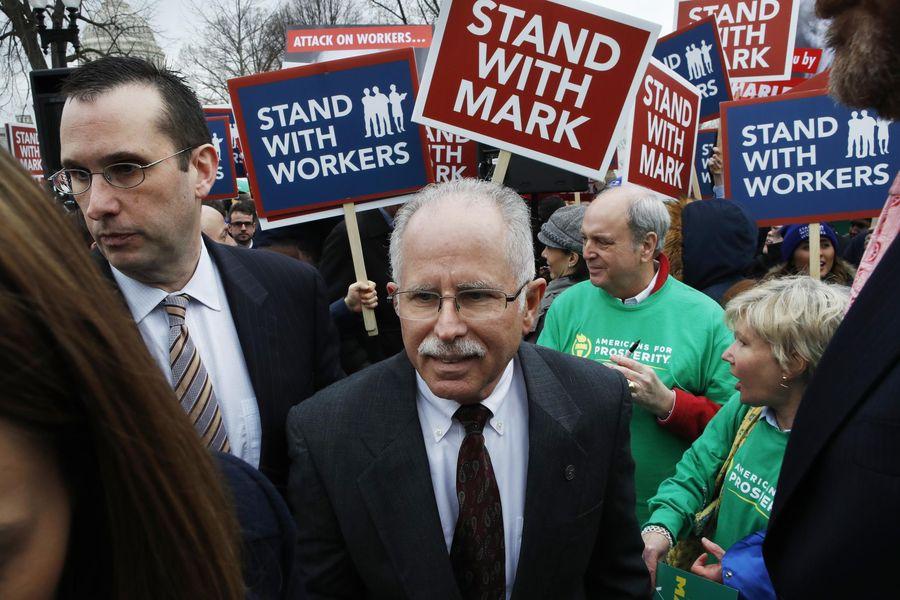
Illinois government employee Mark Janus, center, turns after thanking supporters outside the Supreme Court, Monday, Feb. 26, 2018, in Washington. The Supreme Court takes up a challenge Monday in a case that could deal a painful financial blow to organized labor. The court is considering a challenge to an Illinois law that allows unions representing government employees to collect fees from workers who choose not to join. (AP Photo/Jacquelyn Martin)
Public-Sector Unions Deserve to Be Destroyed
Published March 2, 2018 • Read time: 4m
How does a public-sector union work? Easy.
First, the state creates a monopoly. The monopoly forces taxpayers to fund those workers, whether they do a good job or not. The union then coerces workers to pay dues regardless of whether or not they want to. Then the union uses those dues to help fund political advocacy that perpetuates their monopoly and the union's influence. So, in other words: racketeering.
Among many significant problems with this arrangement, the most obvious is that it's an assault on freedom of association. If there is another organization in American life that has a license to compel workers to participate in their nongovernmental organization simply to secure a job, I haven't heard of it.
The Supreme Court recently heard oral arguments in Janus v. AFSCME, a case in which a man named Mark Janus, a non-union child-support specialist in Illinois, argued that his First Amendment rights were violated because he is forced to pay "agency fees" to a public-sector union. It was dismaying, though not unexpected, that during oral arguments, justices like Ruth Bader Ginsburg, Elena Kagan and Sonia Sotomayor concerned themselves with the impact the decision would have on union membership rather than concerning themselves with impact this kind of policy has on the Constitution.
The vast majority of media coverage on the topic similarly relied on euphemism-heavy stories that did everything possible to avoid words like "compelling," "forcing" or "coercing." Most outlets framed the entire case as a concerted partisan attack on unions and, by extension, the Democratic Party. As a matter of legality, the intentions of those involved shouldn't matter much. But the reason disparate groups attack public-sector unions is that the institution's survival often rests on coercing Americans and undermining the First Amendment. If stripping a political advocacy group of the power to force workers to join their efforts is a crippling event, then it's an event worth celebrating.
He's Mean, But Is He at Least Bright?
Supreme Hypocrisy
It's Time to End ALL Lame-Duck Sessions
The Court Fight Is About Democracy
As it is, workers in union-heavy industries are typically under incredible pressure to join -- in my experience, there are few bullies bigger than the union boss in everyday American life. Yet general union membership continues to crater. Those who resist these efforts are often accused of being "free riders," because they purportedly benefit from collective bargaining but refuse to pay in. This is an exceptionally peculiar argument coming from organizations for which the central mission, as far as I can tell, is to ensure that the least effective workers are protected at the expense of the most effective workers.
More than that, though, the entire case against Janus not only rests on coercion, but on a debatable, if not dubious, notion. John Doe must join a union, because he already benefits from collective bargaining negotiations, union advocates argue. Does he? Even if we concede that collective bargaining negotiations might raise the average salary of teachers, it may very well depress his salary. It is just as easy to argue that collective bargaining hurts the good teacher. Public-sector unions are not only arguing that workers must join a collective and subvert their individual rights, but that they must accept an ideological contention.
In many states, public-sector unions don't have collective bargaining rights. Yet, as I write this, every school in all 55 counties of one of those states -- West Virginia, where the average teachers' salary is a bit higher than the average worker's -- are now closed due to an illegal teacher's strike. Most of those average workers in West Virginia have no choice when it comes to their children's educations.
Yet nearly every story about this situation focuses on the plight of poor teachers rather than powerless parents. On one hand, we hear that teachers unions are vital to the economy because teachers would make far less in the private sector. In the next breath, we hear them argue that teachers are substantially underpaid compared to what others earn in the private sector. So there's a simple way to find out how much public-sector employees are worth individually, and that's breaking the union's monopoly.
If Americans want to join organizations that undercut initiative and achievement to slide employees into safe, pre-determined slots regardless of ability or work ethic, that's their business. If they want to break the law and blackmail entire communities who have no choice but to walk away, they should be fired. If they want to force co-workers to pay for their political activities, they should be stopped. And if they claim that most teachers want to willingly participate in union efforts, the only way to find out is by giving those public employees a choice.
COPYRIGHT 2018 CREATORS.COM

A RealClear Thanksgiving: Investing in a Better Future
David DesRosiers • RealClearPolitics
Trump’s Newsom Problem: Antagonist-in-Chief
Carolina Lumetta • RealClearPolitics
America’s Free Spirit
John Maxwell Hamilton • RealClearPolitics
The GOP Majority Should Go Out in Glory
Daniel McCarthy • RealClearPolitics
Republican Majorities Could Return Sooner Than Expected
J.T. Young • RealClearPolitics
The Danger Before the Attack
Leslie J. Sullivan • RealClearPolitics
RCP Today
Top stories on RealClearPolitics
The Takeaway
Polling intelligence and analysis delivered to your inbox
World News
Featuring the latest world news
Policy
Featuring the latest policy news
Support Our Mission
As part of RealClearPolitics, authors aim to provide balanced, non-partisan analysis by presenting top reporting and commentary from all sides of the political spectrum.
Trusted by policymakers and citizens alike since 2000