
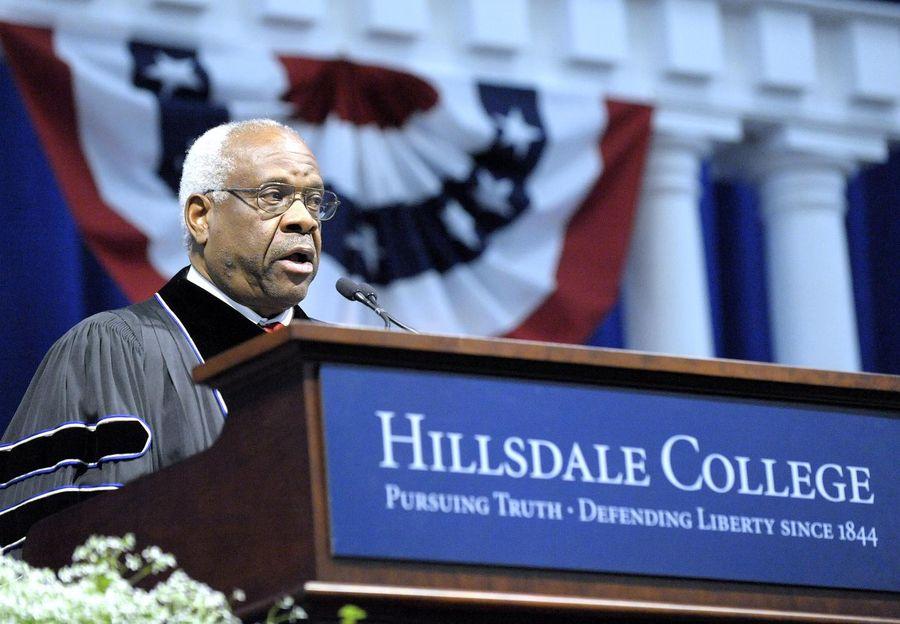
In a Saturday, May 14, 2016 photo, U.S. Supreme Court Associate Justice Clarence Thomas delivers the commencement address to the 2016 Hillsdale College graduating class in the Margot V. Biermann Athletic Center, in Hillsdale, Mich. (Todd McInturf, The Detroit News via AP) (Todd McInturf, The Detroit News via AP)
A Litmus Test for Conservative Court Appointees
Published Oct. 18, 2016 • Read time: 5m
According to news reports, presidential debate moderator Chris Wallace intends to ask Hillary Clinton and Donald Trump about who they would select as a justice for the U.S. Supreme Court. With Justice Scalia’s seat still vacant, one of the first priorities of the next President will be to fill that seat. And as many have observed, with the Court’s even balance and aging members, this election will have long term consequences for the direction of the Supreme Court’s jurisprudence.
It is noteworthy that this discussion will occur during the week of the 25th anniversary of when Justice Clarence Thomas first took the bench. Since Justice Scalia’s passing, Thomas is without question the leading conservative (or originalist, as some say) on the Court. If Trump is able to find a path to victory, he should select a justice who has a similar approach to jurisprudence; but perhaps even more importantly, he should choose someone who has the backbone and character to stay true to his or her principles. This last trait is something that has failed so many Justices appointed by Republican presidents.
In the last 30 years, there are very few liberal justices who have disappointed their political constituency. They vote liberal and as a bloc, almost without exception. In recent times, think Ginsburg, Sotomayor, Kagan, or Breyer. They don’t move to the right -- ever. Republicans appointees often do, from Justices Brennan, Blackmun, and Stevens to Souter, Kennedy, O’Connor and Chief Justice Roberts. Why they do was captured perfectly by Judge Larry Silberman in 1992 when he described what is called the “Greenhouse effect,” named for the influence that then-New York Times Supreme Court reporter Linda Greenhouse had on justices, and in particular conservative justices. According to this theory, in an effort to gain more respect in those pages and amongst the chattering classes, justices inevitably “evolve” and move to the left. This chart shows that all of the current Justices have moved left from where they began. Except one -- Justice Clarence Thomas.
The most unappreciated ingredient in selecting a Supreme Court Justice is fortitude: that is, someone who has already demonstrated character and resolve in the face of criticism. Someone who has the courage of his or her convictions. That is one of the aspects of Thomas’ record that so impressed then-White House Counsel Boyden Gray and President Bush. People forget that even before Thomas was nominated for the Supreme Court, he had been subjected to vicious attacks by liberal interest groups and a Democratic Congress for years. As Chairman of the Equal Employment Opportunity Commission, he was repeatedly hauled before Congress for oversight hearings -- all to make him cry uncle. Thomas never gave them that satisfaction.
His background may provide the clues to the source of his fortitude. Thomas was born into poverty in the segregated Deep South of Pin Point, Georgia, a small coastal marshland community. His father abandoned the family when Thomas was very young and because his mother was struggling to raise three kids on her own, Thomas and his younger brother were sent to live with his grandparents. His grandfather, Myers Anderson, instilled in Thomas the virtues of perseverance and accountability. The Irish nuns who taught him at the segregated Catholic school taught him to believe in himself and that he was the equal of anyone else in God’s eyes. Thomas has faced more obstacles and discrimination than most people, black or white, as he grew up. He was often an outsider who had to find his inner core of beliefs.
This background helps explain the fortitude Clarence Thomas has shown throughout his professional life. Thomas’ opposition to racial preferences in particular has exposed him to unrelenting attacks. The civil rights leadership, along with their allies in the press, has determined that a black man like Thomas is not allowed to have those opinions. Despite the unprecedented attacks after he was nominated, culminating in the 11thhour allegations by Anita Hill, and the constant (and in many cases racist) attacks even after he was confirmed to the bench, Thomas has developed a jurisprudence that is distinct from any other justice. In fact, Thomas built the foundation of his jurisprudence in the 1980s, when he began to grapple with making sense of our founding principles, and the Declaration of Independence in particular. Liberal and conservative scholars have praised the thoughtfulness of his jurisprudence, even though he is often writing solo concurrences or dissents.
One of the most important but overlooked components in appointing conservative justices, should be whether that justice will have the fortitude to remain faithful to those principles 10 years, 20 years or 30 years after he or she takes the bench. As conservatives have witnessed to our great dismay, this component has been lacking in most of the Republican appointees. If Trump does pull off a miraculous win, he should focus on demonstrated fortitude when selecting his choices for the Supreme Court.
Mark Paoletta practices law in Washington, D.C. As a member of the Bush 41 White House Counsel’s office, he worked on Justice Thomas's confirmation. He is also the creator of the website JusticeThomas.com, which provides information about Thomas's career and legacy.
He's Mean, But Is He at Least Bright?
Supreme Hypocrisy
It's Time to End ALL Lame-Duck Sessions
The Court Fight Is About Democracy

Jon Finer’s Old and Dangerous ‘New Approach’ to Israel
Peter Berkowitz • RealClearPolitics
The President Deserves Better
John Ullyot • RealClearPolitics
Congress Doesn’t Need Another Blame Game. It Needs To Find What’s Broken
Jarrod Bernstein • RealClearPolitics
Democrats Won the Midterms. Common Sense Won, Too
Jordanne Kemper • RealClearPolitics
The 120th Congress Shapes Up
Carolina Lumetta • RealClearPolitics
Flooding GOP Primaries With Democrats
Robert Natelson • RealClearPolitics
RCP Today
Top stories on RealClearPolitics
The Takeaway
Polling intelligence and analysis delivered to your inbox
World News
Featuring the latest world news
Policy
Featuring the latest policy news
Support Our Mission
As part of RealClearPolitics, authors aim to provide balanced, non-partisan analysis by presenting top reporting and commentary from all sides of the political spectrum.
Trusted by policymakers and citizens alike since 2000