
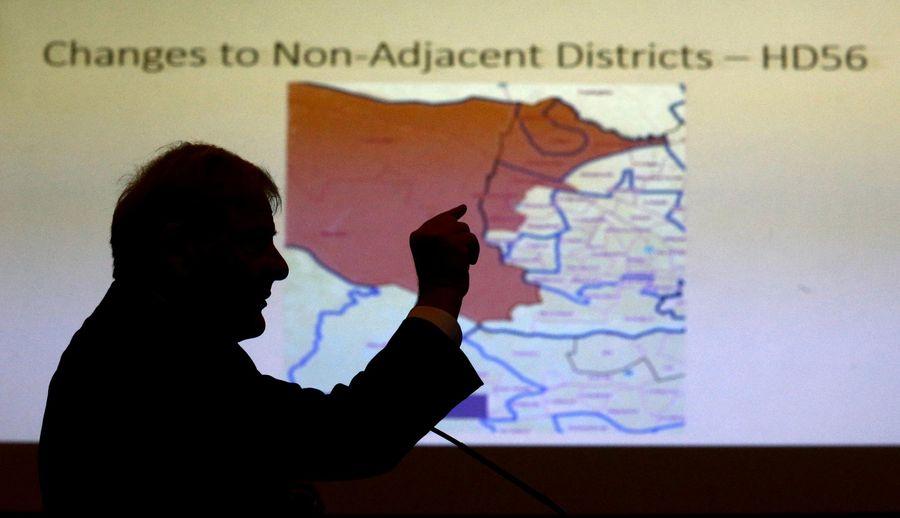
House Minority Leader David J. Toscano, D-Charlottesville, talks about the projected image of one of the redrawn district lines that the House Democrats presented to the House Privileges and Elections committee during a special session called by Gov. Ralph Northam to deal with redistricting at the State Capitol in Richmond, Va., Thursday, August 30, 2018. (Bob Brown/Richmond Times-Dispatch via AP)
With Redistricting in Mind, Dems' Midterm Focus Is on States
Published Oct. 29, 2018 • Read time: 4m
This year’s midterm races are nearing the finish line and politicos are already looking to 2020, but not all of the future focus is on the next presidential contest. The coming decade will signal another round of the U.S. Census and a chance for states to redraw the lines of congressional districts. Although some liberals have worried aloud that Democrats’ failure to give adequate attention to state races has left them at the mercy of Republican gerrymandering, this cycle’s renewed focus on the local level could begin to turn the tide.
“The Democrats have finally figured out that legislative and governors’ races are more valuable than senators,” said Keith Gaddie, political science professor at the University of Oklahoma. “The best place to put money is in state races.”
The national Democratic Party has been accused of being obsessed with capturing and keeping the White House at the expense of attention on legislative contests and statehouse races. During the Obama years, Democrats lost over 900 legislative seats — the most significant number under any president since World War II.
The timing of many of those losses coincided with the 2010 census, giving Republicans significant control over how the new congressional districts were drawn. Accusations of gerrymandering have led to several legal cases. The Pennsylvania Supreme Court recently agreed the districts in the Keystone State were unfairly partisan and redrew the configurations. Republicans had a 13-5 advantage previously, but with the new map they have almost no advantage.
Kids' Lives Matter Too
In a Corner of Ohio, Lessons of 2016
2016 Presidential Election Could Decide State Legislative Races
McCaskill Says No to Run for Missouri Governor
Democrats insist – and in some cases the courts have agreed – that they aren’t trying to replicate the GOP district lines in reverse, but rather want to fairly represent the politics of a state like Pennsylvania, which is considered a purple battleground in presidential years yet deep red on the House level.
“At the NDRC, we are committed to having fair maps [and] we are supporting an independent commission in these states,” said Patrick Rodenbush, spokesman for the National Democratic Redistricting Committee — a group chaired by former Attorney General Eric Holder. “We want a fair process. … Democrats and progressives will do just fine.”
His group released a video this year featuring President Obama discussing the importance of fairly drawn districts as essential to maintaining democracy. Gerrymandering “means that politicians don't have to worry as much about a serious challenge from the other side,” said Obama in the video. “That moves our debate from the rational, reasonable middle where most Americans are to the extremes.”
Even if Democrats motives aren’t that pristine, it would take several cycles to achieve that level of control or even make enough gains to try and get to the Republicans’ current levels. Their immediate hope is that they can provide some sort of buffer. For example, if Democrats win the gubernatorial race in Wisconsin, but the legislature remains Republican, the governor can veto any maps he finds unfair.
“Democrats have blocking position and that’s the most realistic outcome in many of these states,” said Michael Li of the Brennan Center at the New York University School of Law. “When you’re talking about extreme gerrymandering — where maps are schemed in favor of one party — [that] only occurs when one party controls all power.”
Looking past the partisan implications, neutral observers believe that uncompetitive congressional districts have contributed to political polarization, incivility in the public square, and gridlock in Washington. In the vast majority of the nation’s 435 districts, Republican members of Congress don’t even need to speak to Democrats back home – and vice versa. Squeezing moderates out also makes political compromise more difficult, along with respectful inter-party discourse.
“It’s helped make the politics a lot nastier,” said Li.
A tougher problem to tackle is how Americans have been segregating themselves geographically for generations in order to live and work near people who tend to share the same political outlook.
“Because of demographic self-sorting it’s more difficult to draw competitive districts,” said Elaine Kamarck, a fellow at the Brookings Institution. “Rural areas are different from urban areas in some pretty fundamental ways and you can’t always draw a competitive district.”
But Li and other reform-minded experts say that irrespective of self-sorting, the established political duopoly should not be taken off the hook for its history of gerrymandering. “The fact that it’s occurring in battleground states, where it’s the last place you think it would occur, really sort of … discounts a lot of that,” said Li.
So as all eyes focus on the approaching midterms, some groups are already contemplating the next round of elections and hoping that — perhaps based on this year’s results — they will have a chance to redraw the congressional maps. Democrats will most assuredly face a fight from Republicans, however, as they try to regain control and return to fight in states at the local level.

Jon Finer’s Old and Dangerous ‘New Approach’ to Israel
Peter Berkowitz • RealClearPolitics
The President Deserves Better
John Ullyot • RealClearPolitics
Congress Doesn’t Need Another Blame Game. It Needs To Find What’s Broken
Jarrod Bernstein • RealClearPolitics
Democrats Won the Midterms. Common Sense Won, Too
Jordanne Kemper • RealClearPolitics
The 120th Congress Shapes Up
Carolina Lumetta • RealClearPolitics
Flooding GOP Primaries With Democrats
Robert Natelson • RealClearPolitics
RCP Today
Top stories on RealClearPolitics
The Takeaway
Polling intelligence and analysis delivered to your inbox
World News
Featuring the latest world news
Policy
Featuring the latest policy news
Support Our Mission
As part of RealClearPolitics, authors aim to provide balanced, non-partisan analysis by presenting top reporting and commentary from all sides of the political spectrum.
Trusted by policymakers and citizens alike since 2000