
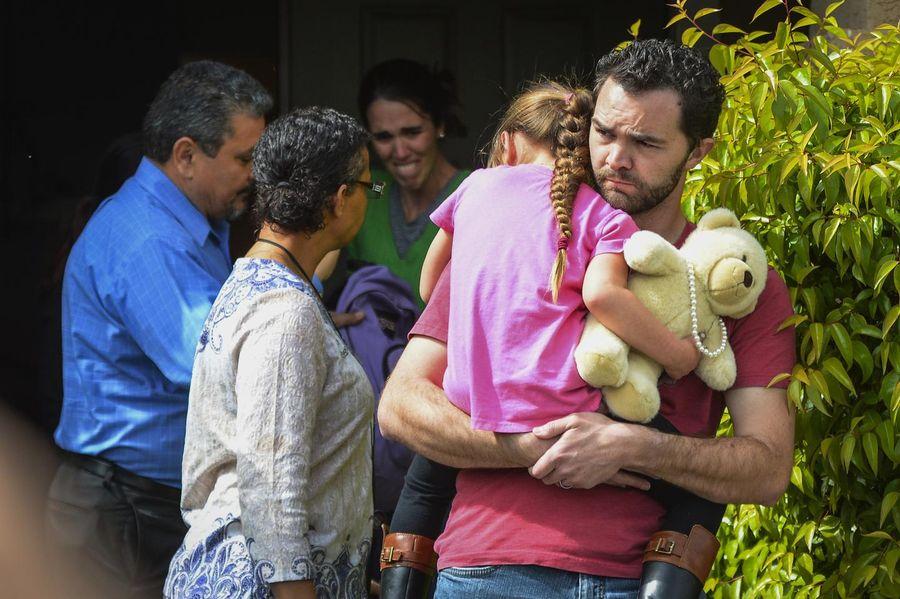
Rusty Page carries Lexi while Summer Page, in the background, cries as members of family services, left, arrive to take Lexi away from her foster family in Santa Clarita, Calif., Monday, March 21, 2016. Lexi, who spent most of her life with California foster parents, was removed from her home on Monday under a court order that concluded her native American blood requires her placement with relatives in Utah. (David Crane/Los Angeles Daily News via AP) MANDATORY CREDIT
Kids' Lives Matter Too
Published March 22, 2016 • Read time: 5m
Join the Conversation
0Six-year-old Lexi’s face was buried in the shoulder of the only dad she has ever known as she was carried down the driveway to a car that would take her to a new home in a state 700 miles away. All we could see was her pink shirt, her braided ponytail, and the teddy bear clutched in her right hand. As Lexi was placed into the back of the waiting black sedan, her distraught mother and siblings rushed from the house screaming, crying, and yelling to her that they loved her.
The footage is hard to watch, but the cameras were there because the Los Angeles County custody case illustrated to so many people the arbitrary and destructive hand of government. This girl was caught up in a toxic stew: a well-meaning, but sometimes abused, federal statute, and local officials who put identity politics ahead of a kid’s welfare.
Lexi, who has lived with foster parents Rusty and Summer Page since she was 17 months old, is being punished by the Indian Child Welfare Act of 1978, a federal law originally designed to keep Native American kids with Native American families. Except that Lexi is only 1.5 percent Choctaw Indian—and the family she’s being sent to live with in Utah isn’t Native American at all.
According to court documents in the case, Lexi’s birth mother struggled with substance abuse and has given up custody of several other children, and her father has a criminal history and no interest in parenting the little girl. But the Utah family that wanted her had a card to play: The girl’s father is 1/32nd Choctaw. He’s never lived on a Choctaw reservation and has no real relationship with the tribe, according to filings in the custody case. But his daughter is 1/64th Choctaw—and that makes her a pawn.
The court filing also states that Lexi is not a blood relation to the Utah couple; they are related only by marriage to the girl’s biological father, through a step-grandfather. Despite all that, a California court recently ordered the Los Angeles County Department of Children and Family Services to place Lexi with the Utah family “in accordance with the federal Indian Child Welfare Act.”
What was the court’s reasoning? Although shrouded in secrecy, local news reports indicate that the department recommended that Lexi be placed in Utah with the non-Indian couple, which it described as her “extended family.” The court acquiesced, ruling that Page family “had not proven by clear and convincing evidence that it was a certainty the child would suffer emotional harm by the transfer.”
That logic seems twisted. In order to keep her, the people who have loved the girl and raised her must prove that the new family would harm her. Even worse is the Orwellian stance by the National Indian Child Welfare Association that ripping Lexi from a loving home—the only safe haven she’s had in her short life—to be “reunified” with people she’s never lived with is in the child’s best interests.
“The foster family was well aware years ago this girl is an Indian child, whose case is subject to the requirements of the Indian Child Welfare Act and who has relatives who were willing to raise her if reunification with her father was unsuccessful,” the organization said in a statement.
The Choctaw Nation issued a similar statement, blaming the foster family for the whole mess. “The Pages were always aware that the goal was to place Lexi with her family, and her permanent placement has been delayed due to the Pages' opposition to the Indian Child Welfare Act,” it said. “We believe that following the Choctaw Nation's values is in Lexi's best interest.”
It’s hard to imagine adults saying such things with a straight face. How is this child, who is 1/64th Choctaw, “an Indian child”? And what are Choctaw “values”?
The answer to the second question is that the Choctaw people have a tradition in this country that they are proud of—and rightly so—both before and after whites dispossessed them of much of their land.
They farmed and formed societies that were admired by George Washington since before America was a nation, fought alongside Andrew Jackson against the British, were forced from their homes in 1830 for their trouble, and tried mightily for two centuries to retain their cultural identity. Which brings us back to the question about defining who is Indian and who is not.
Language addressing that matter is contained in the 1978 federal law. Make no mistake: The statute was seen as a necessary reform to protect Indian culture. Congressional committees had shown that a large percentage of Indian children—up to one-third in some places—were being placed outside the tribe for adoption or foster care. Tribal leaders looked to Washington because state and local adoption authorities were unresponsive.
So how has the pendulum swung so far in the opposite direction? Partly, it’s because of the pitfall of having government decide children’s fate based on their ethnicity—and then having to define ethnicity itself.
In addition, identity politics has become such a driving force in American society that what should be unthinkable—tearing a little girl’s childhood apart in the service of a political point about heritage—is accepted by government officials at all levels.
There has been much discussion during this presidential campaign about whose lives matter. Black lives. White lives. Blue lives. This case reminds us that kids’ lives matter, too – Lexi’s in particular. We should listen to them.
“This is dumb,” she told her foster dad on Monday. “Don't let them take me.''




RCP Today
Top stories on RealClearPolitics
The Takeaway
Polling intelligence and analysis delivered to your inbox
World News
Featuring the latest world news
Policy
Featuring the latest policy news
Support Our Mission
As part of RealClearPolitics, authors aim to provide balanced, non-partisan analysis by presenting top reporting and commentary from all sides of the political spectrum.
Trusted by policymakers and citizens alike since 2000