
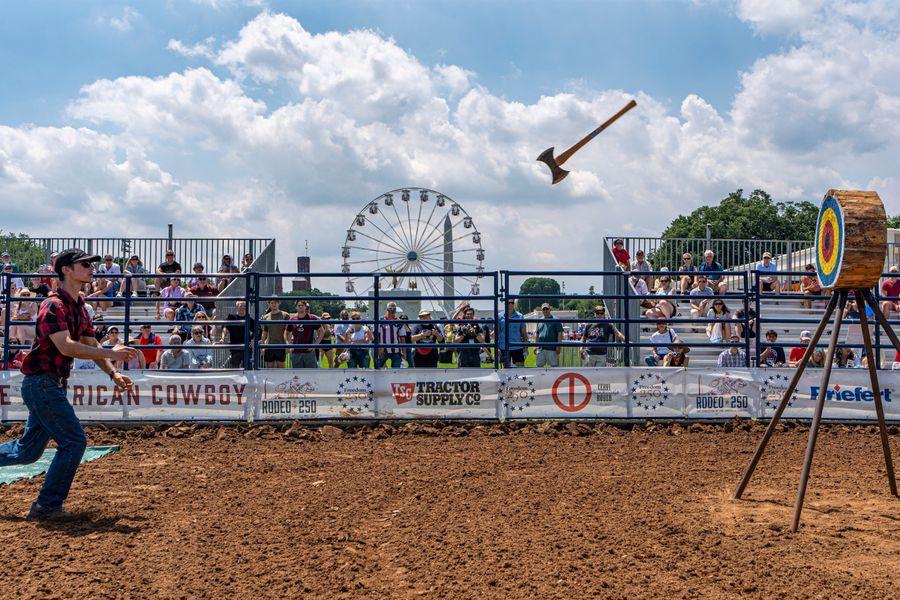
America 250
The Not-So-United States Fair
Published June 30, 2026 • Read time: 7m
Notwithstanding its partisan provenance, the President Trump-created “Freedom 250” organization framed the Great American State Fair as a celebration that would transcend politics. Every state and U.S. territory was to have its own exhibition, intended to unite the full breadth of America.
Walking the fairgrounds tells a different story: One where partisan lines shaped who showed up, how participation was coordinated, and with whose blessing. At an expo to celebrate all of America, the most telling exhibits were the empty ones. Twelve states declined to send delegations, their assigned booths marked by empty chairs and exhibit walls devoid of state history.
The fairgrounds sprawl across the National Mall. A towering Ferris wheel and Arc-de-Triumph-style arch sit at the center of the festivities. A 24-hour prayer tent featuring a baptism pool, a spotlit stage, and an Israeli flag is stationed to the side. White neoclassical structures line both sides of the Mall’s grass field, each marked with a banner bearing an abbreviation for the state or territory it represents.
Even for states that filled their exhibition spaces, the path to the fairgrounds was not simple. Coordinating the exhibits took months of work and leaps through political hoops.
When Kansas Democratic Gov. Laura Kelly declined Freedom 250’s offer to organize an exhibit, Republican Sen. Roger Marshall stepped in. His staff coordinated with Freedom 250, local commodity groups, and family-run Kansas farms to fill the exhibit with information centered around local agribusiness – which Kansans affectionately call the barnyard – over the course of the past month.
Kids' Lives Matter Too
In a Corner of Ohio, Lessons of 2016
2016 Presidential Election Could Decide State Legislative Races
McCaskill Says No to Run for Missouri Governor
“Somebody from the White House said, ‘Gosh, Kansas isn’t going to have any type of appearance here at the state fair. Can you help us out?’” Marshall recalled to RealClearPolitics, adding that everything in the exhibit was donated by the private sector.
“Freedom 250 built out the booths and is providing the AC and electric,” a Freedom 250 spokesperson told RCP. “We tried to work with every state to accommodate whatever they wanted to send to the fair and make sure they’re represented.”
Each state that didn’t send a delegation was guaranteed that their booth would still be represented, a Freedom 250 spokesperson said. For Maine and Connecticut, that meant two empty chairs in their respective exhibits. But for New Jersey, that meant a single county standing in for an entire state.
When New Jersey’s Democratic Gov. Mikie Sherrill refused to participate, Freedom 250 extended a second invite – this time to Cape May County. A consistently Republican county within the largely Democratic state, Cape May County stepped in to represent Jersey. The result is floor-to-ceiling TV displays centered around a towering beachy Cape May-themed structure.
Massachusetts Gov. Maura Healey, also a Democrat, said she would not send a delegation to the fair. So Donna Festinger, a Massachusetts retiree, decided to sidestep Healey and reach out to Freedom 250 directly. After her request to represent Massachusetts was promptly approved, Festinger loaded her car with mini bottles of maple syrup, travel booklets, and pamphlets to drive to Washington all within the past week.
She pulled the exhibit together hastily: One friend went to the Chamber of Commerce for brochures while Festinger coordinated with Winston’s Sugar House in Shelburne Falls. The company spent two nights bottling mini maple syrups and delivered them to Festinger at 6:30 a.m. in time for her to make the ten-hour drive. When RCP asked whether she was there as a Trump supporter or out of love for Massachusetts, she responded: “Both.”
Festinger’s quick turnaround and low-budget exhibit contrasts sharply with Utah’s striking set-up. The state allocated $1 million for participation in the fair while the state legislature was in session, and it shows. The exhibit is among the most robust. The booth is spacious and air conditioned, its interactive elements designed in part by a creative firm, built out in partnership with Utah’s governor’s office and state tourism department.
Loggins Merrill, director of UServeUtah, the state’s commission on service and volunteerism, told RCP the investment reflects a deliberate choice.
“This is the 250th anniversary of our nation,” he said. “And so we really wanted to celebrate that in a big way.”
It’s very much on-brand, as Utah Spencer Cox champions what he calls “disagree better” policies. Merrill says the exhibit is designed to carry that spirit to the fair. “What we have seen through the planning and development has been a lot more focused on the patriotic feeling of how we can be one, how we can be united as Americans,” he said.
Ohio Republican Gov. Mike DeWine attended the first day of the fair alongside his wife Fran. Ohio’s booth aims to give visitors a sense of the state’s diversity and investment in children’s literacy. When asked whether he had been in contact with states that didn’t show up, DeWine told RCP: “People made their own decisions.”
All states RCP spoke with said they organized their booths with no interstate communication.
Oklahoma is one of the few booths with an entirely volunteer-run exhibit. Tara Simmons, a commissioner from Oklahoma250, told RCP that local businesses and donors rallied quickly once the state legislature granted a one-time appropriation to put together an exhibit.
“We wanted everybody to be able to walk in and see themselves in Oklahoma,” Simmons said. The total cost came in around $50,000.
Budget figures ranged widely. Mississippi’s representatives estimated their booth cost between $100,000 and $200,000. South Dakota came in around $25,000 – among the smaller budgets of states that partnered directly with their governors’ offices. Arizona used no taxpayer dollars, funding its exhibit through a grant.
Most no-show states cited financial concerns or scheduling conflicts for their inability to attend the Great American State Fair. But some conceded that political considerations were front and center. Oregon spokesperson Luke Harkins told CNN that “the event in Washington, D.C., is shaping up to be a more partisan affair than originally presented.”
Alaska, Connecticut, Hawaii, Maine, Oregon, Pennsylvania, Rhode Island, Vermont, Washington, American Samoa, the Northern Mariana Islands, and the U.S. Virgin Islands elected not to organize exhibits for the fair. When attendees were asked about the 12 absences, reactions were mixed.
“I’m very frustrated,” Virginia Beach native Kent Robacker told RCP after entering the empty exhibits reserved for Alaska and Hawaii. “This is a 250th anniversary. This should be the highlight of our nation’s celebration of our independence and our state. And we should have representatives from everyone that the state recognizes. It’s an atrocity whenever the governments of those states don’t represent themselves."
A self-identified far-left Pennsylvanian attendee who declined to give her name saw her commonwealth’s empty booth and smiled.
“My immediate reaction was good on you, Josh Shapiro,” she told RCP. “I don’t think there are a lot of left-leaning people at the fair. It doesn’t seem like it anyway.”
Robacker, who identified himself as right-leaning, was direct about what he thought the empty exhibits implied.
“I do believe it is a political move,” he said, “but it’s not a patriotic move – which is really one of those things we should be thinking about [as] above politics.”
The crowds this week have been small – yet another indication of the partisan times in which we live.
Speakers on opening night, for their part, did not pretend to be above politics.
“We have to give a big round of applause for our military band and singers – way better than those libtards that canceled on us,” Transportation Secretary Sean Duffy said to much applause during the kickoff rally.
President Trump styled his remarks as a typical campaign stump speech, denigrating political opponents and lauding his administration’s accomplishments.
“We are removing murderers, gang members, drug dealers, and dangerous criminals by the thousands – they came in through a ridiculous open border,” he told a cheering audience.
“Just like those patriots of 1776, over the past 17 months, we have taken power back from the far-off political class. They’re trying to get it back, but it’s not gonna happen.”
Support Our Mission
The Internet provides an endless stream of content. Not all of it is worth your time. That's why, every day, RealClearPolitics curates the most essential news and information—from all sides and across mediums. The links, videos, and podcasts curated here are the product of human judgment, not algorithms or AI. Please help power our mission of presenting a thoughtful, balanced public discourse through a tax-deductible donation.
Would you consider supporting us today?

The Danger Before the Attack
Leslie J. Sullivan • RealClearPolitics
Jon Finer’s Old and Dangerous ‘New Approach’ to Israel
Peter Berkowitz • RealClearPolitics
The President Deserves Better
John Ullyot • RealClearPolitics
Congress Doesn’t Need Another Blame Game. It Needs To Find What’s Broken
Jarrod Bernstein • RealClearPolitics
Democrats Won the Midterms. Common Sense Won, Too
Jordanne Kemper • RealClearPolitics
The 120th Congress Shapes Up
Carolina Lumetta • RealClearPolitics
RCP Today
Top stories on RealClearPolitics
The Takeaway
Polling intelligence and analysis delivered to your inbox
World News
Featuring the latest world news
Policy
Featuring the latest policy news
Support Our Mission
As part of RealClearPolitics, authors aim to provide balanced, non-partisan analysis by presenting top reporting and commentary from all sides of the political spectrum.
Trusted by policymakers and citizens alike since 2000