
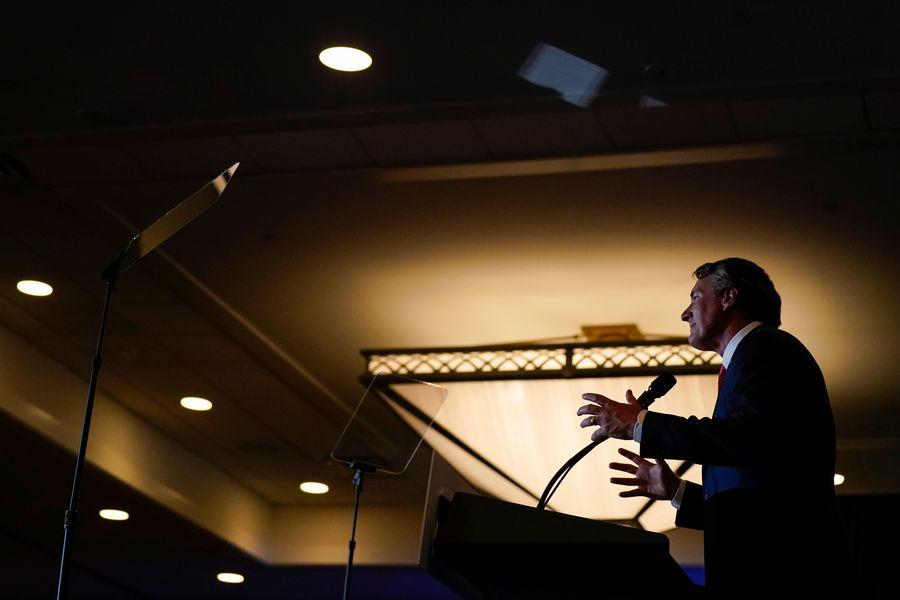
Election 2021 Virginia Governor
The Lessons From Virginia's Election Aren't What You Think
COMMENTARY
Published Nov. 4, 2021 • Read time: 5m
The conventional wisdom from Tuesday’s elections is that the results were a wake-up call for Democrats. Many feel that it was more like a Molotov cocktail had been hurled onto the party’s bedside table. But how much of the losses were the political tectonic plates — which had shifted out of position since the election of Donald Trump — simply resuming a more familiar pre-Trump position, and that Democrats were woefully unprepared to fight on this terrain?
In Virginia, the expectation was that Terry McAuliffe, who left the governor’s mansion four years ago as a pretty popular figure, would easily win back the job by simply reminding people of what he had achieved during his tenure — and by tying Glenn Youngkin to Trump.
The voters had other ideas. And the biggest mistakes Democrats made in this election is that they assumed Virginians were still in the throes of a Trump hangover and viewed Youngkin as a Trumpite in a moderate’s clothing, while fondly remembering McAuliffe’s term in office.
But after Joe Biden won the state by 10 points on promises of normalcy, crushing the coronavirus, getting kids back in schools, an economic boom, and the end of political chaos, voters did not see their expectations come to fruition. Instead, they saw inflation, supply chain bottlenecks, a deadly surge in the delta variant, impassioned clashes about mask mandates at schools, and Democrats at odds with one another on passing popular items on Biden’s agenda.
McAuliffe continued to talk about his record as a former governor and to tie Youngkin to Trump. What he failed to do was to give Virginians a plan to address their pocketbook worries in 2021 and their deep concerns about what is to come. Then came the unfortunate unforced error during a debate with Youngkin where McAuliffe said he did not think parents should be deciding what is taught in schools. Youngkin saw an opening and ran with it, accusing McAuliffe of not wanting parents to be involved in their kids’ education.
Kids' Lives Matter Too
In a Corner of Ohio, Lessons of 2016
2016 Presidential Election Could Decide State Legislative Races
McCaskill Says No to Run for Missouri Governor
Never mind that McAuliffe never actually said what Youngkin accused him of. The die was cast. Coupled with the lack of a bold agenda for tackling Virginians’ frustrations, the strategy of trying to hang Trump around Youngkin’s neck wasn’t enough. And as the campaign progressed and Youngkin came across as a normal and moderate alternative, the Trump clone pitch did not ring true to most voters.
Youngkin, by contrast, was also brilliant at playing both sides of his own party in order to achieve what Trump could not pull off in Virginia: energizing his MAGA base without alienating more moderate suburbanites.
But what McAuliffe was trying to point out should still be a huge concern for Virginians. Youngkin signaled to Trump’s voters that he was one of them by talking about election integrity just often enough (if only during the primary). He also kept them in the fold by announcing at every rally he would ban critical race theory when that concept is not taught directly in any of Virginia’s K-12 public schools. He even closed out with a whopper of an ad about banning Toni Morrison’s “Beloved.” It was indeed, as McAuliffe and Biden both pointed out, the racial dog whistle that Trump supporters, already animated by culture wars, needed to hear. Youngkin also talked about restricting abortion rights and said in an interview that Trump represented so much of why he was running.
But because Youngkin was not Trump, and kept him at a safe distance without poking the bear too much, suburban independent voters did not see Youngkin as the vicious and dangerous demagogue they grew to hate in the Trump persona. McAuliffe, in turn, did not offer the solutions they wanted to hear.
As a result, voters seemed to punish McAuliffe for his ties to an unpopular President Biden more than they cared about Youngkin’s ties to Trump, which were not so obvious to moderate voters but just visible and credible enough for Trump’s base. It was a successful, yet pernicious, two-step by the Republican nominee.
His blueprint may or may not work for the GOP in 2022 because there are many candidates poised to run as mini-Trumps. But given the Virginia outcome, will they change their strategies? Or will they embrace Trump even more. Democrats need to be prepared for both.
While we cannot say that Youngkin’s win means everything for Democrats in 2021, we can’t say it means nothing. Whether a wake-up call or Molotov cocktail, what happened Tuesday surely has Democrats’ eyes wide open.
Democratic candidates in 2022 need to learn from the losses, read the room, offer local solutions, push back vociferously on GOP lies and straw men, speak credibly to their own base voters as well as independents and, most of all, ensure legislative victories they can tout as successes to all voters. Otherwise, by any historical analysis next year will be an uphill battle to keep even the slim majorities Democrats have in the House and Senate.

Democrats Won the Midterms. Common Sense Won, Too
Jordanne Kemper • RealClearPolitics
The 120th Congress Shapes Up
Carolina Lumetta • RealClearPolitics
Flooding GOP Primaries With Democrats
Robert Natelson • RealClearPolitics
Washington Keeps Rewarding Oracle—Veterans Keep Paying the Price
Darin Gaub • RealClearPolitics
The Seeds of Unrestricted Warfare
John Teichert • RealClearPolitics
The Primary System Is Losing the Next Generation
Sean Trende • RealClearPolitics
RCP Today
Top stories on RealClearPolitics
The Takeaway
Polling intelligence and analysis delivered to your inbox
World News
Featuring the latest world news
Policy
Featuring the latest policy news
Support Our Mission
As part of RealClearPolitics, authors aim to provide balanced, non-partisan analysis by presenting top reporting and commentary from all sides of the political spectrum.
Trusted by policymakers and citizens alike since 2000