
In Massachusetts, a Race for Governor, Redemption
Published Oct. 27, 2014 • Read time: 4m
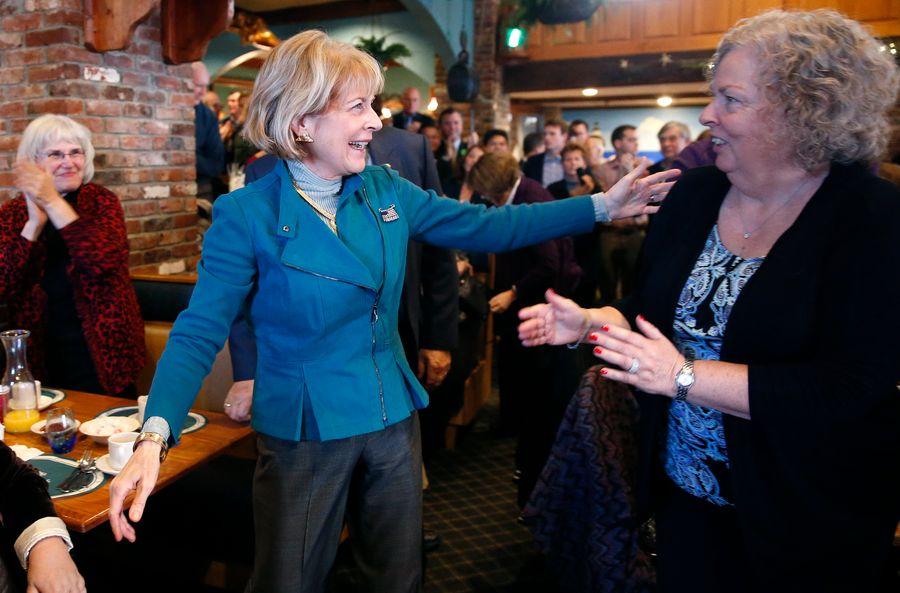
BOSTON (AP) -- For Democrat Martha Coakley, the governor's race in Massachusetts is more than just a contest for the state's top political office. It's also a quest for political redemption.
Four years ago, Coakley, the state's attorney general, crushed her party's hopes and imperiled President Barack Obama's health care overhaul when a little-known Republican state lawmaker, Scott Brown, claimed the U.S. Senate seat left vacant by the death of Edward Kennedy.
That special election has been the source of endless political analysis ever since. Prognosticators attribute the outcome to everything from Obama's unpopularity to Coakley's reluctance to shake hands with voters outside beloved Fenway Park. After the loss, Coakley was even mocked in a "Saturday Night Live" skit.
Now, the 61-year-old Coakley finds herself in another tough contest.
For weeks, polls pointed to a toss-up between Coakley and Republican Charlie Baker in the race to succeed Democratic Gov. Deval Patrick. A new poll by The Boston Globe suggests Baker has the edge.
The Globe poll shows Baker with the support of 45 percent of those polled compared with 36 percent for Coakley, a 9-point advantage in a survey with a margin of error of 4 percentage points. The telephone survey of 500 likely voters was conducted Oct. 19-22.
In another blow to Coakley, the Globe on Sunday endorsed Baker, saying "the Republican nominee would provide the best counterpoint to the instincts of an overwhelmingly Democratic Legislature."
Coakley said she has tried to revamp her public image, including showing a more personal side by talking publicly about the suicide of her brother, Edward, who died in 1996 at age 33 after battling depression.
Kids' Lives Matter Too
In a Corner of Ohio, Lessons of 2016
2016 Presidential Election Could Decide State Legislative Races
McCaskill Says No to Run for Missouri Governor
"I think that people still think from 2010 that I don't have a sense of humor or I'm too chilly," Coakley said at a recent debate. "I've worked for four years to overcome that."
She also has tried to learn from her 2010 loss, promising at a state Democratic convention in June that no other candidate would "travel more miles, knock on more doors, shake more hands or make more phone calls."
Baker, 57, a former CEO of Harvard Pilgrim Health Care and top official under Republican Govs. William Weld and Paul Cellucci, is also seeking redemption.
Baker lost a tough race four years ago, failing to unseat Patrick at a time when the governor appeared vulnerable. By his own admission, Baker came off a little too angry. He has pledged to show a sunnier side as he reaches out to the independent and Democratic voters he will need to win.
"For me it's always been about people," Baker, 57, said at the same debate. "It bothers me that a guy who is pretty facile with math, which does matter when you're talking about a $38 billion budget, is somehow considered to be somebody who doesn't care about people."
For Coakley, the expectations of victory are particularly heavy in a state where Democrats hold every statewide office, every congressional seat and overwhelming majorities in both legislative chambers.
By those measures, Coakley, who has run two successful statewide races and is one of the state's best known political figures, should be a clear favorite.
But Coakley is also facing political and historical headwinds.
Despite a liberal reputation, Massachusetts has been slow to elect women to top offices. Coakley was the first woman elected attorney general and would be the first elected governor.
State attorneys general have had a tough time making the leap to governor in Massachusetts. Coakley has had to defend decisions she made as the state's top law enforcement official, including a decision to fight, rather than settle, a lawsuit by a New York-based children's rights group against the Department of Children and Families.
On campaign issues, Coakley promotes her support of pre-kindergarten education, regional economic development, and support for mental health services. Baker pledges to hold down taxes, support job growth and make government more efficient.
Baker has a fundraising edge. As of mid-October, he had $1.2 million in his account, compared with Coakley's $300,000.
A super political action committee funded almost entirely by the Republican Governors Association has pumped more than $8 million into the race to support Baker. That's more than twice the super PAC spending supporting Coakley, much of it from unions and the Democratic Governors Association.
Still, Coakley has significant advantages, including a strong Democratic get-out-the-vote operation. Among those who have campaigned for her are Michelle Obama and Bill and Hillary Rodham Clinton.
That's not enough to calm die-hard Democrats.
They remember the closing days of the 2010 Senate race when even a visit by the president couldn't salvage Coakley's campaign.
"We need to be more involved in elections," said Chuck Nardo, a 49-year-old carpenter from Quincy, who sees Coakley as a champion of the middle class and small business. "Because now we know anybody can sneak in."
Copyright 2014 The Associated Press. All rights reserved.

Jon Finer’s Old and Dangerous ‘New Approach’ to Israel
Peter Berkowitz • RealClearPolitics
The President Deserves Better
John Ullyot • RealClearPolitics
Congress Doesn’t Need Another Blame Game. It Needs To Find What’s Broken
Jarrod Bernstein • RealClearPolitics
Democrats Won the Midterms. Common Sense Won, Too
Jordanne Kemper • RealClearPolitics
The 120th Congress Shapes Up
Carolina Lumetta • RealClearPolitics
Flooding GOP Primaries With Democrats
Robert Natelson • RealClearPolitics
RCP Today
Top stories on RealClearPolitics
The Takeaway
Polling intelligence and analysis delivered to your inbox
World News
Featuring the latest world news
Policy
Featuring the latest policy news
Support Our Mission
As part of RealClearPolitics, authors aim to provide balanced, non-partisan analysis by presenting top reporting and commentary from all sides of the political spectrum.
Trusted by policymakers and citizens alike since 2000