
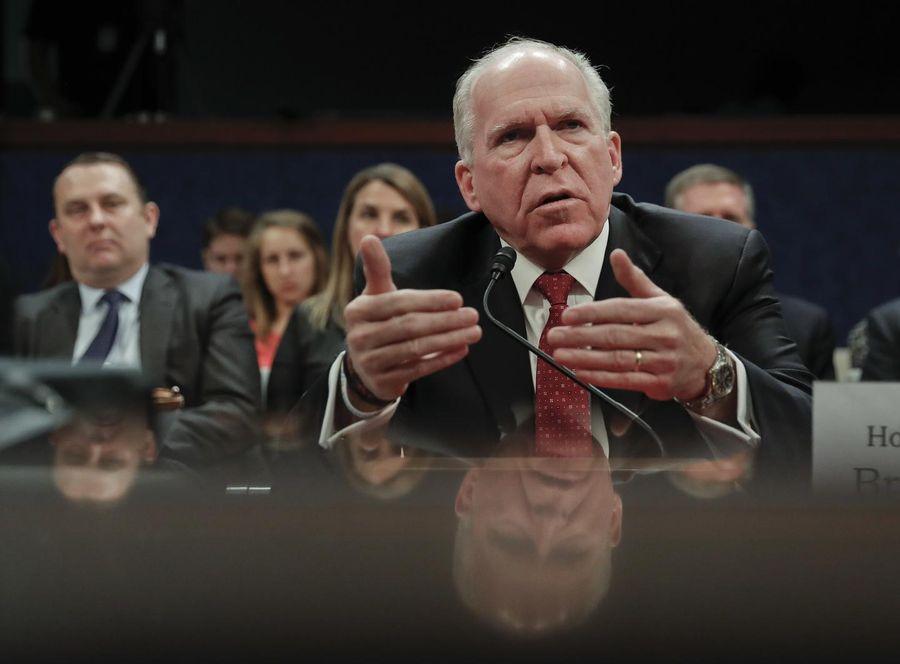
Former CIA Director John Brennan testifies on Capitol Hill in Washington, Tuesday, May 23, 2017, before the House Intelligence Committee Russia Investigation Task Force. (AP Photo/Pablo Martinez Monsivais)
Fact-Checking the Red Menace
Published Aug. 28, 2018 • Read time: 4m
Ron DeSantis, a Republican member of the House of Representatives in the hunt for the governorship of Florida – the state’s primary is being held today -- found himself on the wrong side of a fact check from PolitiFact recently. The fracas began when DeSantis sided with President Trump and against Obama-era CIA Director John Brennan. Brennan, in a tweet, had called Trump’s conduct during a meeting and press conference with Russian President Vladimir Putin “treasonous.”
Several hours later during an interview with Fox News, DeSantis asserted that Brennan is not one to talk, given that “he was a member of the Communist Party during the Cold War.” DeSantis had other choice words for Brennan, but this claim in particular became the subject of PolitiFact’s examination. In a piece titled “Was John Brennan once a member of the Communist Party?,” Heaven Taylor-Wynn saddles DeSantis with a verdict of “Mostly False.”
Taylor-Wynn, via the exemplary reporting typical of the Pulitzer Prize-winning PolitiFact, shows that Brennan was never a registered member of the Communist Party. So in the strictest sense, DeSantis’ claim is simply false. But is the reality is a bit more complicated?
DeSantis’ assertion presumably originates from a CNN report linked to by Taylor-Wynn in her fact check. The report concerns Brennan’s turn as a speaker at the 2016 Congressional Black Caucus Foundation’s annual conference. During a panel on diversity in the intelligence community, Brennan was asked whether a history of activism would hamper an individual’s prospects for future government service. According to CNN, Brennan answered that he was apprehensive when taking a polygraph test upon his entry into the CIA because he had been asked “Have you ever worked with or for a group that was dedicated to overthrowing the U.S.?”
Kids' Lives Matter Too
In a Corner of Ohio, Lessons of 2016
2016 Presidential Election Could Decide State Legislative Races
McCaskill Says No to Run for Missouri Governor
Brennan told the audience that he disclosed to the CIA interviewer that he had voted for Communist Party candidate for president Gus Hall in 1976, but that he was never a member of the party. He told the story by way of reassuring the crowd that a history of radical activism wouldn’t preclude government work. So in the barest sense, DeSantis’ claim is untrue.
But PolitiFact doesn’t only assign ratings of “True” and “False.” It also has other ratings such as “Half True,” “Mostly True,” and “Mostly False,” the one which was assigned to DeSantis. In apprehending Brennan’s claim, Taylor-Wynn asserts that Sen. Rand Paul — who said in a Fox interview that “John Brennan started his illustrious career by voting for the Communist Party” — and commentator Sebastian Gorka — who said on Fox that “John Brennan … voted for the Communist Party at the height of the Cold War in 1976 when the Soviet Union actually wanted to destroy America” — “framed similar criticism of Brennan more accurately, singling out the vote but not going as far as saying he belonged to the party itself.”
This is a fair argument on the part of Taylor-Wynn. But would it be equally fair to argue that DeSantis should have garnered a “Mostly True” rating? Brennan copped to voting for America’s greatest enemy during the height of the Cold War, and Gorka called Brennan’s vote treasonous. Brennan himself seems sensitive to this accusation, given that he once believed his honest answer as to whether he ever worked to overthrow the U.S. might derail his career. So one must ask whether the crux of DeSantis’ argument is really that Brennan was once a card-carrying Communist. It seems probable that DeSantis, Paul, and Gorka were all attempting to make the same point: that it’s hypocritical for Brennan to call Trump’s warm behavior towards Putin an act of treason given that he, Brennan, once effectively voted for Russian takeover.
Taylor-Wynn also editorializes a bit on Brennan’s behalf, writing that “in 1976, Brennan was studying political science at Fordham University. This was the first election after the Watergate scandal, which left many Americans disillusioned with American politics.” She consults with a political science professor who opines that, at the time, Jimmy Carter’s progressive chops were in doubt. Ultimately, she concludes that “becoming a member of a party is a much more specific and intensive commitment than simply pulling a lever in the ballot booth.” This may be so, but it is unlikely to assuage those concerned by Brennan’s 1976 vote.
This piece is but one of many examples of the subjectivity of fact-checking politicians’ statements, which almost invariably entail hyperbole – in this case by Donald Trump’s critics as well as his defenders.. While in the barest sense, Brennan was never a Communist, the importance of context is both highly relevant -- and highly open to interpretation.

The Danger Before the Attack
Leslie J. Sullivan • RealClearPolitics
Jon Finer’s Old and Dangerous ‘New Approach’ to Israel
Peter Berkowitz • RealClearPolitics
The President Deserves Better
John Ullyot • RealClearPolitics
Congress Doesn’t Need Another Blame Game. It Needs To Find What’s Broken
Jarrod Bernstein • RealClearPolitics
Democrats Won the Midterms. Common Sense Won, Too
Jordanne Kemper • RealClearPolitics
The 120th Congress Shapes Up
Carolina Lumetta • RealClearPolitics
RCP Today
Top stories on RealClearPolitics
The Takeaway
Polling intelligence and analysis delivered to your inbox
World News
Featuring the latest world news
Policy
Featuring the latest policy news
Support Our Mission
As part of RealClearPolitics, authors aim to provide balanced, non-partisan analysis by presenting top reporting and commentary from all sides of the political spectrum.
Trusted by policymakers and citizens alike since 2000