
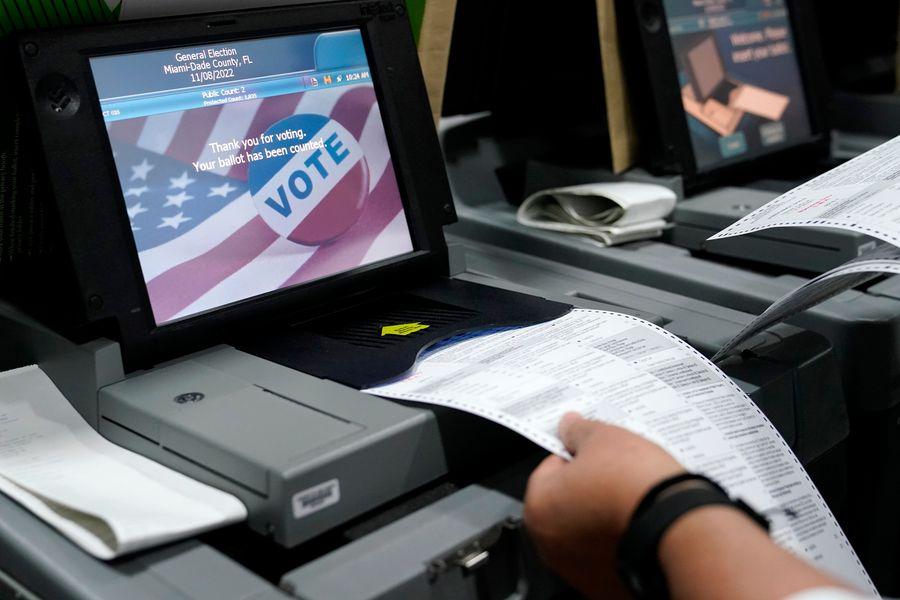
Election 2022 Florida
Remember: Polls Can't Always Detect Late Momentum
COMMENTARY
Published Nov. 1, 2022 • Read time: 4m
A poll is a snapshot, not a prediction. That maxim used to be a fairly standard caveat when media outlets published poll data. I rarely hear it these days, but it’s important – especially at the end of a campaign.
Surveys in the final week of October may be more predictive than those from early September, but they can still struggle to capture any final momentum bursts, or busts. Moreover, since the frequency of polling has declined, we may have races with little or no sampling taken in the final week of the campaign, making it literally impossible to detect late shifts.
Several senatorial and gubernatorial candidates in recent years have outperformed their final polls.
Polls were wildly off in Maine’s 2020 race, with incumbent Republican Susan Collins behind in every poll all year, and seemingly down by about five points in the few polls taken during the last week. Yet she won by 8.6 points. Were the polls flat wrong the whole time, or did something click for Collins at the end? The New York Times quoted rural Mainers who grew weary of the weeks-long Democratic ad blitz against Collins. By October, those attacks were airing alongside Collins spots featuring a beloved Maine sports and nature reporter, criticizing the “$100 million” in Democratic “dark money” ads from “out of state.” The juxtaposition may have worked out for Collins just in time. (And Collins’ own negative attack ads may have helped out, too.)
Also in 2020, North Carolina’s incumbent Republican Thom Tillis was behind in the final RealClearPolitics average by 2.6 points against Cal Cunningham. The Democrat was ahead almost the entire campaign, leading by nearly 10 points in mid-summer, and six at the end of September. Then in early October, the married candidate admitted to sending sexual text messages to another woman. The polls soon tightened, giving at least some indication of a momentum shift, even if Tillis didn’t take the lead until the final day.
In 2018, three Senate candidates overcame small deficits in the RealClearPolitics polling average: Indiana’s Mike Braun (0.7 points), Florida’s Rick Scott (2.4 points) and Arizona’s Kyrsten Sinema (1 point). Polls indicated that all three – two Republicans and one Democrat – were losing a bit of momentum in the final days. (In the case of Indiana, no major media outlet polled the state in the final week.)
On the gubernatorial side, there were no 2020 candidates who defied the final RCP average. But 2018 had five comeback kids (three Republican, two Democratic) all of whom are again on the ballot this year: Florida’s Ron DeSantis, Ohio’s Mike DeWine, Iowa’s Kim Reynolds, Nevada’s Steve Sisolak and Kansas’ Laura Kelly. (The Ohio, Iowa, and Kansas races were lightly polled.)
So far in this 2022 midterm cycle, we’ve seen a period of Democratic momentum followed by a Republican resurgence. The summer featured the overturning of Roe v. Wade, the prime-time hearings from the House’s Jan. 6 committee, and the FBI raid on Mar-a-Lago, alongside a slowdown in the inflation rate. As threats to reproductive freedom and democratic elections dominated the news, Democratic fortunes improved, peaking at a 1.3-point generic congressional ballot average lead in late September. Then inflation kicked up anew and Republicans launched an ad campaign hammering Democrats on crime. As of October 30, the GOP leads in the generic congressional ballot by 2.9 points.
The most recent CBS News poll, which gives Republicans a two-point congressional ballot edge, shows that both parties are landing their punches. Majorities believe that if Democrats win, they will try to “cut police funding” and “open the U.S. Mexico border,” and if Republicans win, they will try to “overturn Democratic wins in elections” and “pass a national abortion ban.”
The clash of narratives will continue through the final week. Should you be more upset about inflation and crime, or abortion bans and election denialism? Can Democrats turn the tables, and argue that they take inflation and crime more seriously than Republicans? Can Republicans successfully downplay the possibility of a federal abortion ban and insist they won’t question Joe Biden’s legitimacy?
The poll data we have informs us about what is on voters’ minds and how effective the parties’ messages have been to date. But there is still time for campaigns to make adjustments, and for the priorities of undecided voters to shift. And there are only so many snapshots we can take before Election Day.


RCP Today
Top stories on RealClearPolitics
The Takeaway
Polling intelligence and analysis delivered to your inbox
World News
Featuring the latest world news
Policy
Featuring the latest policy news
Support Our Mission
As part of RealClearPolitics, authors aim to provide balanced, non-partisan analysis by presenting top reporting and commentary from all sides of the political spectrum.
Trusted by policymakers and citizens alike since 2000