
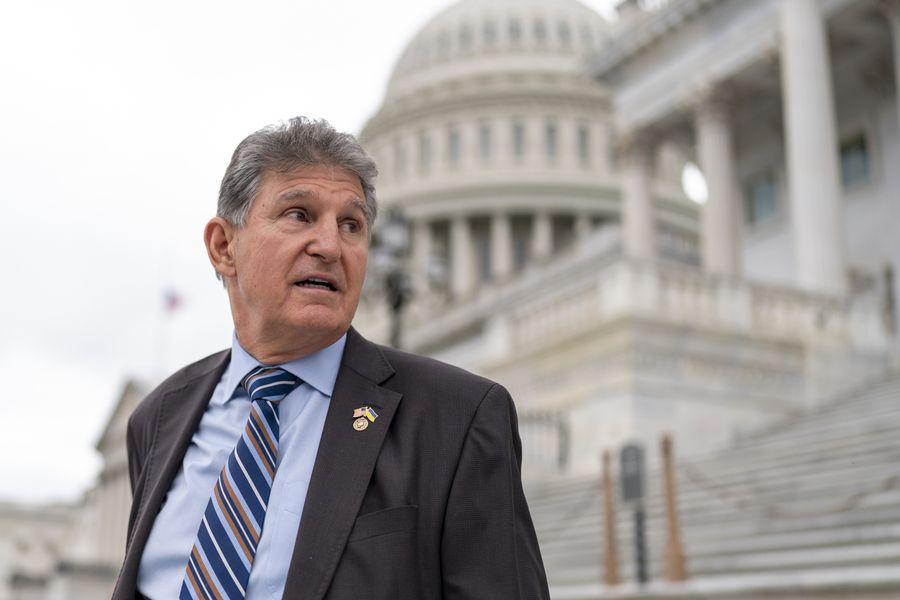
Senate Manchin
Manchin and Kennedy: Two Profiles in Courage
COMMENTARY
Published Jan. 29, 2026 • Read time: 7m
This is a tale of two memoirs by two senators. To borrow further from Charles Dickens, they illustrate why we live in “the best of times” and “the worst of times."
One senator is John Kennedy of Louisiana. He still serves. The other is Joe Manchin of West Virginia. He stepped down before the last election.
The books have parallels. Both authors recount their inspirational parents, their wonderful wives and kids, their unpremeditated entry into politics, and their defiant political courage.
The first three points are canned story lines of the stump speech variety. I suspect they will make most readers yawn. The last one is also familiar on the campaign trail but commands our attention given the pervasive partisan conformity on Capitol Hill. The difference between the books is that only one of the authors has an authentic claim to breaking from the pack.
Let’s start with the other one.
Two aspects of Sen. Kennedy’s book put his approach to politics in sharp perspective.
First is the cover. It carries the title, in red type, “How to Test Negative for Stupid: And Why Washington Never Will.” Below the flippant title is a cartoonishly posed photo of the senator, presumably at a Senate hearing, looking fed up with the proceeding and, by inference, the entire institution.
The second significant aspect of the Kennedy book is the Colonel Cornpone tone that slips and slides inside its covers. Since coming to Washington in 2017, Kennedy, a Louisiana Republican, has fashioned an image of himself as a simple, truth-telling, sagacious Southern pundit. It is not unusual for newcomers to look for a gimmick to attract attention to themselves. Kennedy’s shtick has served that purpose. He is often turned to by the media for a catchy quote and appears frequently on talk shows.
Portman-Strickland Senate Race Finally Set in Ohio
Portman Wastes No Time Attacking Strickland
Strickland Skirts Primary Debates in Ohio Senate Race
Senate Says Climate Change Is Real
There is an element of genius to Kennedy’s act. Americans enjoy disparaging Congress, and he feeds that public disdain. His book is on The New York Times Best Seller list. But it cannot be said that it is a profile in courage, which is what he wants us to believe.
Kennedy declares that he’s “independent-minded,” adding that his book “is about the mighty weapon of candor, which most people in Washington, D.C. have only a casual relationship with.”
Kennedy has at times shown an independent streak, but on issues that have required little fortitude. He opposed President Trump’s first-term bill to reform sentencing requirements. It aimed to lower mandatory sentences for certain crimes and expand rehabilitation programs.
When the president called him on the telephone, Kennedy refused to change his mind. Fine. But he agreed to the president’s request that he not go on a television show to argue against the bill. So much for his claim to talking truth to power. The bill passed with bipartisan support.
Kennedy’s career has been largely a theatrical performance that seeks to score cheap points instead of dealing seriously with serious issues. Down-home quips and ad hominem disparagement do not contribute much and, when scrutinized, are either meaningless or offensive. What does he add to the public discourse when he prefaces an anecdote by recalling, “I am nervous as a pregnant nun”?
Kennedy likes the phrase so much he used it in a speech a couple of years ago at the Gridiron Dinner, an annual white-tie event where journalists and politicians roast each other. The audience did not laugh much. They winced. (I was there.)
In his book, Kennedy said he was proud of not hiring a joke writer for his dinner speech, as many do. It is easy to believe he wrote the book himself. He did, however, hire a blue-ribbon firm in Washington to help promote it. The senator says he does not play “peacock politics.” You decide.
Among Kennedy’s contributions to meaningful debate is his admonition to President Biden “to try harder not to suck.” He describes himself as working harder than “an ugly stripper.”
Kennedy’s facile comments deriding others boomerang. What should we make of him calling members of the press “hyenas” and then working so hard to court them? Or building up his image as a glib speaker by putting down former Senate Majority Leader Mitch McConnell and Senate Minority Leader Chuck Schumer because their speeches are boring and because they read them instead of speaking off the cuff?
“I get it,” Kennedy says. “They have to be careful because the press hangs on their every word.” What’s wrong with being careful of your words or, if you are a journalist, recording them accurately?
A tip-off to Kennedy’s performative approach to governing is his accent. When he was treasurer of the state of Louisiana, he spoke in normal tones, not his current exaggerated good-ol’-boy twang.
Excuse my attempt to ape his one-liners, but Kennedy’s accent is as authentic as crawfish on a crème brûlée. His accent calls to mind a review a New Orleans newspaper once gave to a restaurant that falsely claimed local Louisiana authenticity: “T’aint Creole, t’aint Cajun, t’aint French, t’aint country American, t’aint good.”
Now, let’s have a look at Joe Manchin, the moderate Democrat from conservative West Virginia. Manchin does not have a single zippy line in his book. That’s deliberate. “I don’t try to be funny,” he writes. “I don’t appreciate sarcasm.”
No one will quarrel with this. But Manchin gives a vivid picture of what it means to be truly independent in this day and age.
Here is one of the stories Manchin tells. You may want to compare it to Kennedy’s courage to vote no on sentencing reform. In 2021, Joe Biden wanted to pass a $3.5 trillion-version of his “Build Back Better” bill. Biden considered it a signature piece of legislation during his presidency. Manchin thought it was too expensive, had too many handouts, and lacked adequate accountability. His vote was crucial to passage.
In a private meeting, the president tried to coax him along. Manchin promised he would continue to negotiate. The White House put out an announcement that, contrary to what Manchin believed they had agreed, singled him out as the lone Democratic holdout. This put him under enormous pressure and led to threats against him and his family.
Manchin’s response? Instead of bending, he went on Fox News and said he definitely would not support the bill.
Biden and his budget aides were forced to rework the legislation. They shrank its mandate and its cost. The bill came back as the Inflation Reduction Act. It passed in the Senate by a one-vote margin, thanks to Joe Manchin.
Manchin was often on the margins of the modern Democratic Party. He was a coal broker before he went into politics, and a strong supporter of the industry in his state as governor and in Congress. This did not win friends on the left. He angered his colleagues by casting the only Democratic vote for Brett Kavanaugh’s appointment to the Supreme Court. He found the allegations against Kavanaugh thin and uncorroborated. Manchin also broke ranks with his party and endorsed the reelection of Republican Sen. Lisa Murkowski, another independent-minded senator.
Meanwhile, Manchin co-authored a bill to require background checks for firearm purchases and favored legislation to codify the protections in Roe v. Wade. This did not help him with West Virginia voters. Manchin chose not to run for reelection in 2024. Poll numbers showed it would be very difficult for him to win.
As a young man, Manchin attended the University of West Virginia on a football scholarship and became the starting quarterback as a freshman. An early injury ended his career. Nick Saban, one of his childhood friends and another product of West Virginia, wrote the introduction to the book.
Manchin wasn’t a prestigious Rhodes Scholar at Oxford University, as Kennedy was, and did not attend the top-flight University of Virginia law school, as Kennedy also did. But he is a better student of good government and articulates an authentic down-to-earth understanding of the dangers of hyper-partisanship and its underlying causes: gerrymandering, closed primaries, and the Supreme Court’s Citizens United decision, which helped open the door to untold amounts of money in U.S. elections.
The subtitle of John Kennedy’s book says Washington will never “Test Negative for Stupid.” That nihilistic approach to politics and his self-gratifying one-liners don’t offer hope for anything better.
One can attribute Manchin’s independence to his need to survive in a red state as much as to personal courage. But we can admire him for trying to find a middle way, and we can hope that others will be brave enough to follow his example.
Support Our Mission
The Internet provides an endless stream of content. Not all of it is worth your time. That's why, every day, RealClearPolitics curates the most essential news and information—from all sides and across mediums. The links, videos, and podcasts curated here are the product of human judgment, not algorithms or AI. Please help power our mission of presenting a thoughtful, balanced public discourse through a tax-deductible donation.
Would you consider supporting us today?

Democrats Won the Midterms. Common Sense Won, Too
Jordanne Kemper • RealClearPolitics
The 120th Congress Shapes Up
Carolina Lumetta • RealClearPolitics
Flooding GOP Primaries With Democrats
Robert Natelson • RealClearPolitics
Washington Keeps Rewarding Oracle—Veterans Keep Paying the Price
Darin Gaub • RealClearPolitics
The Seeds of Unrestricted Warfare
John Teichert • RealClearPolitics
The Primary System Is Losing the Next Generation
Sean Trende • RealClearPolitics
RCP Today
Top stories on RealClearPolitics
The Takeaway
Polling intelligence and analysis delivered to your inbox
World News
Featuring the latest world news
Policy
Featuring the latest policy news
Support Our Mission
As part of RealClearPolitics, authors aim to provide balanced, non-partisan analysis by presenting top reporting and commentary from all sides of the political spectrum.
Trusted by policymakers and citizens alike since 2000