
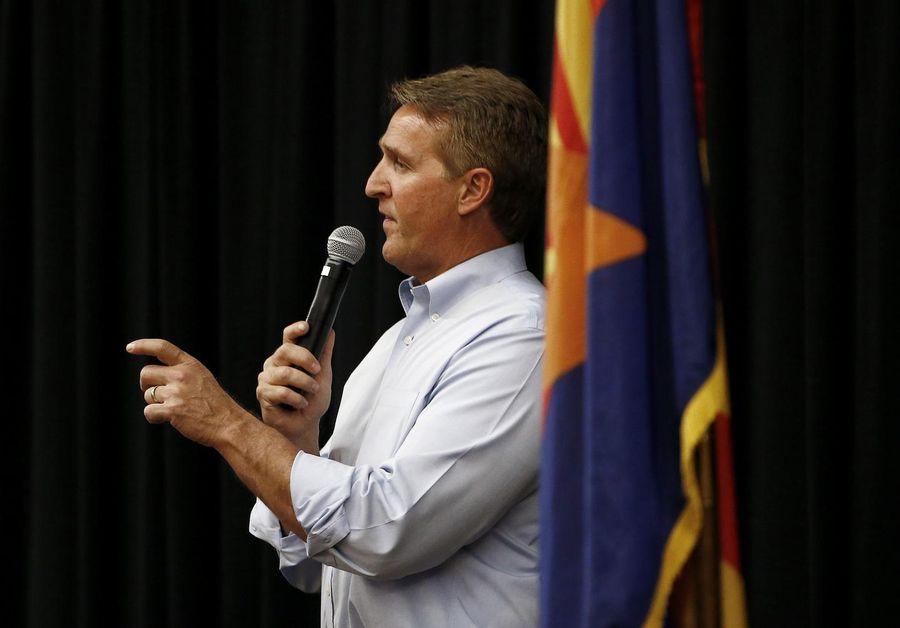
Arizona Republican Sen. Jeff Flake answers a question during a town hall Thursday, April 13, 2017, in Mesa, Ariz. Flake is holding his first public event with constituents since January after coming under withering criticism for his voting record and avoiding such gatherings in recent months. (AP Photo/Ross D. Franklin)
GOP Health Plan Puts Sens. Flake, Heller in Hot Seat
Published June 30, 2017 • Read time: 5m
For the already-contentious 2018 re-election campaigns of Republican Sens. Jeff Flake and Dean Heller, the GOP’s health care plan looks to create additional uncertainty.
Facing a failed vote, Senate Minority Leader Mitch McConnell shelved the original plan on Tuesday to the relief of several members of his party.
Both moderates and conservatives in the party found things to dislike in the GOP legislation. But the bill presented an especially tough tightrope for Flake and Heller, the two most endangered Republican incumbents in the upcoming midterm election.
Heller, whose home state of Nevada favored Clinton to Trump by 2.4 points in 2016, immediately responded to the June 22 release with doubts.
“Throughout the health care debate, I have made clear that I want to make sure the rug is not pulled out from under Nevada or the more than 200,000 Nevadans who received insurance for the first time under Medicaid expansion,” Heller said in a statement. “At first glance, I have serious concerns about the bill’s impact on the Nevadans who depend on Medicaid.”
He then announced his formal opposition to the bill the next day alongside Nevada Gov. Brian Sandoval.
“This bill … is not the answer,” Heller said about the Better Care Reconciliation Act (BCRA), joining GOP Sens. Rand Paul, Ted Cruz, Ron Johnson, and Mike Lee as the fifth Republican against the measure. “In this form, I will not support it.”
Although some were surprised by the Nevada lawmaker’s forthrightness about a bill that did not have a Congressional Budget Office score at the time, Democratic strategist Jim Manley was not among them.
Portman-Strickland Senate Race Finally Set in Ohio
Portman Wastes No Time Attacking Strickland
Strickland Skirts Primary Debates in Ohio Senate Race
Senate Says Climate Change Is Real
“He’s been all over the place,” Manley said of Heller, in reference to his attitude toward health care in the past few months. “The way he handled this bill shows that he still can’t figure out how he’s going to get re-elected in 2018.”
Flake, on the other hand, has been much less outspoken about the BCRA. Having issued only a tweet on the subject since June 22 – “I’m going to take time to thoroughly read and review [the BCRA],” he wrote, Flake has not released an official statement.
A vocal and relatively longstanding opponent of President Trump, Flake may face difficulty in his Arizona primary, particularly from the conservative wing. His home state favored Trump to Clinton by 3.5 points in 2016.
The Trump administration has proven not to be shy in expressing its frustration with congressional slights.
America First Policies, a Trump-sanctioned political organization, even discussed plans to air a $1 million television and radio ad campaign against Heller in response to his lack of support for the BCRA. Although the group ultimately decided against the move and Heller was reportedly not fazed by the threat, it serves as a reminder, said Republican strategist Matt Mackowiak, that proximity to Trump should be determined on a state-by-state basis.
In a state like Nevada that has already expanded Medicaid and is governed by someone as popular as Sandoval, Mackowiak said, creating some distance between oneself and the president might be a prudent move.
Heller and Flake are coming off close wins in 2012 – Heller by 1.16 percent and Flake by 3.03 percent. Neither can afford the historical polling hit historically caused by health care.
A 2012 American Politics Research piece studied the effect of House Democratic voting on the Affordable Care Act (ACA) in 2010, concluding that supporters of the bill lost an average of 5.8 points in that year’s midterm election compared to those who opposed it. Democrats lost the House that cycle, which many saw a result of their votes on the ACA.
“There’s no doubt that there are members of Congress that aren’t serving any more because of their votes on Obamacare,” said Manley, who also described the pressure felt by Republicans to deliver on the long-standing promise to repeal and replace Obamacare.
A Republican strategist with experience in Senate races agreed.
“Historically, you’re going to see challenges in midterm elections when one party is in power,” the source said. “The flip side is that midterms have been generally beneficial to Republicans based on past precedent or turnout models.”
A key difference between the ACA of 2010 and the BCRA of today, though, is the relative unpopularity of each bill. Even at the ACA’s most unpopular, according to data compiled by RealClearPolitics, its approval rating among the American public was 38.5 percent; a recent NPR, PBS, and Marist Poll found that 17 percent of Americans, less than half that figure, support the BCRA.
For that reason, the Republican strategist said, the GOP’s decision to postpone consideration of the health care measure was a wise one. As long as Republicans create a reasonable and responsible solution, the source said, the public will be more forgiving of a missed deadline. This is especially true, Mackowiak added, with the nearly impossible task of whipping 50 votes from 52 available GOP senators who range in ideology from the moderate Republican Sen. Susan Collins to the conservative Sen. Ted Cruz.
“Clearly the backroom conversations are demonstrating, not just for those two but overall, the lack of consensus over this bill, which is why they decided to take the time out and regroup and rethink it, and I think that was a sound strategy,” the strategist said.
Mackowiak reiterated that the almost 17 months between now and Election Day are more than enough time for anything to happen, though.
“Just look at how much has happened over the past five months,” he said.

Jon Finer’s Old and Dangerous ‘New Approach’ to Israel
Peter Berkowitz • RealClearPolitics
The President Deserves Better
John Ullyot • RealClearPolitics
Congress Doesn’t Need Another Blame Game. It Needs To Find What’s Broken
Jarrod Bernstein • RealClearPolitics
Democrats Won the Midterms. Common Sense Won, Too
Jordanne Kemper • RealClearPolitics
The 120th Congress Shapes Up
Carolina Lumetta • RealClearPolitics
Flooding GOP Primaries With Democrats
Robert Natelson • RealClearPolitics
RCP Today
Top stories on RealClearPolitics
The Takeaway
Polling intelligence and analysis delivered to your inbox
World News
Featuring the latest world news
Policy
Featuring the latest policy news
Support Our Mission
As part of RealClearPolitics, authors aim to provide balanced, non-partisan analysis by presenting top reporting and commentary from all sides of the political spectrum.
Trusted by policymakers and citizens alike since 2000