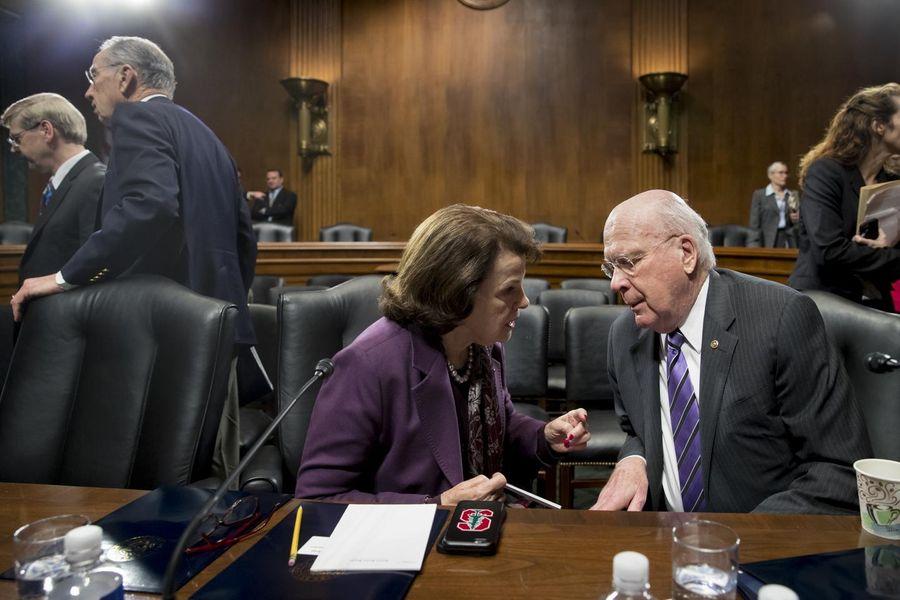
Sen. Dianne Feinstein, D-Calif., ranking member on the Senate Judiciary Committee, confers with Sen. Patrick Leahy, D-Vt. on Capitol Hill in Washington, Wednesday, Feb. 1, 2017, after the panel voted to approve the nomination of Attorney General-designate Sen. Jeff Sessions, R-Ala., following angry exchanges between Republicans and Democrats. Committee Chairman Sen. Chuck Grassley, R-Iowa, departs at upper left. (AP Photo/J. Scott Applewhite)
Advice and Dissent
Published Feb. 16, 2017 • Read time: 4m
If Donald Trump nominates you for a job, this disqualifies you for that job.
Under the Constitution, the president has the power to appoint judges, ambassadors, and other officials, but only with the advice and consent of the Senate. With respect to President Trump’s nominees, Democrats are giving advice but not consent.
Earlier this month, Senate Minority Leader Chuck Schumer of New York boastfully predicted, “If not total unanimity, we’re going to have near Democratic unity in opposing the remaining nominees for President Trump’s Cabinet.”
He was right.
On Monday, every Democrat but one voted against the confirmation of Steven Mnuchin for treasury secretary.
No vote was needed on Wednesday, when fast-food executive and erstwhile employer of an illegal immigrant Andrew Puzder withdrew his nomination for Labor Secretary.
Last week, Democrats unanimously opposed Betsy DeVos for secretary of education—in part because they found her ignorant and unqualified—but mainly because they found her views disharmonious with their own. “It is difficult to imagine a worse choice,” said Massachusetts Sen. Elizabeth Warren. Unlike Warren, I do not find it difficult to imagine Paris Hilton.
The Democrats voted unanimously against Tom Price for Department of Health and Human Services secretary and were one vote shy of unanimity in opposing Jeff Sessions for attorney general.
They opposed Sessions because Sessions supported Trump during the campaign, signifying (in their minds) his subservience. “He’s not independent of Donald Trump,” Schumer said. “He supported Donald Trump from the very beginning.”
Portman-Strickland Senate Race Finally Set in Ohio
Portman Wastes No Time Attacking Strickland
Strickland Skirts Primary Debates in Ohio Senate Race
Senate Says Climate Change Is Real
Of course, Sessions isn’t the first attorney general with partisan leanings. Independence was notably lacking in President Kennedy’s appointment of his brother, Bobby Kennedy, as attorney general, and in President Nixon’s selection of his former law partner and campaign chairman, John Mitchell. But in partisan squabbles, inconvenient history is irrelevant history.
Vermont Sen. Pat Leahy said that Sessions had “only blind allegiance” to Trump. This was an extraordinary charge from Leahy, who demonstrated, at best, legally blind allegiance to President Obama.
After the Senate “silenced” Warren last week, Schumer accused “the other side of the aisle” of “escalating the partisanship and further decreasing comity in the Senate.” In truth, both parties are guilty of escalating the partisanship, which is to say that both parties are guilty of doing their jobs. It is now the job of the Democrats, as the minority party, to see that the Republicans accomplish as little as possible.
Formerly foes of gridlock and obstructionism, Democrats are suddenly big fans of both. The other day, Sen. Dianne Feinstein of California tweeted gleefully: “Voted ‘No’ on Sessions attorney general nomination. All nine @JudiciaryDems voted ‘No.’”
“No” used to be a bad word among Democrats. In 2014, President Obama, complaining about the GOP at a Democratic fundraiser, said, “We’ve got one party in Congress right now that has been captured by ideologues whose core premise is ‘no.’” As long as there are two parties, there will always be a party whose core premise is no—the party that’s out of power, presently the Democrats—just as there will always be another party saying no to the naysayers.
For the previous eight years, Democrats were the anti-no party. Last year, then-Senate Minority Leader Harry Reid of Nevada accused Republicans of waging “a campaign of partisan sabotage aimed at denying the president’s constitutional duty to pick nominees.” Now that the parties have switched places, Democrats are waging their own campaign to sabotage the president’s nominees, which is their partisan and constitutional right.
The problem, however, is that Democrats are opposing Trump’s nominees for no other (apparent) reason than that they are Trump’s nominees. Prior to Trump’s nomination of Neil Gorsuch for the Supreme Court, Schumer said, “It’s hard for me to imagine a nominee that Donald Trump would choose that would get Republican support that we could support.”
The “Yes We Can” Democrats are now the “Hell No” Democrats.

A RealClear Thanksgiving: Investing in a Better Future
David DesRosiers • RealClearPolitics
Trump’s Newsom Problem: Antagonist-in-Chief
Carolina Lumetta • RealClearPolitics
America’s Free Spirit
John Maxwell Hamilton • RealClearPolitics
The GOP Majority Should Go Out in Glory
Daniel McCarthy • RealClearPolitics
Republican Majorities Could Return Sooner Than Expected
J.T. Young • RealClearPolitics
The Danger Before the Attack
Leslie J. Sullivan • RealClearPolitics
RCP Today
Top stories on RealClearPolitics
The Takeaway
Polling intelligence and analysis delivered to your inbox
World News
Featuring the latest world news
Policy
Featuring the latest policy news
Support Our Mission
As part of RealClearPolitics, authors aim to provide balanced, non-partisan analysis by presenting top reporting and commentary from all sides of the political spectrum.
Trusted by policymakers and citizens alike since 2000