
Trump Dominates As Rivals Pick Up Few Wins
Published March 1, 2016 • Read time: 12m
Donald Trump cut a swath through the Super Tuesday primaries, racking up multiple victories and paving his road to the Republican presidential nomination.
Ted Cruz carried his home state of Texas and narrowly won neighboring Oklahoma and far-flung Alaska. Marco Rubio carried Minnesota and ran a strong second in Virginia, which only served to muddy the question of which Cuban-American freshman senator should step aside for the other.
Cruz has claimed in recent days that it is “a fact” that he’s the only candidate to have defeated Trump anywhere and is the only Republican with any chance to wrest the nomination from him. The first part of this assertion was indeed a fact—Cruz carried Iowa—but the second was spin. Now, after a night in which Rubio finally won a state, even those who loathe Cruz must concede that he has shown more strength than any of Trump’s other rivals.
Cruz certainly made this point himself Tuesday night. “So long as the field remains divided, Donald Trump’s path to the nomination is more likely,” he told supporters in Stafford, Texas. “And that would be a disaster for Republicans.”
“We are the only campaign that has beaten Donald Trump,” he added. “Once! Twice! Three times!” (His win in Alaska wouldn't be known till later.)
But not so fast. Rubio won his first state and put up a good fight in the bellwether state of Virginia. Whether that is enough to give him the momentum to attract donors and endorsers ahead of March 15 primaries in Florida and Ohio is uncertain. John Kasich, who ran second to Trump in New Hampshire, finished a very close second Tuesday to the front-runner in sparse voting in Vermont. Ben Carson, as is his habit, finished last.
Tuesday’s results indicate that the GOP contest could be wrapped up on that pivotal March 15 date. Florida is Rubio’s home state; Ohio is Kasich’s. Both are winner-take-all primaries. Even if Trump’s momentum is stalled in those two races, the odds are becoming more likely that it would take a brokered convention to deny Trump the 2016 Republican presidential nomination.
Cruz's Path to Nomination
Trump Stands by His Manager
With Tweets on Heidi Cruz, Trump Sinks to New Depths
A Vote for Kasich Is a Vote for Trump
RealClearPolitics’ team of campaign correspondents breaks down what the Super Tuesday results mean for each of the contenders:
Can Trump Be Stopped?
In winning all but four of the Republican contests Tuesday—and three of the first four contests going into Super Tuesday—Trump is now firmly in control of the Grand Old Party’s locomotive as it careens down the track toward the July convention in Cleveland.
Some leading GOP figures were already planning to leap off the runaway Trump train, while others were still trying to figure out some way to derail it. But how?
“This situation demonstrates that the nominating process is really well out of the hands of the party,” veteran Republican lawyer Cleta Mitchell told RCP Tuesday night.
Citing a series of influences ranging from open primaries to a truncated primary season, Mitchell added, “All of these factors have come together in a harmonic convergence that there is no GOP leadership that can do one thing about this.”
Linda DiVall, a GOP pollster, added that party leaders “will be holding their breaths tonight and closely scrutinizing exit polling results to determine viability for candidates not named Trump.”
Some members of the beleaguered Republican establishment were already galvanized into action before the polls closed Tuesday. A super PAC formed by the wealthy Ricketts family served notice that it will make a last stand against Trump. Tim Miller, a well-known GOP operative who had worked on Jeb Bush’s campaign, sent out an email announcing that he’d joined the group, called Our Principles PAC. Its pitch to Republican voters in the states ahead will be that Trump is a certain loser against the Democratic ticket in November.
“As the results roll-in tonight, I wanted to emphasize that the fight to stop Donald Trump from getting the nomination is intensifying regardless of tonight’s outcome,” Miller wrote. “Hillary Clinton will destroy him even if she's campaigning from jail. Our Principles PAC will fight until the last delegate is counted to stop that from happening.”
Here’s the problem with that plan. The candidate whom Miller previously worked for spent something in the neighborhood of $100 million, never dented Trump’s popularity, and is already out of the race.
Here’s another problem: Trump is leading handily in Michigan, site of the next major primary. He’s leading Rubio by double digits in Florida. He’s leading Kasich in Ohio. He’s leading almost everywhere.
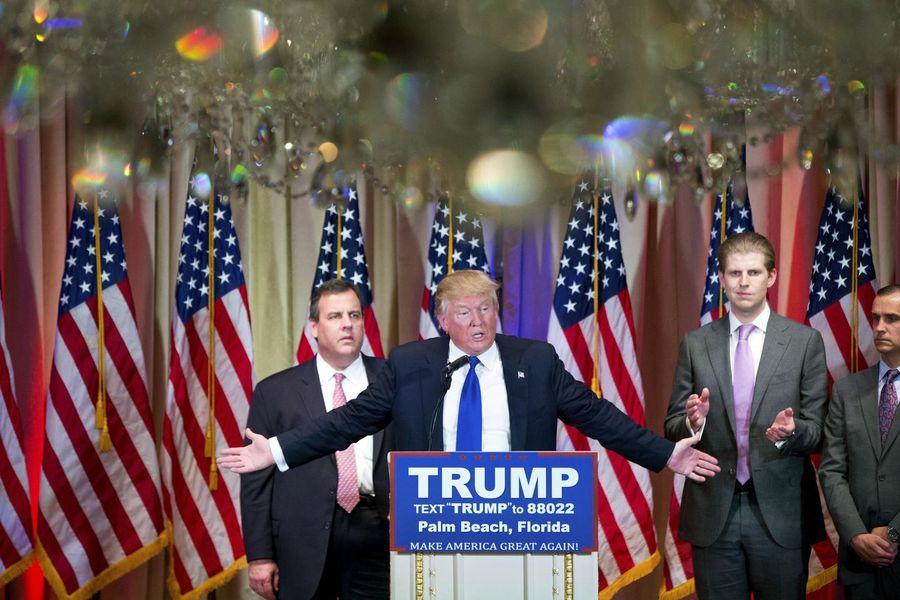
Trump’s victory lap in Palm Beach, Fla., was emceed by New Jersey Gov. Chris Christie, who introduced Trump in a new role—a unifier of Republicans.
“Tonight is the beginning of Donald Trump bringing the GOP together for a big victory this November,” Christie said. “He is bringing the country together. That’s not a campaign—it’s a movement.” – Carl M. Cannon
Cruz’s Bravado
The Super Tuesday primaries did not boost Cruz toward the nomination to the extent his campaign envisioned earlier in the primary process. But they could mark a turning point for the Texas senator’s campaign.
Cruz emerged having won his home state and two more, Oklahoma and Alaska, over Trump, giving the senator four wins thus far. As he reveled in his victories Tuesday night, he pitched himself anew as the candidate best positioned to take down Trump, urging Republicans to rally around his candidacy.
“Tomorrow morning we will face a choice,” Cruz said. “So long as the field remains divided, Donald Trump’s path to the nomination remains more likely, and that would be a disaster for Republicans, for conservatives and for the nation.”
“Our campaign is the only campaign that has beaten, that can beat, and that will beat Donald Trump,” he added.
Not long after Trump entered the Republican presidential race last summer, Cruz laid out his strategy at a summit hosted by the Koch political network. The Southern states voting on Super Tuesday, he said, would be his “firewall.” Reinforcing his focus on these states, Cruz would embark that month on a bus tour throughout the South.
Trump, with his deep appeal in the South, upended Cruz’s game plan and sent him scrambling to win decisively even in his home state. Now, the primary map will shift to turf less favorable to Cruz.
Cruz holds a few key advantages over his non-Trump rivals, however, including a powerful fundraising apparatus that could sustain his campaign over the long term. And he will likely enjoy some momentum coming out of Super Tuesday, which could help him to make his case as the Republican Party’s last best hope to stop the front-runner.
In a sign that Cruz’s pragmatic pitch might indeed hold water, one of his foremost Republican foes, Sen. Lindsey Graham, told CBS News on Tuesday night: "We may be in a position where we have to rally around Ted Cruz.”–Rebecca Berg
Rubio Gets First Win
After a long night of watching his chief rivals beat him at almost every turn, Marco Rubio finally found relief a half-hour before midnight by winning the Minnesota caucuses—his first victory of this raucous primary season.
The Florida senator has emerged in recent weeks as a last best hope for the Republican Party establishment, but his trajectory has been questionable. The Minnesota win puts an end to his losing streak, and his campaign believes the terrain ahead is more favorable to him.
But Rubio's path ahead is uncertain. Among his challenges: an emboldened Cruz, who is pitching himself as the only viable and proven alternative to Trump.
Rubio sought to dampen Cruz's victories by pointing to the expectations game—which in itself has changed over and over again amid Trump's continued gains.
"Tonight was supposed to be Ted Cruz's big night. I mean, his whole campaign was built on his Super Tuesday strategy," Rubio told reporters. "If you can't sweep up Super Tuesday, where in this country are you going to have a big showing? Because it only gets worse for him."
Rubio's argument, of course, won't deter Cruz, and the rivalry between the two figures to grow more heated in coming days.
But at his campaign rally on his home turf of Miami, Rubio's fire was focused less on Cruz and more on Trump. Rubio spent the past few days laying into the real estate mogul on everything from his policy positions and business dealings to his spray tan and hand size. It was a shift in strategy for a candidate who wanted to run on an optimistic and party-expanding platform but found his options dwindling as Trump continued to gain speed.
"Donald Trump is the most unusual front-runner we've ever had. He is someone that can't be elected in November," Rubio told reporters after the votes were counted. "He would be a disaster for the conservative movement. A vote for Donald Trump is literally a vote for Hilary Clinton in November."
Tuesday’s results now apply ever increasing pressure on Rubio to win his home state of Florida on March 15, where the victor wins all of the state's 99 delegates. While Trump leads by a significant margin there, Rubio is confident about winning the state. But he is also pledging to stay in the race beyond the Sunshine State, regardless of future outcomes, and feels encouraged by a "Never Trump" movement sweeping the traditional Republican wing.
"He would split our party in half," Rubio said. "Donald Trump will never have 1,237 delegates and I'm going to campaign as long as it takes, beyond Florida. I'm going to campaign as long as it takes to ensure that our party does not fall into the control of a con artist." — Caitlin Huey-Burns
Kasich Exceeds Low Expectations
The Ohio governor exceeded his relatively low expectations on Super Tuesday and argued that the GOP primary is now shifting to his “home turf.”
While Trump dominated the night and Cruz and Rubio each notched victories, Kasich didn’t win any of the 11 states up for grabs. But he did pull off a surprisingly close second-place finish in Vermont and competed closely with Rubio for second in Massachusetts. He highlighted those results, plus his potential to win some delegates in Virginia, and said his campaign “absolutely exceeded expectations.”
Hours before the results were finalized, his campaign sent an email to supporters soliciting donations with the “home turf” argument as the Michigan and Ohio primaries approach.
John Weaver, the top strategist for Kasich’s campaign, sent a memo Tuesday night declaring the race will “fully reset” when Ohioans vote in a winner-take-all primary in two weeks. Weaver called on Rubio to exit the race, citing internal campaign data showing that Rubio voters would split 2-1 to Kasich over Trump if the Florida senator dropped out.
“Rubio’s presence in the race is keeping Republicans from consolidating around Governor Kasich,” Weaver said.
Though Kasich and his campaign have been bullish on his chances in Michigan and Ohio, the polls show winning the states will require a heavy lift. According to the RCP average, Kasich is in fourth place in Michigan, trailing Trump by nearly 20 points and also sitting behind Rubio and Cruz.
Kasich is betting heavily on reversing those numbers in Michigan, which holds its primary next Tuesday. He’ll hold three town-hall gatherings in the Great Lakes State Wednesday and at least three more over the weekend.
He is in slightly better position in his home state of Ohio, where the latest poll last month showed him trailing Trump by five points, but within the margin of error. Kasich said the campaign was “almost to March Madness” at his election night event in Mississippi, which also holds its primary next Tuesday.
“We’re down to the final five and you know what they all struggle for, what they all fight for all season long: Home court advantage. So I think I’m going to have a little bit of home court here in Mississippi come next week. And we’re heading north, right onto my home court with Michigan and then, I’m going to tell you now, we will beat Donald Trump in the state of Ohio and it’ll be a whole new day." – James Arkin
What’s Next
Much of the focus over the next two weeks will be on the March 15 primaries of Ohio and Florida—not only because they are winner-take-all contests but also because they will help determine the future or the end of the road for their respective home state candidates.
Kasich has said he will leave the race if he fails to win Ohio, but his campaign is confident in his ability to overpower his rivals in the state that has twice elected him governor. But before Kasich even gets to the Buckeye State, he will face a substantial test in his ability to take on Trump in Michigan on March 8.
Meanwhile, Rubio is confident he will win his home state of Florida, even through Trump leads by a significant margin there. A loss in Florida would be considered a fatal blow to his campaign, but the junior senator is also pledging to take the fight all the way to the convention.
Cruz heads to Kansas, which holds a primary on March 5, along with other contests in which he hopes his conservative appeal will hold: Louisiana and Kentucky. He also could see potential in Mississippi on March 8.
The strategies moving forward, however, represent more of a combined effort to deny Trump the delegates necessary to win the nomination, and contest him at the convention, than to defeat Trump outright.
“We shall see,” said Cleta Mitchell. “I’m still hoping that Marco will beat him in Florida on March 15 and that our long national nightmare will be over.” – Caitlin Huey-Burns

Congress Doesn’t Need Another Blame Game. It Needs To Find What’s Broken
Jarrod Bernstein • RealClearPolitics
Democrats Won the Midterms. Common Sense Won, Too
Jordanne Kemper • RealClearPolitics
The 120th Congress Shapes Up
Carolina Lumetta • RealClearPolitics
Flooding GOP Primaries With Democrats
Robert Natelson • RealClearPolitics
Washington Keeps Rewarding Oracle—Veterans Keep Paying the Price
Darin Gaub • RealClearPolitics
The Seeds of Unrestricted Warfare
John Teichert • RealClearPolitics
RCP Today
Top stories on RealClearPolitics
The Takeaway
Polling intelligence and analysis delivered to your inbox
World News
Featuring the latest world news
Policy
Featuring the latest policy news
Support Our Mission
As part of RealClearPolitics, authors aim to provide balanced, non-partisan analysis by presenting top reporting and commentary from all sides of the political spectrum.
Trusted by policymakers and citizens alike since 2000