
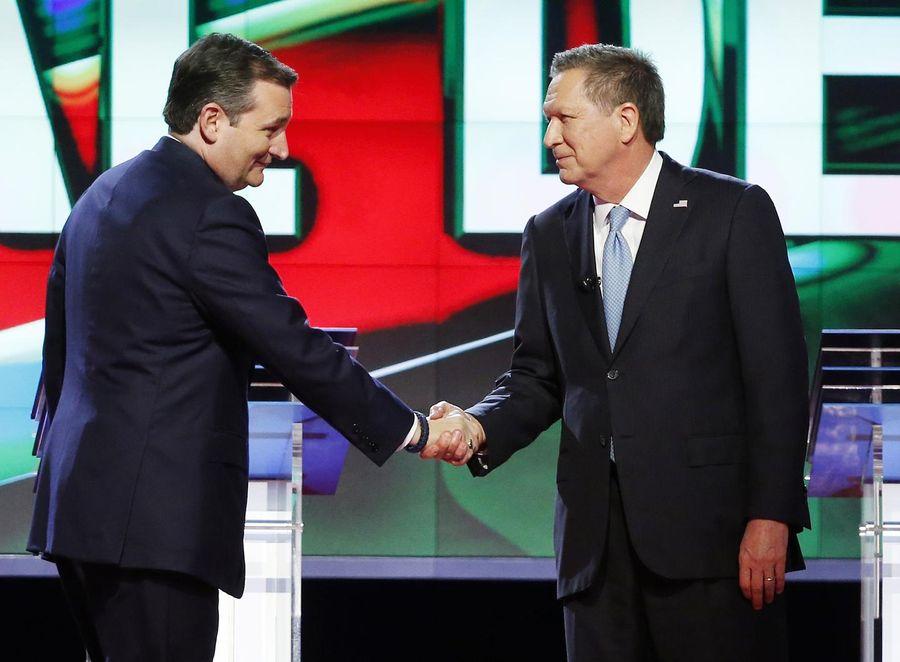
Republican presidential candidate, Sen. Ted Cruz, R-Texas, left, shakes hands with Republican presidential candidate, Ohio Gov. John Kasich, at the start of the Republican presidential debate sponsored by CNN, Salem Media Group and the Washington Times at the University of Miami, Thursday, March 10, 2016, in Coral Gables, Fla. (AP Photo/Wilfredo Lee)
The Four Republican Camps
Published March 22, 2016 • Read time: 6m
As we enter the late rounds of the Republican presidential contest—the rounds that will decide the bout—the party and its allies have divided into four distinct camps:
The Trumpers: These are the people who want Donald Trump to win the Republican nomination. Their numbers are not yet entirely clear, but they seem to comprise roughly two-fifths of the GOP electorate and probably a shade more. Angry with the political class, opposed to open-borders immigration and to trade imbalances, and sick of liberal political correctness, this group is willing to overlook any number of questionable qualities (and the absence of many salutary qualities) that would normally prove to be disqualifying to one seeking the office first held by General Washington.
The Trumpers are also willing to overlook the fact that, to become president, Trump would have to break longstanding precedent. Across this republic’s history, Americans have not elected as president anyone who has not served as a commanding general, vice president, U.S. senator, governor, or federal cabinet secretary—with one exception: Abraham Lincoln, who had merely been a U.S. congressman. For Trump to beat Hillary Clinton, Americans would have to abandon their usual resume requirements, which have held up for 228 years.
Prominent Trumpers: Jeff Sessions, Chris Christie, Ben Carson, Sarah Palin. Possible (undeclared) prominent Trumper: John Kasich. (After months of complaining about not getting asked enough debate questions, Kasich followed Trump’s lead in declining to debate Ted Cruz on Monday; and he chose to run ads in Utah, where the best strategy for him—if he’s really vying for the nomination in an open convention, rather than to be Trump’s V.P.—would have been to stay out of the state, let Cruz hit 50 percent there and thus win all of the state’s delegates, and set back Trump.)
Cruz's Path to Nomination
Trump Stands by His Manager
With Tweets on Heidi Cruz, Trump Sinks to New Depths
A Vote for Kasich Is a Vote for Trump
The Cruzers: These are the people who want Cruz to win the Republican nomination. As with the Trumpers, their numbers are not entirely clear but should become more evident as we enter the season of closed primaries (those in which only Republicans can vote), starting with Tuesday’s Arizona primary. (Four-fifths of the primaries prior to Arizona have been open; two-thirds of the primaries from Arizona onward will be closed.) Similarly fed up with the political class, but focused more on Washington Republicans’ abandonment of conservative principles and/or unwillingness to fight for them, this group couldn’t care less that Cruz isn’t particularly cozy with his Senate colleagues—and might even consider that a virtue.
The Cruzers view this election, coming off of eight years of an unpopular liberal presidency, to be perhaps a once-in-a-generation opportunity to elect a genuine conservative to the White House. With Clinton poised to be the competition, they like their chances—if Cruz can win the nomination.
Prominent Cruzers: Mike Lee, Carly Fiorina, Rick Perry, Jeb Hensarling
The Realists: These are people who don’t particularly want Cruz to be the nominee, but they are backing Cruz (at least for now) because they are clear-eyed enough to recognize that he is the only person left who can stop Trump. Many members of this group want an open convention because they are hoping that another candidate will emerge there (while other members of this group just want to stop Trump, whether before or at the convention, and are content to have Cruz do the job.) They realize the only way to get to an open convention is for Cruz to win a majority of the delegates (or very, very nearly so) from this point forward. If Cruz fails to do so, Trump will win the nomination before the convention, as Trump needs to win only 53 percent of the remaining delegates (based on results prior to Arizona and Utah).
Prominent Realists: Lindsey Graham, Mitt Romney
The Ostriches: These are people who have their heads in the sand and are indulging in the fantasy that someone other than Cruz can stop Trump. They are openly rooting for Kasich to do well from this point forward, thereby forcing an open convention that they think he—or someone other than Trump or Cruz—can win. In addition to holding the rather farfetched belief that Kasich could prevail at the convention without ripping apart a party whose voters clearly want an outsider this time around, the Ostriches are denying the basic math of the race.
In neutral-site states (those apart from Texas and Ohio), Trump has won 39 percent of the vote to date (going into Arizona and Utah), while Cruz has won 26 percent, Kasich 11 percent, and others 25 percent. If Kasich catches fire (by his standards) and wins, say, 25 percent of the vote going forward, that will leave 75 percent. If Trump continues to win his customary 39 percent, that will leave just 36 percent for Cruz (less, really, as write-ins or those no longer in the race will likely get at least 1 percent of the vote, as they have in every primary since Super Tuesday). Trump would therefore almost surely win a plurality in most of the states to come, most of which are winner-take-all, and sew up the nomination before the convention.
If, however, Kasich were to continue getting his customary 11 percent of the vote, Cruz could win pluralities by holding Trump to about 43 percent—a realistic goal. And if Kasich were to get out, Cruz could win by holding Trump under 50 percent (or, to be more exact, under 48 or 49 percent, given the votes that will likely go to other candidates)—a goal that’s even more realistic.
The only way Kasich’s continued presence could be useful is if he could actually win states going forward, rather than just making it harder for Cruz to win them. But going into Tuesday’s contests, he’s 1-for-29—and 0-for-28 when not running on his home turf. In very blue Illinois, in his own region, he fared 10.6 points worse than Cruz and 19.1 points worse than Trump. Indeed, if he and Rubio hadn’t been in the race, Illinois likely would have swung from Trump to Cruz.
In short, the only chance of having an open convention is if Cruz beats (or at least effectively ties) Trump from here on out—and the only way Cruz can realistically achieve this goal is if Kasich’s vote tally stays more or less where it has been, or drops. In trying to boost Kasich’s vote tally, the Ostriches are undermining their own stated goal of getting to an open convention where Kasich can allegedly prevail.
Prominent Ostriches: Daniel Henninger, David Brooks, Kimberley Strassel, The Arizona Republic
Jeffrey H. Anderson, a former senior speechwriter at the Department of Health and Human Services and a longtime opponent of Obamacare, is co-creator of a computer ranking system that was used for 16 years by college football’s Bowl Championship Series to help decide the national championship matchup.

Congress Doesn’t Need Another Blame Game. It Needs To Find What’s Broken
Jarrod Bernstein • RealClearPolitics
Democrats Won the Midterms. Common Sense Won, Too
Jordanne Kemper • RealClearPolitics
The 120th Congress Shapes Up
Carolina Lumetta • RealClearPolitics
Flooding GOP Primaries With Democrats
Robert Natelson • RealClearPolitics
Washington Keeps Rewarding Oracle—Veterans Keep Paying the Price
Darin Gaub • RealClearPolitics
The Seeds of Unrestricted Warfare
John Teichert • RealClearPolitics
RCP Today
Top stories on RealClearPolitics
The Takeaway
Polling intelligence and analysis delivered to your inbox
World News
Featuring the latest world news
Policy
Featuring the latest policy news
Support Our Mission
As part of RealClearPolitics, authors aim to provide balanced, non-partisan analysis by presenting top reporting and commentary from all sides of the political spectrum.
Trusted by policymakers and citizens alike since 2000