
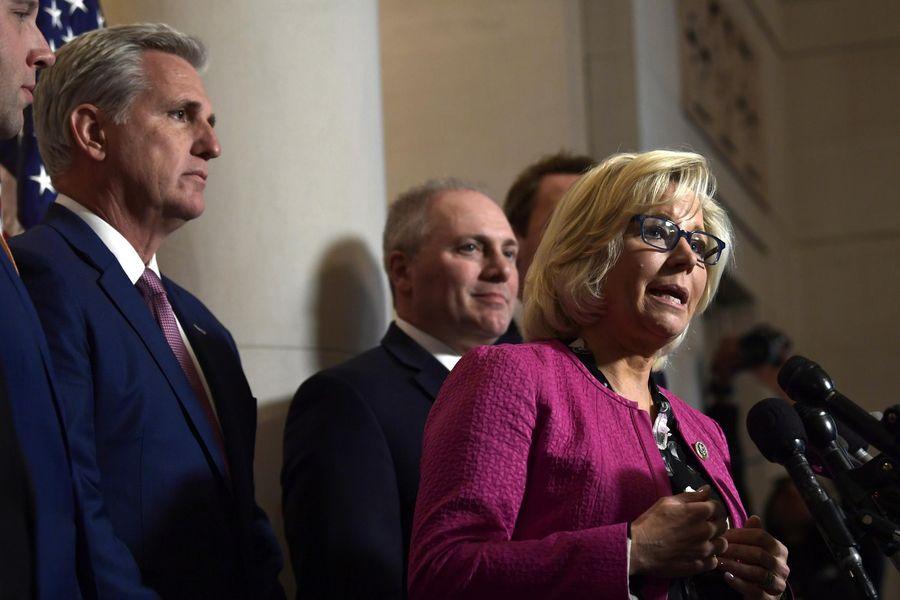
Rep. Liz Cheney, R-Wy., right, speaks during a news conference on Capitol Hill in Washington, Wednesday, Nov. 14, 2018, following a meeting for the House Republican leadership elections. Cheney, who is standing with House Majority Leader Kevin McCarthy of Calif., left, and House Majority Whip Steve Scalise, R-La., center, was voted in as conference chair. (AP Photo/Susan Walsh)
GOP Sounds Alarm After Women Candidates' Losses
Published Dec. 5, 2018 • Read time: 4m
The midterms were the Year of the Woman for Democrats in Congress, but for Republicans it was a year of sharp decline. While Democrats will add 35 women to their already strong bench in the House (64 serve in the 115th Congress), the Republican tally will fall to 13 from 23.
In the Senate, the numbers were less harsh for the GOP. A total of 24 women will take seats in the chamber next month -- 17 Democrats and seven Republicans. Eleven female Democrats and three Republican women won races last month, which, combined with the House tally, will result in the smallest number of GOP women in Congress since 1994.
These results have caused some within the party to hit the panic button on how to reverse this trend.
“This is rock bottom and there’s only one way to go from here and that’s up,” said Sarah Chamberlain, president of the Main Street Republican Partnership. “Republicans need to recruit, support and raise money for women candidates to get them elected.”
For years, the GOP number was growing organically without much attention to the issue. Explained Chamberlain, “Republicans go for the best candidate, regardless of gender, and are just as likely to pick a male candidate over a woman if they have a better chance of winning.” In contrast, she added, this happens less in the Democratic Party because they “get [more] excited about having women on the ballot.”
Although the election was something of a wipeout for Republican women in the House, it wasn’t due to fewer candidates. This election was a record year in that regard, with 120 filing to run and 52 advancing to the general election. “This wasn’t a recruitment problem – the election didn’t go as well as we had hoped in the House for BOTH men and women,” said Jessica Furst Johnson, general counsel of the National Republican Senatorial Committee.
Cruz's Path to Nomination
Trump Stands by His Manager
With Tweets on Heidi Cruz, Trump Sinks to New Depths
A Vote for Kasich Is a Vote for Trump
Rep. Elise Stefanik, who was chair of recruitment for the NRCC, said she was “proud that we almost tripled the number of women who stepped up and ran for Congress. Unfortunately, many of these women did not make it through their primaries or general elections, which has left the number of women in the GOP conference at a crisis level.”
Democrats benefit from a superior infrastructure of women’s groups that recruit, fundraise and organize on behalf of female candidates. The largest of these groups is EMILY’s List, which in 2018 raised more than $61 million. Republicans have smaller counterpart groups, and there’s a growing sentiment that more is needed. Early next year, Stefanik plans to relaunch her leadership PAC to support women candidates, with a focus on primaries. “The goal is to engage, empower and elevate women candidates," explained the New York congresswoman.
Part of the GOP rebuild effort is to develop a “farm team” of candidates by cultivating state and local candidates. In the midterms, 2,088 women were elected to state legislatures -- 1,411 Democrats and 657 Republicans. “We need to empower Republican women at the state and local level to run for office,” said Furst Johnson. “This will create a deep bench of people who have resumes of leadership and government experience to run for higher office.”
One of the first things the party did upon digesting the midterm outcome was to elevate Republican women to visible congressional leadership roles. Rep. Liz Cheney of Wyoming will head the Republican conference, making her the third highest-ranking Republican in the House. Sen. Joni Ernst of Iowa will be vice chairwoman of the Senate GOP conference, making her the first Republican woman in a Senate leadership job in eight years. Rep. Kay Granger of Texas was selected to be the ranking member of the powerful House Appropriations Committee.
In her new leadership position, Cheney is arguing that all issues are women’s issues and that Republicans just need better communication on the economy, health care and national security. She called it “fundamentally offensive and paternalistic” to think that women voters are driven by their gender. However, she did concede that Republicans do need more female messengers spreading the party’s message.
“In 2020, we need to talk about issues that suburban women care about, and we didn’t do that in this election,” said Chamberlain. “The White House had a lopsided strategy, which focused on rural voters to win the Senate. It worked, but they left wide open the suburban voter.” During the campaign, there wasn’t much discussion of the lowest unemployment rate for women in 17 years or that for the first time in decades women’s wages are rising. “In 2020 we can’t win with just our base – we need to win back independent and suburban voters and especially women,” said Andrea Bottner, a senior adviser to RightNOW Women PAC.

Congress Doesn’t Need Another Blame Game. It Needs To Find What’s Broken
Jarrod Bernstein • RealClearPolitics
Democrats Won the Midterms. Common Sense Won, Too
Jordanne Kemper • RealClearPolitics
The 120th Congress Shapes Up
Carolina Lumetta • RealClearPolitics
Flooding GOP Primaries With Democrats
Robert Natelson • RealClearPolitics
Washington Keeps Rewarding Oracle—Veterans Keep Paying the Price
Darin Gaub • RealClearPolitics
The Seeds of Unrestricted Warfare
John Teichert • RealClearPolitics
RCP Today
Top stories on RealClearPolitics
The Takeaway
Polling intelligence and analysis delivered to your inbox
World News
Featuring the latest world news
Policy
Featuring the latest policy news
Support Our Mission
As part of RealClearPolitics, authors aim to provide balanced, non-partisan analysis by presenting top reporting and commentary from all sides of the political spectrum.
Trusted by policymakers and citizens alike since 2000