
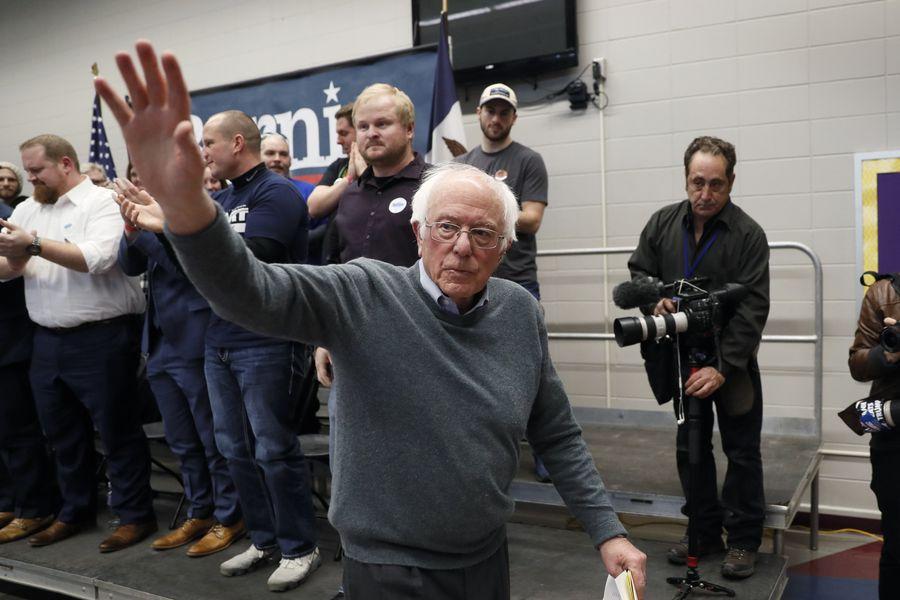
Democratic presidential candidate Sen. Bernie Sanders, I-Vt., waves as he leaves a town hall meeting, Sunday, Dec. 15, 2019, in Keokuk, Iowa. (AP Photo/Charlie Neibergall)
Don't Sleep on Bernie
ANALYSIS
Published Dec. 18, 2019 • Read time: 5m
Join the Conversation
0Any analysis of the 2020 Democratic primary race should start with an acknowledgment that any one of the four candidates bunched within six percentage points of each other in both Iowa and New Hampshire has a reasonable chance of winning the nomination. And yet no single candidate has a particularly strong chance at this point of becoming the party’s standard-bearer.
One of the weirder features of the race, though, is how little press coverage is being dedicated to the scenario where Sen. Bernie Sanders becomes the nominee (I’m talking about press coverage here; election analysts tend to take him seriously). But the scenario is quite real, even if it isn’t necessarily the most likely one.
To understand why this is possible, it is necessary to remind ourselves that the Democratic primary process is not a single election. Rather, it is a sequence of elections, where the outcomes of later elections are dependent upon the outcomes of earlier ones. So, let’s look at the first few.
The Iowa caucuses bat leadoff, in early February. Sanders came very close to winning them in 2016 (reports differed about whether coin flips in tied precincts made the difference). Today, he’s in second place in the RealClearPolitics average, a few points behind Pete Buttigieg. Moreover, he does have some momentum (though it’s not as impressive as Buttigieg’s): He’s up seven points in the RCP polling average since late September. In addition, the Hawkeye caucuses are often fertile ground for overperformances by candidates running outsider campaigns that appeal to younger voters; this is what led Barack Obama (in 2008) and Sanders (in 2016) to late surges. I wouldn’t call the Vermont lawmaker the favorite – again, in this field no one is – but overall, he is well-positioned here.
Lies, Assault and Cover-ups Don't Stop Donald Trump
Trump Stands by His Man; Obama on a Health Scourge; Hayden Interview; Reagan's Courage
Analysis: For Trump, Few Limits to Win-At-Any-Cost Approach
What If Clinton Isn't Indicted?
The next race is New Hampshire a week later. This is a somewhat natural fit for Sanders, who hails from a neighboring state. Sanders blew the roof off here in 2016, winning by over 20 points. His lead today is not as impressive – just 1.3 points – but he is nevertheless ahead, and blowouts are going to be hard to come by in a 15-person field.
At this point, things become difficult to game out, because the sequential nature of the races begins to come into play. By mid-February most of the field will have dropped out, and where their share of the electorate goes will likely prove crucial. Perhaps more importantly, Sanders may have won the two marquee early contests and thus will have some momentum heading into Nevada. He currently trails there, but the race is underpolled and he very nearly won in 2016.
If Sanders were to sweep the first three contests, he would become very difficult to beat. There are then typically two arguments made as to why he can’t win the nomination at this point: the South Carolina primary and Super Tuesday. Joe Biden has a healthy lead in the former, largely boosted by his strength among African American voters, who make up about 60% of the electorate in the Palmetto State.
This analysis, however, quickly runs into problems. Biden does seem likely to put on a dominant performance in South Carolina, which will help him stanch any bleeding from the early states. But he will be damaged if he loses the first three races. Moreover, if for some reason he doesn’t put on a dominant performance in South Carolina, either because Sanders has gotten some momentum or some other candidate has begun to erode Biden’s standing with African Americans, the former vice president will be in deep trouble. In other words, South Carolina isn’t so much an impediment to Sanders winning the nomination as it is an absolute must-win for Biden.
That brings us to Super Tuesday. Again, this is often held up as a firewall for Biden, given the number of African American-heavy Southern states that will be holding their elections that first Tuesday in March. There is a point here: If Biden performs well in South Carolina, he will likely be expected to hold his own in Alabama, Arkansas, North Carolina, Tennessee, Texas, and Virginia.
Those are not, however, the only states holding primaries on March 3. Colorado, Maine, Massachusetts, Minnesota, Oklahoma, Utah and, of course, Vermont, are all Sanders-friendly states where he performed well four years ago. Some of those were caucus states in 2016 but will be holding primaries this time around. The main prize is California, where Sanders and Biden are currently neck-and-neck. On top of all of this is the wild card of Michael Bloomberg, who will be spending hundreds of millions of dollars trying to siphon off the voters Biden needs to win; even breaking off 5% of them could be sufficient to derail the front-runner.
To the extent Biden is dependent on African Americans, he wouldn’t have many states left at that point; only four Southern states would remain. That’s not to say Biden can’t win other states with fairly large African American populations, like Illinois. It’s only to say that his African American “firewall” would have been breached.
If Sanders were to sweep the first three states and then win California, it would be very difficult to deny him the nomination. That’s not to say it couldn’t be done, nor is it to say it is more likely than not that he’ll sweep the first states. But this scenario is realistic enough that the broader political press should seriously consider it.

Jon Finer’s Old and Dangerous ‘New Approach’ to Israel
Peter Berkowitz • RealClearPolitics
The President Deserves Better
John Ullyot • RealClearPolitics
Congress Doesn’t Need Another Blame Game. It Needs To Find What’s Broken
Jarrod Bernstein • RealClearPolitics
Democrats Won the Midterms. Common Sense Won, Too
Jordanne Kemper • RealClearPolitics
The 120th Congress Shapes Up
Carolina Lumetta • RealClearPolitics
Flooding GOP Primaries With Democrats
Robert Natelson • RealClearPolitics
RCP Today
Top stories on RealClearPolitics
The Takeaway
Polling intelligence and analysis delivered to your inbox
World News
Featuring the latest world news
Policy
Featuring the latest policy news
Support Our Mission
As part of RealClearPolitics, authors aim to provide balanced, non-partisan analysis by presenting top reporting and commentary from all sides of the political spectrum.
Trusted by policymakers and citizens alike since 2000