
Dinner With Barack: Who Was on the GOP List, and Why
Published March 6, 2013 • Read time: 9m
To remedy America’s long-term fiscal problems, President Obama has tried cajoling Senate Republicans, working around them, and then campaigning full-out against them. Wednesday night he tried to cook up a coalition of the willing over a warm meal and some wine.
Surprising much of Washington in the wake of the acrimonious debt ceiling, fiscal cliff, and sequestration battles, Obama chose a blustery night in March to play the convivial host, inviting a dozen GOP senators to meet him privately for supper at the Jefferson Hotel -- neutral territory close to the White House.
The president talked last week about seeking “a common-sense caucus” in Congress willing to work across the aisle. The dinner guest list Wednesday says plenty about how the White House will try to remake partisan opponents into legislative collaborators. The list, below, offers some clues.
At a press conference Wednesday afternoon, Sen. Lindsey Graham said Obama asked for his help in planning the get-together. The South Carolina Republican said the president had some ideas about whom to invite and asked Graham for suggestions too. The list became a mix of people the president had already reached out to and some new ones.
Graham guessed that he and his colleagues "will try to talk sense into him and he will try to talk sense into us" at the dinner.
“It’s sad that this makes news,” he added. “The fact that there is a lot of interest in a dinner between the president and a handful of Republican senators is a pretty good statement about where we’re at as a nation.”
Lies, Assault and Cover-ups Don't Stop Donald Trump
Trump Stands by His Man; Obama on a Health Scourge; Hayden Interview; Reagan's Courage
Analysis: For Trump, Few Limits to Win-At-Any-Cost Approach
What If Clinton Isn't Indicted?
Next week, Obama plans to journey to the Capitol to meet with the House and Senate Republican conferences on their turf, something he has rarely done since Republicans took control of the lower chamber after 2010. His goal is to find an exit strategy on the budget that could free up his domestic legislative agenda this year, which could easily be buried on Capitol Hill as long as fiscal battles and manufactured crises such as sequestration dominate lawmakers’ attention.
The president says his policy target is an agreement on the final piece -- a petite bargain -- of a $4 trillion pact on deficit reduction over 10 years. Obama and Congress, in stutter steps, wound up with $2.5 trillion already in law. That means they’re fighting over a blend of revenue changes Obama wants, and spending and entitlement changes Republicans want -- tallied in the end to at least $1.5 trillion.
Lawmakers receiving the VIP invitations to Wednesday’s dinner (and a few who have already spoken with the president by phone but were not invited) told RCP they are heartened by Obama’s sudden interest in consulting with conservatives, many of whom have met weekly over the last few years with their Democratic colleagues to chat about budget solutions.
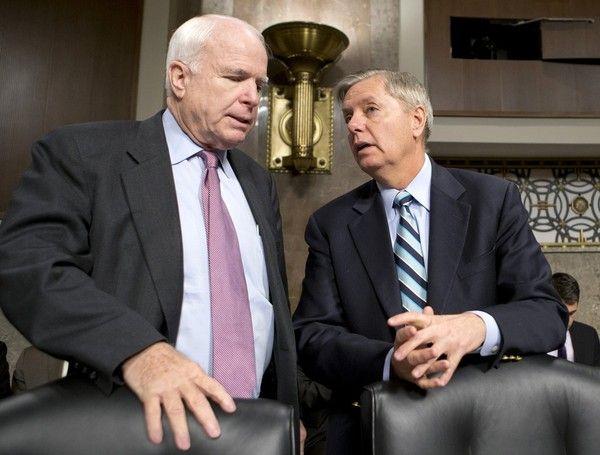
A good host wouldn’t invite Sen. John McCain to dinner without Graham, his sidekick and influential pal. The duo, never shy in front of microphones, talked with Obama at the White House last week about efforts to pass immigration reform this year, as well as the across-the-board spending reductions at the Pentagon that both senators would like to reverse. Graham is not allergic, at least in theory, to the idea of revenues becoming part of a serious debt reduction package if Democrats also give ground on entitlements.
“We need to have this dialogue, and I’m glad the president is doing it,” McCain said of the dinner gathering. “We have continued discussions. That’s been my experience with other presidents, where you establish lines of communication. . . . It’s never too late.”
Graham said hours before the dinner, “Where this goes I don’t know . . . but I do know where the country is going. If we don’t fix entitlements, they’re going to consume all the money we send to Washington in the future, and Medicare and Social Security are going to collapse. And the president knows that also."
Since a third amigo, Joe Lieberman, retired from the Senate, McCain and Graham have allied with Sen. Kelly Ayotte, a New Hampshire freshman, which meant she received an invitation. She was an articulate surrogate for Mitt Romney during last year’s presidential campaign and a frequent critic of the White House.
Sen. Richard Burr of North Carolina often assails Obama and his policies, and entitlement spending gets him particularly worked up. Burr, a member on the Finance Subcommittee on Fiscal Responsibility and Economic Growth, has urged the president to work with Congress to tackle tax reform and the long-term drivers of debt and deficits. "I'm not willing to raises taxes one more penny,” he told a local TV station before sequestration took effect. “What I am willing to do is the reforms that are needed," he added. "The American people know we can't have a strong economy … without reform, and [including] entitlements.”
Bob Corker of Tennessee, an influential member of the Senate’s banking panel and its Special Committee on Aging, said he met Monday with White House advisers and spoke with the president over the weekend. “The president is very aware that I put out a very detailed plan” to deal with the fiscal cliff last winter, he said when asked why he was invited to dinner. “I think he knows I’d like to solve this problem.”
Oklahoma’s Tom Coburn and Saxby Chambliss of Georgia each spoke with the president earlier this week. They are longtime participants in the Senate’s “Gang of Eight” who work on a bipartisan basis to find budget solutions. Coburn, proud of his independent streak, has been close to the president since Obama’s time as a senator from Illinois. He says he’s willing to cut defense resources in addition to entitlement spending to try to rein in debt over the long haul. Chambliss has announced he will retire from the Senate in 2014, and he’s expressed his willingness to consider tax changes as part of a 10-year budget pact.
Another invitee, Indiana Sen. Dan Coats, has been quieter than some of his colleagues in the debt and deficit debate, but he brings with him legislative experience. Coats served in the Senate two decades ago but left the chamber to practice law and serve as the U.S. ambassador to Germany. Elected again in 2010, he is a member of the Joint Economic Committee and a supporter of a balanced budget amendment to the Constitution. Coats has expressed support for a big budget deal and been critical of short-term measures that are now commonplace on Capitol Hill. “I am disappointed that he continues to call for higher taxes to pay for more spending,” Coats said after Obama’s State of the Union address. “We have heard many of these words before. The real test will be to see if the president finally will lead and act on pro-growth policies.”
North Dakota Sen. John Hoeven enjoyed sky-high approval ratings as governor, and has been helping to dig congressional Republicans out of a negative name ID. He gave the GOP’s weekly address two weeks ago, calling for a sequestration deal that would give the president the flexibility to apply the sequester cuts to the different agencies. Hoeven told RCP that he and his colleagues want a grand bargain, and hold out hope for one if they can nudge the president’s hand on entitlement reform.
Last year, Tea Party favorite Ron Johnson of Wisconsin called Obama’s re-election “a body blow to Americans, a body blow to freedom.” He also predicted that if House Speaker John Boehner compromised on tax loopholes with the president, he’d lose his powerful perch. But Johnson, elected in 2010 to his first political office, likens deficit and debt reduction deal-making with Democrats to a painful dental operation that might save some teeth. "It's causing a cavity," Johnson explained last month during a speech in his home state. "Actually, it's worse yet; that cavity is turning into an abscess that's now infecting the body. We've got to heal that infection. We've got to take care of . . . $4 trillion. We got the shot of Novocain. We got the drill. We got the antibiotic.”
Another Gang of Eight member, Mike Johanns of Nebraska, also received an invitation. (He was seen entering the restaurant with Ayotte and Johnson.) Like Chambliss, Johanns is retiring in 2014, though after just one term. A former governor and agriculture secretary under George W. Bush, he sits on the Banking Committee and opposed the financial reform bill signed into law in 2010. He has voiced frustration with congressional gridlock, and his efforts with the Gang of Eight proved unsuccessful during the fiscal cliff talks. And he scolded fellow Republicans for holding up a vote on the nomination of Chuck Hagel, who also hails from the Cornhusker State, for defense secretary.
Pat Toomey of Pennsylvania headed the conservative, fiscal policy-focused Club for Growth before his election to the Senate in 2010. A leader behind the Republicans’ sequester alternative bill that would have granted flexibility to the president, he has been a top critic of the administration -- and of his own chamber for failing to pass a budget in years.
Obama also spoke by phone to Ohio Sen. Rob Portman, a former budget director during the Bush administration, over the weekend, as well as to Maine’s Sen. Susan Collins on Monday afternoon. They are not invited to the Jefferson. “It must have been something I said,” Collins joked to reporters.
None of the GOP Senate leaders received dinner invites. South Dakota Sen. John Thune, on the leadership team, told RCP he welcomed the president’s outreach to his colleagues but said Obama should not sit down empty-handed.
“Put some things on the table that he’s been reluctant to [present] -- that are difficult for him and his political base,” Thune advised. “If this isn’t just about optics, if it’s meaningful and substantive, then he ought to come prepared to give something in return.”

Congress Doesn’t Need Another Blame Game. It Needs To Find What’s Broken
Jarrod Bernstein • RealClearPolitics
Democrats Won the Midterms. Common Sense Won, Too
Jordanne Kemper • RealClearPolitics
The 120th Congress Shapes Up
Carolina Lumetta • RealClearPolitics
Flooding GOP Primaries With Democrats
Robert Natelson • RealClearPolitics
Washington Keeps Rewarding Oracle—Veterans Keep Paying the Price
Darin Gaub • RealClearPolitics
The Seeds of Unrestricted Warfare
John Teichert • RealClearPolitics
RCP Today
Top stories on RealClearPolitics
The Takeaway
Polling intelligence and analysis delivered to your inbox
World News
Featuring the latest world news
Policy
Featuring the latest policy news
Support Our Mission
As part of RealClearPolitics, authors aim to provide balanced, non-partisan analysis by presenting top reporting and commentary from all sides of the political spectrum.
Trusted by policymakers and citizens alike since 2000