
Obama, GOP Leaders to Meet on Averting "Cliff"
Published Nov. 9, 2012 • Read time: 6m
President Obama will launch formal discussions with congressional leaders at the White House Nov. 16 aimed at heading off more than $600 billion in tax increases and spending cuts that loom as a statutory certainty after Dec. 31.
The meeting will be the first for the president and congressional leaders since Obama’s re-election Nov. 6, and will come one day before he departs on a week-long trip to Asia. The goal is a bipartisan pact to reduce the deficit and thereby boost economic growth by blending tax changes and spending reductions that take effect over a period of 10 to 12 years.
Faced with the press of time, significant leverage over Republicans who oppose tax hikes, and support from Americans who put him back in the Oval Office, Obama wants to negotiate swiftly. Economists believe the United States could drive itself back into recession if the White House and Congress fail to reach agreement this year.
Republican congressional leaders continued to push the responsibility for solving the so-called fiscal cliff onto the president, while expressing a willingness to work with him to avert it. But they rejected Obama’s request to pass the Senate bill that would extend the Bush-era tax rates for middle-income families only, retaining their longstanding opposition to raising tax rates on any Americans, arguing that such would negatively affect small-business owners.
Obama also stressed a willingness to negotiate.
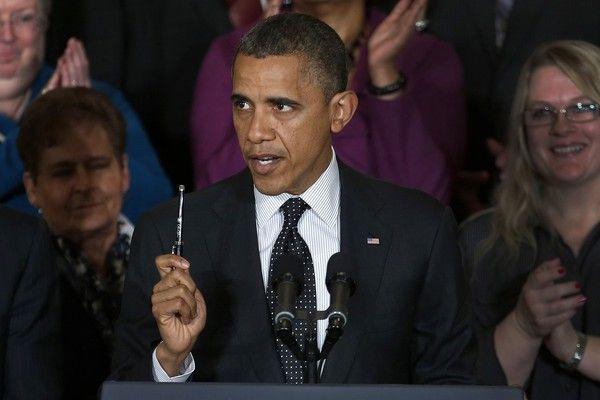
“I've put forward a detailed plan that allows us to make these investments while reducing our deficit by $4 trillion over the next decade,” he said at an East Room event Friday. “I want to be clear: I'm not wedded to every detail of my plan. I'm open to compromise. I'm open to new ideas. I'm committed to solving our fiscal challenges.”
Gavin Newsom's Misguided Redistricting Initiative
A Warning Against the Overuse of Sanctions
Open The Books on the California State Checkbook
Senate Passes Bill Addressing Heroin, Opioid Crisis
The president delivered his 10-minute prepared statement surrounded by more than 200 people described by the White House as middle-income “stakeholders” who would be impacted if the government fails to avoid the cliff.
Obama took no questions from reporters packed into the far reaches of the room, and the White House later said the president will wait until Nov. 14 before meeting with reporters on a range of subjects. (Predecessors who won re-election -- stretching back at least to Ronald Reagan -- held news conferences within two or three days of Election Day, but White House Press Secretary Jay Carney said Obama had been interviewed by television and radio frequently in October and November.)
Although the president said he has an open mind, he made clear he will begin the discussions having ruled out options sought by Republicans. He insists on an end to the Bush-era tax breaks for families earning more than $250,000 a year; an extension of the existing tax breaks that benefit families earning less than $250,000 annually; a “balance” of revenue increases along with new reductions to spending to curb deficits; and credit for the $1 trillion in spending cuts agreed to and enacted into law during the summer of 2011.
“I am not going to ask students and seniors and middle-class families to pay down the entire deficit while people like me, making over $250,000, aren't asked to pay a dime more in taxes,” Obama said. “This was a central question during the election. It was debated over and over again. And on Tuesday night, we found out that the majority of Americans agree with my approach. And that includes Democrats, independents and a lot of Republicans across the country, as well as independent economists and budget experts.”
Because the two parties tried and failed to achieve a “grand bargain” worth $4 trillion in deficit reduction the last time they negotiated, the operating assumption is that $4 trillion remains the overarching goal. Democrats in Congress have discussed a threshold ratio of $2 in total spending reductions to every $1 of revenue increases included in any pact.
Although Republican lawmakers insist there are not enough votes in Congress to adopt higher tax rates, they have floated the idea of enacting some -- as yet unspecific -- tax changes to produce additional revenue without raising rates.
In a statement following Obama’s remarks, House Speaker John Boehner said he looked forward to meeting with the president next week. But he argued that the “increased tax rates that would be allowed under the Senate-passed bill are part of the fiscal cliff that economists are warning us to avoid. Those increased tax rates will destroy jobs in America by hurting small businesses across the country.” Instead, he offered the House-passed legislation that would extend current law for a year so that lawmakers could work on reforming the tax code.
Boehner embarked this week on something of a public relations campaign to get ahead of the president on this issue. He gave a televised speech on Wednesday congratulating Obama on winning re-election, opened the door to increased revenues so long as they are part of comprehensive tax reform, and said it’s time for the president to take the lead.
In the senior chamber, Senate Republican Leader Mitch McConnell dismissed the idea that Obama’s Nov. 6 victory provided him with a sweeping mandate to increase taxes.
“There is no consensus on raising tax rates, which would undermine the jobs and growth we all believe are important to our economy,” McConnell said, adding that Democrats had not offered plans to reform entitlements, which is where the big savings are to be found on the spending-reduction side of the equation.
“The president has a duty to lead. We implore him again to do so,” McConnell added, echoing Boehner’s remarks. Jim Jordan, the chairman of the House Republican Study Committee, said the president’s speech doesn’t equal legislation. “Send us a bill,” he said.
In his first official press conference since the election, Boehner spoke Friday about the growing burden of entitlement programs. “We’re spending a trillion dollars more than what we take in. You can’t continue to do that. This is year two of a 25-year demographic bubble,” he said. “Ten thousand baby boomers, like me, are retiring every day.”
Boehner insisted to reporters that reforming and simplifying the tax code, including closing special-interest loopholes on both the individual and corporate level and lowering tax rates, “will bring jobs back to America. It will bring more revenue.”
Asked what kind of leverage he holds in negotiations in light of the 2012 election results, Boehner pointed to the fact that the GOP still controls the House.
“The American people re-elected a Republican majority, and I’m proud of the fact that our team in a very difficult year was able to maintain our majority,” he said. But as a party, he acknowledged, “we’ve got some work to do.” Conversations about “who we are as a party” will continue, he said, but the “GOP principles are sound.”

Congress Doesn’t Need Another Blame Game. It Needs To Find What’s Broken
Jarrod Bernstein • RealClearPolitics
Democrats Won the Midterms. Common Sense Won, Too
Jordanne Kemper • RealClearPolitics
The 120th Congress Shapes Up
Carolina Lumetta • RealClearPolitics
Flooding GOP Primaries With Democrats
Robert Natelson • RealClearPolitics
Washington Keeps Rewarding Oracle—Veterans Keep Paying the Price
Darin Gaub • RealClearPolitics
The Seeds of Unrestricted Warfare
John Teichert • RealClearPolitics
RCP Today
Top stories on RealClearPolitics
The Takeaway
Polling intelligence and analysis delivered to your inbox
World News
Featuring the latest world news
Policy
Featuring the latest policy news
Support Our Mission
As part of RealClearPolitics, authors aim to provide balanced, non-partisan analysis by presenting top reporting and commentary from all sides of the political spectrum.
Trusted by policymakers and citizens alike since 2000