
Amid "Frank" Talks, Obama Uses Polls as Pry Bar
Published Dec. 14, 2012 • Read time: 12m
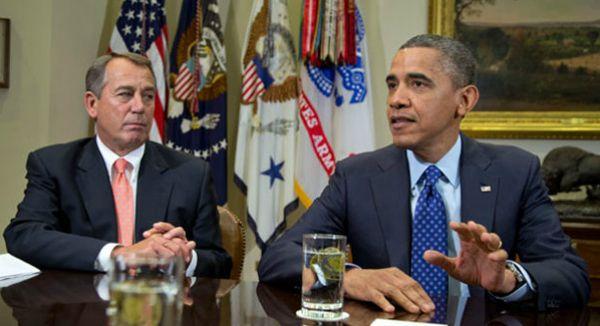
President Obama and John Boehner met privately Thursday night in search of a budget deal while new polls underscored why the president believes public opinion has become a powerful pry bar to use in the negotiations.
All sides continued to say they were committed to averting nearly $600 billion in tax hikes and deep spending cuts set by law to begin Jan. 1.
Obama’s invitation to the speaker for the White House talks was his second in five days. The two men, who had met Sunday, spent 50 minutes in what Boehner’s staff described as a “frank” discussion, with the prospect of more such conversations.
News of the evening meeting triggered a rally on Wall Street, after a day in which aides to the two leaders had been trading public barbs about a lack of progress.
The relentless PR at the White House and on Capitol Hill has its roots in the bitter presidential race. And so far, the result has been marked public support for Obama: His job approval numbers have inched above 50 percent since his re-election.
Although the budget negotiations involve more than tax policy, Obama has relentlessly focused on maintaining existing tax advantages for middle-class families and raising rates for “wealthy” families earning $250,000 or more a year. Because most Democrats say they oppose cuts to beneficiaries of Medicare, Medicaid and Social Security, Obama has been publicly vague about the “tough spending cuts” he has promised to reduce future deficits and stabilize U.S. debt.
It is no mystery why he is vague. For example, as part of a survey conducted for the AFL-CIO by Hart Research among union and non-union voters on Nov. 5-6, 73 percent said their intended message to the candidates was: “We should protect Medicare and Social Security benefits from cuts.” More than two-thirds said they opposed raising the Medicare eligibility age as part of a budget deal; 69 percent opposed making large cuts to Medicaid benefits in any pact; and an overwhelming 84 percent said they did not want Social Security benefits reduced by Congress and the president.
Gavin Newsom's Misguided Redistricting Initiative
A Warning Against the Overuse of Sanctions
Open The Books on the California State Checkbook
Senate Passes Bill Addressing Heroin, Opioid Crisis
House Minority Leader Nancy Pelosi on Thursday warned Republicans against raising the eligibility age for Medicare from 65 to 67 as a way to shrink federal spending. “We are not throwing America's seniors over the cliff to give a tax cut to the wealthiest people in America. We have clarity on that,” she said.
Pelosi, who spoke with the president for more than 40 minutes at the White House a week ago, repeated her confidence in Obama’s negotiations.
Boehner and Senate Republicans are eager to discuss the tender topic of entitlement programs and their explosive growth as a percentage of future budgets. Conservatives’ want to hear more specific policy offers from the White House about possible spending reductions because they believe they can make Obama more vulnerable with his base.
Nonetheless, the president appears for the moment to have the bigger megaphone and the momentum as he appeals directly to the American people to pressure House Republicans to raise tax rates. It was a strategy that worked last year, compelling Republicans to extend the payroll tax holiday until the end of December 2012, White House spokesman Jay Carney explained, and Obama decided it was worth trying again.
“I cannot say that a Republican congressman who now believes we ought to extend tax cuts for the middle class and accepts [that] . . . we will not extend tax cuts for the top 2 percent came to that position after he or she saw a local news report,” Carney said, referring to the president’s enlistment of local television news coverage Thursday. “But I think . . . the president's continued efforts to explain to the American people what his views are . . . has had an effect.”
Indeed, a new Wall Street Journal/NBC News poll of 1,000 adults finds that 76 percent -- including 61 percent of Republicans surveyed -- “would accept” higher taxes on the top 2 percent of Americans in order to avert a collection of statutory budget changes set to take effect Jan. 1. In other words, an overwhelming majority -- regardless of party -- supports Obama’s stance, which he repeated Thursday afternoon during a series of interviews at the White House with local TV anchors from Philadelphia, Miami, Minneapolis and Sacramento, Calif.
Speaking with Minnesota’s WCCO-TV before he met with Boehner, Obama expressed measured optimism that he and the speaker can hammer out a budget deal that can clear Congress.
“I remain hopeful that we can get this resolved. It shouldn’t be hard to get resolved,” Obama said. “The big problem right now is that the Republicans in the House are resistant to the idea of the wealthiest Americans paying higher tax rates, and I understand they have a philosophical objection,” Obama continued. “On the other hand, we’re willing to make some really tough decisions about spending cuts. We’ve already made a trillion dollars’ worth of spending cuts [enacted in 2011].”
A handful of prominent Senate Republicans and a few of their House GOP colleagues have publicly voiced support for Boehner’s opening concession that his party would agree to raising revenues, but Boehner still insists he does not have the votes on his side of the aisle to pass higher tax rates.
Because taxes on almost all Americans will rise in January under current law, a small but vocal group of Republican lawmakers has tried to argue publicly to their colleagues that they should not balk at concessions beyond the New Year. The result of doing so, they warn, will be rebukes from abroad, from financial markets, from the public, and from Obama and his fellow Democrats. These lawmakers are urging their leaders to construct a framework pact before the end of December and return in 2013 with the new Congress to write major entitlement and tax “reform” policies into law.
But many House conservatives who represent safe GOP districts remain philosophically and politically wary of voting for higher taxes or conceding to Democrats. Boehner continues to be buffeted by public sentiment, by House GOP rivalries and refusals, by White House demands, and by entreaties from the business community to shake hands on a credible Washington agreement as soon as possible to ease economic uncertainty.
While Obama had a big head start on messaging as he returned to governing Nov. 7, congressional Republicans have made an effort to play catch-up and repair their disparate communications.
Boehner's face-to-face visit with the president followed a series of phone calls between the two men, some staff discussions, and exchanges of term sheets. House Republicans have been advised by PR experts to publicly reinforce their own pursuit of a negotiated settlement with Obama and Democrats.
The budget ideas traded between Obama and Boehner this week were initially supposed to remain confidential while talks continued, reporters were told. But in customary Washington fashion, congressional leaks and White House statements quickly overtook a brief news vacuum as the negotiators took their talking points to the nearest TV cameras.
"It's a work in progress," Obama said Thursday afternoon when asked about the deficit talks. Reporters shouted questions as he crossed the road to pay a brief visit to National Security Council staffers who attended a holiday event at Blair House.
Boehner on Thursday tried to emulate the president’s appeal to the public, looking for his own brand of support to bolster the GOP’s position. The Ohio congressman has told Obama that without significant and detailed commitments to curb federal funding of mandatory spending programs, conservatives will never consider higher taxes. Boehner announced a new Twitter hashtag, #SpendingIsTheProblem, intended to bookend Obama’s Twitter weapon, #My2k, which refers to the $2,200 average annual tax break middle-class families could lose on Jan. 1.
It is unclear how Twitter has impacted the Washington budget debate, since the vast majority of Americans do not use the social media platform. Most news organizations, however, follow tweet commentary as part of their reporting.
At a morning news conference, the speaker blamed the struggle to reach an accord on Obama’s concentration on taxes. Boehner turned to a chart designed by House Budget Committee Chairman Paul Ryan to illustrate why Republicans believe more revenues alone cannot erase federal deficits over the next decade.
“The president wants to pretend that spending isn’t the problem. That’s why we don’t have an agreement,” Boehner complained. “The election wasn’t a mandate to raise tax rates on small businesses. It was a mandate for both parties to work together to take on the big challenges that our country is facing.”
Many House Republicans insist they have public backing to rival Obama’s assertion that he has captured the high ground.
“I won by a bigger percentage than the president did. I was re-elected to a second term. So we both have our respective mandates,” said Indiana Rep. Todd Young, a new member of the tax-writing Ways and Means Committee. “I would even argue that my level of specificity about solving the nation’s thornier problems was far greater than the president’s was,” he told RCP.
Young said he worked with the Indiana Chamber of Commerce to poll businesses and individuals on the issue of taxes, and found opposition to tax hikes -- including higher rates, closed loopholes, and eliminated deductions -- in the absence of entitlement reforms. He shared the survey results with the House GOP leadership, he added.
Public opinion polls released this week suggest Americans are eager to see the White House and Congress resolve their battle soon. Even a deal with higher tax rates and reduced spending for Medicare and Social Security is acceptable, according to 65 percent of Americans in the Wall Street Journal/NBC News poll.
A majority, however, also said the president and congressional Republicans will be held “equally” to blame if they fail to resolve the impasse by year’s end. If no compromise is reached, 19 percent said it would be the fault of the president and Democrats, while 24 percent said they would hold the GOP responsible.
Other surveys disclosed similar findings this week: 69 percent of Americans favor taxing the wealthy to help pay down deficits, and a majority said they would accept significant spending cuts in addition to tax hikes, according to a Fox News poll.
A Bloomberg survey found 58 percent of Americans support Obama’s desire to raise taxes on the wealthy in combination with reductions in entitlement programs; 37 percent said they were opposed.
Texas Rep. Kevin Brady, also a member of the House Ways and Means Committee, said he is ignoring polls, believing they are flawed. The legislative calendar is driving lawmakers more than polling, he argued. “The clock ticking is actually getting people’s attention,” he said.
Rep. Sandy Levin, the ranking Democrat on Ways and Means, made the opposite point. The polls are accurate, he said, and reflect America’s message in the election, which he translated into a return to the 1990s marginal tax rate of 39.6 percent for upper-income earners.
“The handwriting is on the wall because the Clinton era for the upper 2 percent was a critical part of the [election] debate,” he told RCP. “And the people have spoken. Now the surveys are accentuating what the electorate decided.”
Republicans are trying to create some counter-messaging. House GOP Whip Kevin McCarthy touted the GOP’s new campaign-style Web videos in which business owners and others explain their opposition to higher tax rates. In one version, an Ohio accountant named Linda says higher taxes will deter employers from hiring.
Democrats “are using their campaign muscle to the best of their ability. From a social media aspect, they obviously have the bully pulpit and are using it to their advantage,” said an aide to McCarthy. “The president can make all the campaign stops he wants to and say that members of Congress aren't being honest with the facts in this debate, but when you bring folks like Linda into the conversation expressing serious concerns with the president's policies, it's hard for them to ignore that.”
McCarthy also invited small-business owners to the Capitol as part of discussions about a possible compromise, and GOP leaders have encouraged lawmakers to rally their constituents.
Earlier this week, House conference chairwoman Cathy McMorris Rodgers gathered a handful of Republican lawmakers -- mostly women -- and dozens of mothers, fathers and small children at the foot of the Capitol to argue that failure to curb spending and reform entitlement programs would hurt American families.
“That’s what parents and grandparents do: we fix problems,” said North Carolina Rep. Virginia Foxx at the event. McMorris Rodgers said she was concerned about the share of federal debt her daughter, age 2, could shoulder in the future.
Several lawmakers interviewed by RCP said they have made their concerns and objections clear to House leaders, but they are not privy to all the budget specifics being developed by Boehner and his lieutenants. Ohio Rep. Pat Tiberi said it’s “hard to gauge anyone’s temperature when you don’t know what the deal is.”
Freshman Rep. Sean Duffy, a conservative from Wisconsin, said Boehner can count votes intuitively without measuring support on taxes, which may be why lawmakers were advised this week to expect to be in Washington up to and perhaps beyond Christmas.
“I don’t think there is any temperature to take,” Duffy said. “I don’t think you have a conference that is going to vote for rate increases. I’m not going to vote for rate increases. . . . Do you think [Democrats] are going to come forward with the spending cuts that I want? They are not going to offer what I want.”

Congress Doesn’t Need Another Blame Game. It Needs To Find What’s Broken
Jarrod Bernstein • RealClearPolitics
Democrats Won the Midterms. Common Sense Won, Too
Jordanne Kemper • RealClearPolitics
The 120th Congress Shapes Up
Carolina Lumetta • RealClearPolitics
Flooding GOP Primaries With Democrats
Robert Natelson • RealClearPolitics
Washington Keeps Rewarding Oracle—Veterans Keep Paying the Price
Darin Gaub • RealClearPolitics
The Seeds of Unrestricted Warfare
John Teichert • RealClearPolitics
RCP Today
Top stories on RealClearPolitics
The Takeaway
Polling intelligence and analysis delivered to your inbox
World News
Featuring the latest world news
Policy
Featuring the latest policy news
Support Our Mission
As part of RealClearPolitics, authors aim to provide balanced, non-partisan analysis by presenting top reporting and commentary from all sides of the political spectrum.
Trusted by policymakers and citizens alike since 2000