
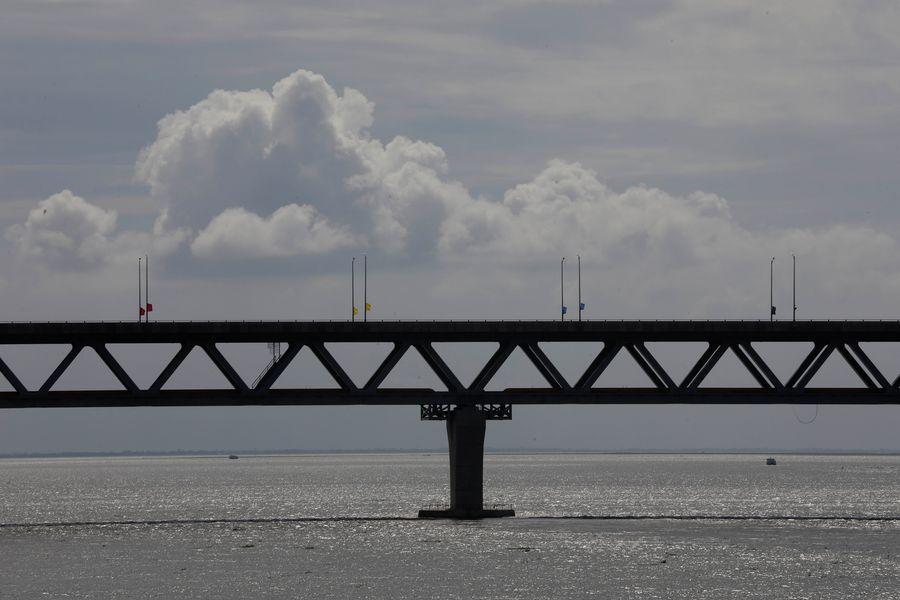
Bangladesh Bridge
Bangladesh's Padma Bridge Boosts Connectivity
COMMENTARY
Published Aug. 13, 2022 • Read time: 4m
Bangladesh is well located. It borders India and has three major ports in the Bay of Bengal. It also is part of the Asian Highway network, which connects 32 Asian countries to Europe.
In short, Bangladesh is a vital crossroads in Southeast Asia.
Now it is even more so. In June, Bangladesh opened the Padma Bridge. Located 42 miles from Bangladesh’s capital, Dhaka, the bridge links the southwest of the country to the northern and eastern regions. It has already dramatically reduced the travel time between Dhaka and major business centers in Khulna, Jashore, and Barishal.
The bridge carries more than cars and trucks. High pressure gas transmission lines and fiber optic cables are embedded in the structure. By providing such essential infrastructure – both physical and digital -- and by giving easy access to new markets for farmers, the bridge is expected to boost Bangladesh’s already burgeoning, annual Gross Domestic Product by an additional 1.2 percentage points. It is, in almost every way, the embodiment of modern connectivity.
The Padma Bridge is both a game-changer and an engineering marvel. The double-layer, steel-truss span incorporates a four-lane highway on an upper level with a single-track railway on the lower level. Steel piles driven 400 feet into the riverbed support the bridge, a record for all bridges in the world. Modern friction pendulum bearings support the steel superstructure and the concrete pier foundation.
Discussions about a bridge over the Padma River date back to Bangladesh’s independence in 1971 when a feasibility report was submitted suggesting that such a project would help the new nation’s economy. My grandfather Sheikh Mujibur Rahman, the first president of Bangladesh and Prime Minister from 1972-1975, even announced the construction of a bridge over the Padma River during his tenure.
BART Is Not a Homeless Shelter
Thank Gridlock for Economic Turnaround
Infrastructure Is Not the Problem
Take the Public-Private Road to Efficiency
But that dream was stolen from Bangladesh when he was assassinated along with most of his family.
My mother Prime Minister Sheikh Hasina, the daughter of Sheikh Mujibur Rahman, survived by being out of the country at the time of the assassination, and continued to pursue the dream of a connected Bangladesh. For my tenacious mother, who has survived other assassination attempts over the years including a grenade attack, little can stand between her and her goals for Bangladesh.
So when international lenders like the World Bank, the Japan International Cooperation Agency, the Asian Development Bank and the Islamic Development Bank withdrew funding for the bridge over claims that the World Bank had uncovered massive corruption in connection with the project, my mother remained adamant that the bridge would be built.
Of course, there was no corruption. Contrary to the World Bank’s assertions, a Canadian court found no evidence of corruption in the project and dismissed all charges. The court characterized the so-called evidence as “gossip and rumour.”
But the damage was done. International financing dried up. Bangladesh decided to go it alone. The Bangladesh government put up all $4 billion to pay for the bridge’s construction. As Prime Minister Hasina said: “We will prove to the world that we are not beggars, but achievers. We will bow to none.”
Bangladesh did not beg or bow, but it did achieve. Padma Bridge marks a new beginning of Bangladesh’s improved connectivity.
While plans to build Padma Bridge gained momentum in the 2010s, another project seeking to interconnect Bangladesh was taking shape: Digital Bangladesh. The Digital Bangladesh Initiative rapidly increased internet access and training in information and communications technology (ITC). It also bolstered economic development by replacing plodding, paper-based government services with user-friendly internet and smartphone-based applications.
Digital Bangladesh created a network of more than 8,500 Digital Centers that provided online services from cradle to grave. In 2008, those services were all but inaccessible; only 800,000 people in Bangladesh had access to the internet. Now, Bangladesh boasts more than 120,000,000 internet users.
Bangladesh also taught millions how to succeed in the newly-digitized world. The government built 86,000 digital classrooms and trained 1.5 million students in communications technology. As a result, information technology exports have soared from about $25 million in 2008 to $2 billion in 2021.
The additional connectivity of Padma Bridge and Digital Bangladesh is made possible by rapidly increasing power generation. Electricity, which was available in 47 percent of the country in 2009, covered 99 percent of the country in 2020.
Bangladeshis are connecting themselves to the world and to each other. It is one of the great success stories of Asia.
Sajeeb Wazed is the Bangladesh government’s Information and Communication Technology adviser.

Congress Doesn’t Need Another Blame Game. It Needs To Find What’s Broken
Jarrod Bernstein • RealClearPolitics
Democrats Won the Midterms. Common Sense Won, Too
Jordanne Kemper • RealClearPolitics
The 120th Congress Shapes Up
Carolina Lumetta • RealClearPolitics
Flooding GOP Primaries With Democrats
Robert Natelson • RealClearPolitics
Washington Keeps Rewarding Oracle—Veterans Keep Paying the Price
Darin Gaub • RealClearPolitics
The Seeds of Unrestricted Warfare
John Teichert • RealClearPolitics
RCP Today
Top stories on RealClearPolitics
The Takeaway
Polling intelligence and analysis delivered to your inbox
World News
Featuring the latest world news
Policy
Featuring the latest policy news
Support Our Mission
As part of RealClearPolitics, authors aim to provide balanced, non-partisan analysis by presenting top reporting and commentary from all sides of the political spectrum.
Trusted by policymakers and citizens alike since 2000