
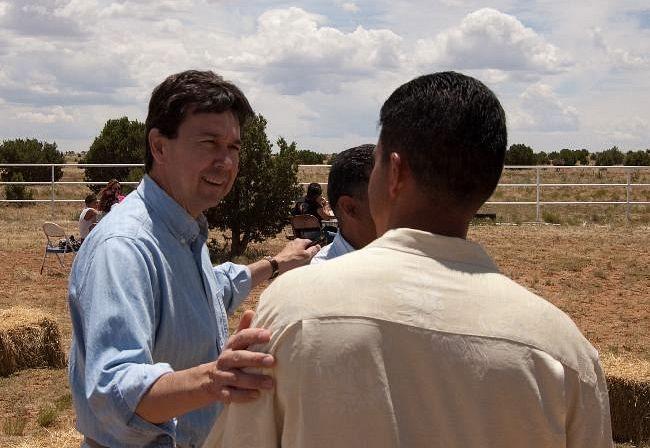
Barela Bucks Party on Immigration in New Mexico
Published Oct. 13, 2010 • Read time: 5m
ALBUQUERQUE, N.M. - Republican House candidate Jon Barela was returning from a recent trip to the southern part of his state to visit his parents in Las Cruces when he was stopped at a border patrol station.
Barela's father had recently suffered a stroke, so the former Albuquerque public school board official was preoccupied and had not shaved in a week when he was stopped at the patrol station in his older car.
"I looked as tired as I was," Barela recalled in an interview with RealClearPolitics on Tuesday. "They never stop me, and if they do, they say, ‘You American?' Yeah. ‘Hit the road.' The one time I look like a vagabond or somebody who just didn't look the part of being a professional, or whatever you want to say, ‘Oh man, pull over. Where are you going? Why were you in Cruces?'"
Barela said his story was one of many that reveal the fruitlessness of profiling in border security, which he calls the "first priority" of immigration reform.
"I don't consider that very effective border enforcement," Barela said. "You go to Israel, and it's a totally different ballgame. Everybody is given the once over. You go to other foreign countries, and they have a much more serious approach toward dealing with people. There's a fine line there between personal liberty and harassment versus legitimate border security."
Jobs and the economy are the most salient issues in this House district, which Democrat Martin Heinrich represents. In 2008, Heinrich became the first Democrat to represent the district since it was drawn in 1969. But New Mexico's border state status and the 1st District's plurality of Hispanic voters ensures that immigration reform remains a pressing issue here.
The Rise and Fall of Marco Rubio
An Invasion of Artificial Outrage
Obama Administration Tells Agents to ID Which Immigrants Not to Deport
Green Shoots of Sanity?
While Barela's insistence on securing the border first is a position that Republican candidates share nationwide, his support for a temporary guest worker program puts him at odds with members of his own party.
"Sure we need to secure the border, but I break ranks -- or excuse me, I have a different view -- than perhaps some in our party leadership have on that issue," Barela said. "Civil rights, I'm a little more moderate on. I don't know what you call it -- moderate, more independent-minded on civil rights."
Barela added that he's "not a round ‘em up, and throw ‘em out guy" and that Congress needs to devise a program which accommodates immigrants regardless of status.
"Offer them an opportunity to enter this temporary -- emphasize temporary -- guest worker program so we can account for them, they can be subjected to a background check, and those who don't get into a guest worker program, I'm going to assume are here for the wrong reason, and we go after them," Barela said. "I think people misperceive a lot of our positions, who support some sort of temporary status, is that being the priority of immigration reform. No, the priority in immigration reform is first and foremost border security. Then we talk about the subsequent things we do to fix the immigration issue."
Barela said that he does not support the DREAM Act, which would provide temporary residency for qualified alien students. Heinrich supports the bill, which was most recently included in the 2010 National Defense Authorization Act but was filibustered in the Senate.
Barela said that he could not support a bill that he deemed an "immediate path" to citizenship, but he took issue with the refrain used frequently within his own party: that granting a path to citizenship for illegal aliens was akin to "amnesty."
"Being the old lawyer, words mean something," Barela said. "Amnesty is where you totally forgive the crime and you pardon them basically. We're not pardoning anybody. We're basically giving them temporary status. If they want to become citizens, they have to go to the back of the line. It may take them many years."
On education, Barela said he didn't support the Bush administration's push for No Child Left Behind when he was working in public education. But as far as Barela's party leadership goes in the House, the candidate suggested that because Minority Leader John Boehner and his lieutenants have not been in power, they have not been able to put forward an agenda to follow.
He pointed out that New Mexico's 1st District remains "a bellwether district in a bellwether state," but independents in the district have not seemed to turn en masse from Heinrich, in spite of the difficult national climate for Democrats.
The race remains a toss up according to RealClearPolitics, but Heinrich has maintained a slight lead in recent polls.
After Heinrich's 2008 victory, national Democrats quickly deemed him a rising star in the party and seemed confident that his district would remain safely in their hands going forward.
But Barela isn't buying that hype, even as Heinrich appears to be faring better than other incumbent Democrats who have similar profiles, as the campaign enters its final stage.
"There are a lot of rising stars, which they're having to protect this year," Barela said of the Democrats.

Jon Finer’s Old and Dangerous ‘New Approach’ to Israel
Peter Berkowitz • RealClearPolitics
The President Deserves Better
John Ullyot • RealClearPolitics
Congress Doesn’t Need Another Blame Game. It Needs To Find What’s Broken
Jarrod Bernstein • RealClearPolitics
Democrats Won the Midterms. Common Sense Won, Too
Jordanne Kemper • RealClearPolitics
The 120th Congress Shapes Up
Carolina Lumetta • RealClearPolitics
Flooding GOP Primaries With Democrats
Robert Natelson • RealClearPolitics
RCP Today
Top stories on RealClearPolitics
The Takeaway
Polling intelligence and analysis delivered to your inbox
World News
Featuring the latest world news
Policy
Featuring the latest policy news
Support Our Mission
As part of RealClearPolitics, authors aim to provide balanced, non-partisan analysis by presenting top reporting and commentary from all sides of the political spectrum.
Trusted by policymakers and citizens alike since 2000