
National Tailwind? This Republican Takes Local Tack
Published March 21, 2014 • Read time: 6m
Facebooks photos
How confident are national Republicans about their House prospects in 2014?
So confident that even the low-expectations game -- typically a cornerstone of any electoral communications strategy -- is going out the window.
Earlier this week, RNC Chairman Reince Priebus predicted a “tsunami-type” GOP victory in the midterms, citing as harbingers the still “poisonous” nature of Obamacare and the GOP triumph in last week’s special election in Florida’s 13th Congressional District.
But as eager as Republicans are to go on offense, if they have any realistic hope of expanding their House majority, they must defend their territory in a handful of key races in which party incumbent are facing serious challenges.
National Democrats have identified 35 GOP-held districts that they believe can be turned blue. Of these, 18 districts that President Obama carried in 2012 offer particularly strong opportunities for pickups in what is otherwise shaping up to be a tough year for the minority party.
But with the current House composition of 233 Republicans and 199 Democrats, even their best-case scenario offers little possibility of a Democratic takeover heading into the last two years of Obama’s second term.
“The midterm dynamic is that the president’s party almost always loses seats or ground, and that’s particularly pronounced when the president is not popular,” said Kyle Kondik, who analyzes congressional races at the University of Virginia Center for Politics.
With the president’s job approval now down to 43.4 percent, according to the latest RealClearPolitics polling average, his unpopularity figures to offer an additional cushion for some of those vulnerable Republicans running in districts Obama carried in 2008 and 2012.
One of the more compelling opportunities for Democrats to gain ground in the lower chamber comes in Republican Rep. Chris Gibson’s seat in New York’s 19th District, which stretches across the Hudson Valley north of New York City.
A couple of key underlying metrics in this race suggest why it is such an enticing target.
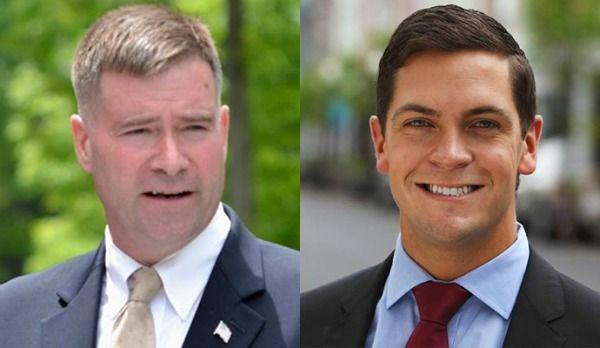
As a member of the majority party in a Congress with an approval rating hovering around 10 percent nationally, Gibson is a second-term lawmaker in a district Obama carried by six points in 2012. To make matters even more complicated for the incumbent, his presumed Democratic opponent, Sean Eldridge (pictured at right), is a partially self-funded millionaire with national name recognition in elite Democratic circles. And the likely challenger has thus far outperformed Gibson, a decorated Army combat veteran, in drawing money from sources other than his own bank account.
Given Obama’s sinking approval rating, Republican strategists on the whole want to nationalize the midterms, hoping to capitalize on difficulties the party holding the White House historically must contend with in the sixth year of a presidency.
Gibson’s plan, however, is to do exactly the opposite. It rests on the somewhat counterintuitive notion that the best survival strategy for the most vulnerable House Republicans is to localize their races.
“All politics are local, so what you’ll see in November is really the manifestation of that,” Gibson said in an interview with RealClearPolitics. “I have a message that really resonates in the district: It begins with service.”
His re-election strategy can be summed up by an old political maxim, which his campaign hopes will continue to apply, even in an era when the vast majority of voters have little faith in government’s ability to work for them: People may hate Congress on the whole, but they generally like their own representative.
Democrats, on the other hand, argue that a prevailing anti-incumbent mood and the Democratic leanings of districts such as Gibson’s will hold sway.
“They don’t like their congressman who voted to keep the government shut down, who voted to repeal, not fix, the Affordable Care Act, and who voted persistently to undermine the economic strength of women,” Rep. Steve Israel, who chairs the Democratic Congressional Campaign Committee, said in response to Gibson’s comments.
To play offense in NY-19 and other districts that offer pickup opportunities, Democrats are also aiming to keep the debate at the local level, albeit with a twist.
Israel encourages his recruits to run almost mayoral-type races, while at the same time pinning their opponents to national Democratic charges of Republican extremism and aloofness.
“The pundits talk about how historic trends suggest the president’s party loses seats, but there is a new history in 2014 that has never been less favorable to Republicans,” Israel asserted. “We’re running against a Republican Congress that shut down the government, wages a war on women and jobs and has a historically low approval rating.”
While Republicans undoubtedly took a hit in public perceptions after last fall’s government shutdown, GOP strategists are confident that more recent memories of the disastrous rollout of the Affordable Care Act and continued questions about its further implementation will supersede those negative impressions of Republicans.
While Gibson did join his party colleagues in voting to defund Obamacare, on the stump and in interviews on the trail, he tends to steer away from the issue that has long been at the forefront of national policy discourse. When health care comes up, as it often does, he notes that there are some aspects of the law that should stay and some that should be repealed.
But Gibson prefers to emphasize his record on what he calls “constituent-driven legislation,” including the farm bill, Lyme disease prevention, broadband expansion, flood relief measures, and tourism development.
“I feel very warm support, not just from Republicans and independents, but from Democrats, because they see in a cynical age rife with partisanship that I’m putting service first,” he said.
So far, at least, this strategy appears to be paying dividends.
When the DCCC earlier this month announced its “Red to Blue” program, the 19th District of New York was not among the Democratic campaign arm’s top 16 targets. Instead, it was listed as one of a dozen “emerging races” that the DCCC is “working hard” to put into contention.
Gibson was a top Democratic target in 2012 but managed to win by the same margin that Obama did in his district.
“In this case, Democrats really have to portray Gibson as a pawn of his party’s right wing, and that’s why it’s going to be difficult” to defeat him, said David Wasserman of the non-partisan Cook Political Report. “Part of the problem for Democrats is that the Republicans in these Obama districts actually fit these districts quite well.”

RCP Today
Top stories on RealClearPolitics
The Takeaway
Polling intelligence and analysis delivered to your inbox
World News
Featuring the latest world news
Policy
Featuring the latest policy news
Support Our Mission
As part of RealClearPolitics, authors aim to provide balanced, non-partisan analysis by presenting top reporting and commentary from all sides of the political spectrum.
Trusted by policymakers and citizens alike since 2000