
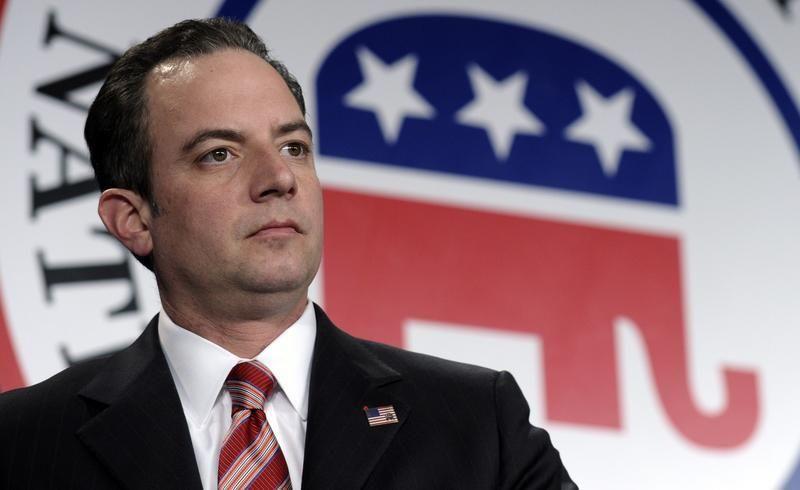
RNC Chair: 2014 Will Be "Tsunami" for GOP
Published March 18, 2014 • Read time: 5m
Join the Conversation
0The head of the Republican National Committee doesn't see a wave election for his party in November. Instead, Reince Priebus is predicting something bigger and more powerful: "I think we're in for a tsunami-type election in 2014."
With Election Day still eight months away, the RNC chairman sounded confident Tuesday that the GOP would gain several Senate seats, possibly enough to take the majority, and perhaps also expand the party’s hold on the House.
“My belief is that it’s going to be a very big win, especially at the U.S. Senate level, and I think we may even add some seats in congressional races,” he told reporters at an event sponsored by the Christian Science Monitor in Washington.
While a bold pronouncement this far out, Priebus’ prediction isn’t unfounded. Republicans need to gain six seats to win a majority in the Senate, and their path winds through several states that President Obama lost in 2012 and where he is unpopular. Those states -- Arkansas, Alaska, Louisiana, Montana, North Carolina, and South Dakota -- have seats currently held by Democrats and therefore are favorable terrain for Republican pickups. But the party is also hoping to pad its odds by running viable candidates in places the president won, including Colorado, Virginia, Michigan, and possibly New Hampshire.
While the map favors the GOP, Democrats are playing offense in traditionally difficult states like Georgia (where they have coalesced around Michelle Nunn and Republicans are embroiled in a contentious primary) and in Kentucky (where newcomer Alison Lundergan Grimes is challenging Senate Minority Leader Mitch McConnell). Democrats hope divisive Republican primaries will weaken the general election candidate, and argue that the incumbents up for re-election have survived a difficult climate before.
But the circumstances in 2014 are very different from 2008, when many of those Democrats were elected or re-elected and when Barack Obama was popular and a help to fellow party members rather than a hindrance. Republicans say the president’s lagging poll numbers will weigh down Democrats, and that, given the now-implemented health care law, the political climate is now “toxic” for them.
Priebus pointed to last week’s Republican victory in a special election for Florida’s 13 Congressional District: “You had the nationalization of Barack Obama and Obamacare … a poisonous issue for Democrats, just like there were national issues that really hurt us in 2008 and 2006. That’s going to happen in 2014.”
But the potential for Republican victories also raises significant questions related to governing and to the open 2016 presidential contest.
If Republicans do take the Senate majority, there nonetheless will be limits to the party’s power, as a Democrat will still occupy the White House. However, Priebus said that dynamic would give the party “a much better opportunity to box the president in.”
More importantly, he argued, victory in 2014 is required for a similar outcome in 2016, when the presidential race dynamics will be much different from those of the midterm.
“I need to and we need to at the RNC make sure that we can capture the positives and the benefits that we’ve been able to provide in 2014 and build on that to have success in 2016, which is a very different type of election, with different issues that move the electorate,” Priebus said.
“The question is whether or not we can build on that to get to 2016, put a candidate on the ballot that people want to sit down and have a beer with and be a party that can speak to people’s hopes and aspirations and how they feel, and whether they like and relate to the person we have on the ballot.”
Priebus’ comments came one year after the RNC released its “autopsy” report in the wake of the 2012 defeat; the report outlined the GOP’s deficits, including negative public perceptions of it, as well as ways to improve and expand the party’s appeal. (Priebus' DNC counterpart, Debbie Wasserman Schultz, held a press conference Tuesday morning to assert that the report's goals have not been realized.)
The 2016 field for Republicans appears wide open, with potential candidates ranging from Chris Christie to Paul Ryan to Rand Paul to Ted Cruz. The RNC hopes to strengthen the primary process by having fewer debates and by hand-picking moderators, and moving up the date of the national convention. Republicans say they are also boosting their voter data and turnout models and expanding their efforts on the ground to compete with the Democrats’ robust programs.
But unaddressed policy issues remain, such as immigration reform, that figure to play a significant role in 2016. In the RNC’s autopsy report, Priebus backed reform as a necessary way to broaden the party’s appeal after Mitt Romney won only 27 percent of Latino voters. A bipartisan comprehensive reform bill passed the Senate last June, but the GOP-led House has refused to take it up. House Speaker John Boehner introduced a set of reform “principles” earlier this year, but later dismissed the possibility of legislation after outcry from his conference.
Priebus insisted that the party is making advancements in Latino communities at the local level, and cautioned against “impos[ing] your definition of what comprehensive immigration reform is. … I think we do need to tackle this issue, and I think there’s general agreement that that needs to happen, but I don’t believe there’s agreement as to what that package looks like.”



RCP Today
Top stories on RealClearPolitics
The Takeaway
Polling intelligence and analysis delivered to your inbox
World News
Featuring the latest world news
Policy
Featuring the latest policy news
Support Our Mission
As part of RealClearPolitics, authors aim to provide balanced, non-partisan analysis by presenting top reporting and commentary from all sides of the political spectrum.
Trusted by policymakers and citizens alike since 2000