
Stepping Back From the 'Abyss of Destruction'
Published Oct. 28, 2022 • Read time: 4m
Join the Conversation
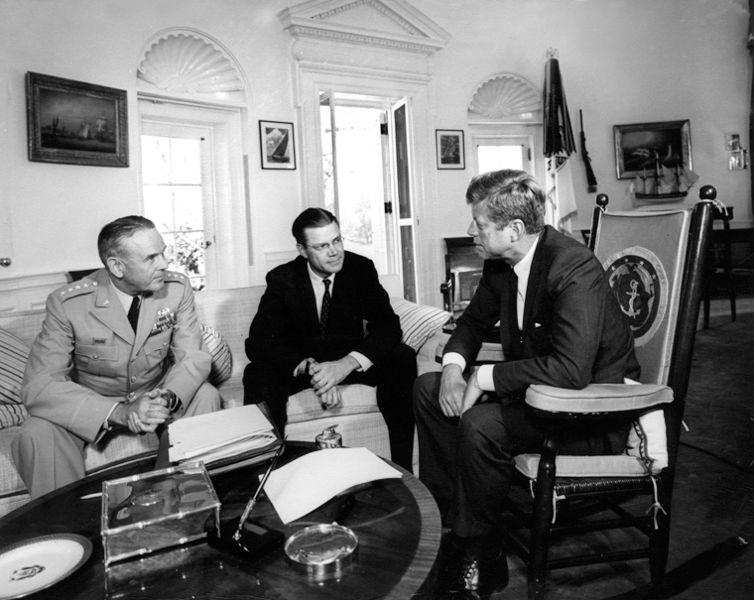
0It’s Friday, the day of the week when I like to pass along a quotation intended to be uplifting or enlightening. Today’s words of wisdom come from a former cabinet officer in John F. Kennedy’s administration. It was 60 years ago today that Soviet premier Nikita Khrushchev agreed to remove nuclear arms from Cuba, ending the 13-day standoff that had put the world, in President Kennedy’s ominous phrase, at “the abyss of destruction.”
Anyone old enough to remember the Cuban Missile Crisis knows it was no joke. Elementary schools practiced “duck and cover” drills in lieu of fire drills. That's right: In the event of Armageddon, children were to drop to the floor and hide under their desks – as if that would mitigate the effect of a hydrogen bomb blast. Thousands of American families began building bomb shelters in their back yards. But what was the real fallout from JFK's standoff with Khrushchev?
“We were eyeball to eyeball and the other guy blinked,” was how Secretary of State Dean Rusk put it. But that’s not quite what happened. And in this instance, the impulse of Kennedy’s advisers and biographers toward hagiography simultaneously glorified JFK and shortchanged him, while creating a potentially dangerous mythology.
In truth, the young American president bargained with his Soviet counterpart, negotiations that produced two U.S. concessions. First, JFK promised publicly not to invade Cuba. This was primarily a face-saving device Khrushchev designed for Fidel Castro's benefit. Second, the Kennedy administration agreed to remove some U.S. nuclear missiles based in Turkey.
Rethinking the Pledge; Trump and Women; One Last Egg Roll; Eulogizing Ike
2016: A Repeat of the 1960s
An Apology, Fashioned for Nancy Reagan
Nancy Reagan, Guardian of a Legacy
It’s normal for White House sycophants to extol a president's virtues, but in his compelling book “When Presidents Lie,” Eric Alterman teases out the theme in the Cuban Missile Crisis. He concludes that the adulatory portrait of a commander-in-chief with such cool-headed machismo was one of the factors that led Lyndon Johnson to escalate the war in Vietnam.
In Alterman's telling, LBJ wanted to show Bobby Kennedy that he could be as tough as his martyred brother. A more balanced view of President Kennedy's actions during the Thirteen Days, in other words, might have done his successors a greater service.
What is the moral of this story in our time, when a less stable and more histrionic Russian leader is openly threatening to deploy nuclear arms?
While running for president in 1960, Jack Kennedy had repeatedly claimed that Dwight Eisenhower’s administration had allowed a dangerous "missile gap" to develop between the United States and the Soviet Union. This was untrue, which Kennedy knew.
The real story, as Benjamin Schwarz wrote in The Atlantic nine years ago, was that at time of the Cuban Missile Crisis, the Soviet Union had 36 intercontinental ballistic missiles (ICBMs), 138 long-range bombers with 392 nuclear warheads, and 72 submarine-launched ballistic-missile warheads (SLBMs). “These forces were arrayed against a vastly more powerful U.S. nuclear arsenal of 203 ICBMs, 1,306 long-range bombers with 3,104 nuclear warheads, and 144 SLBMs – all told, about nine times as many nuclear weapons as the U.S.S.R.,” Schwarz noted. “Nikita Khrushchev was acutely aware of America’s huge advantage not just in the number of weapons but in their quality and deployment as well.”
And so, Khrushchev behaved not only humanely in looking for a way out of the crisis, but rationally. Is Vladimir Putin rational? The whole world hopes so, despite disturbing evidence to the contrary.
But even nations guided by rational leaders often pursue irrational courses of action, war being among the most obvious. And nuclear war, often described as “unthinkable,” would be the most irrational possible course of action. We came close in 1962, and even closer in 1983, when a defective Soviet early warning system mistook the sun’s reflection off a cloud for a missile launch. A cool-headed Russian military officer named Stanislav Petrov trusted his gut instinct instead of established procedures dictated by a machine, thereby saving the world. We were lucky, in other words. And not for the first time.
As he wrote his memoirs two decades ago, Kennedy administration Secretary of Defense Robert McNamara ruminated on this idea while discussing 13 fateful days in October 1962.
“I want to say, and this is very important: at the end we lucked out,” McNamara wrote. “It was luck that prevented nuclear war. We came that close to nuclear war at the end. Rational individuals: Kennedy was rational; Khrushchev was rational; Castro was rational. Rational individuals came that close to total destruction of their societies. And that danger exists today.”
And that is our quote of the week.

Congress Doesn’t Need Another Blame Game. It Needs To Find What’s Broken
Jarrod Bernstein • RealClearPolitics
Democrats Won the Midterms. Common Sense Won, Too
Jordanne Kemper • RealClearPolitics
The 120th Congress Shapes Up
Carolina Lumetta • RealClearPolitics
Flooding GOP Primaries With Democrats
Robert Natelson • RealClearPolitics
Washington Keeps Rewarding Oracle—Veterans Keep Paying the Price
Darin Gaub • RealClearPolitics
The Seeds of Unrestricted Warfare
John Teichert • RealClearPolitics
RCP Today
Top stories on RealClearPolitics
The Takeaway
Polling intelligence and analysis delivered to your inbox
World News
Featuring the latest world news
Policy
Featuring the latest policy news
Support Our Mission
As part of RealClearPolitics, authors aim to provide balanced, non-partisan analysis by presenting top reporting and commentary from all sides of the political spectrum.
Trusted by policymakers and citizens alike since 2000