
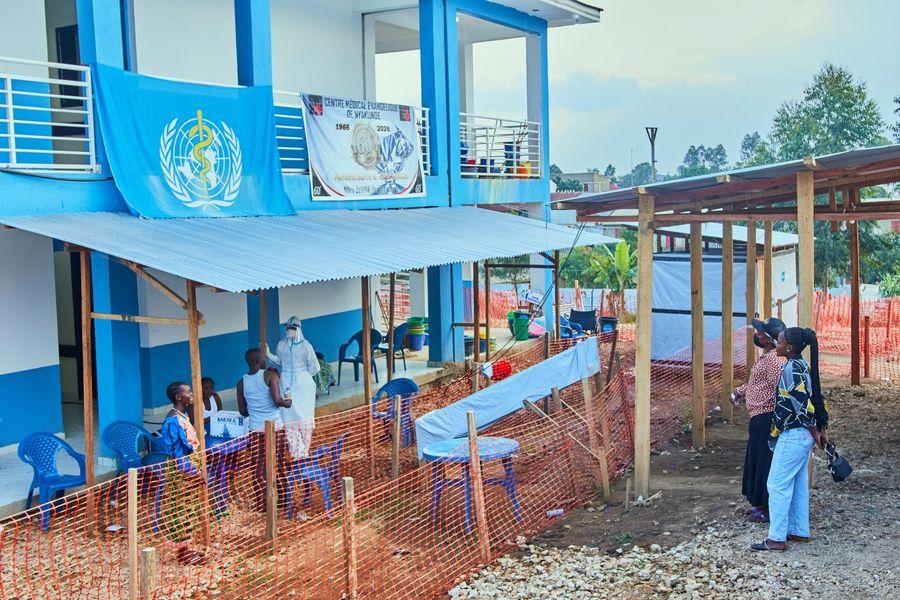
Ebola Trials
The Scramble To Contain Ebola in Democratic Republic of Congo and Uganda
Published July 7, 2026 • Read time: 6m
The World Health Organization and the Africa Centers for Disease Control and Prevention are scrambling to contain a fast-moving Ebola outbreak in the Democratic Republic of Congo and Uganda that has claimed nearly 400 lives and sparked alarm across the globe.
Their joint $518 million response plan aims to contain the rare Bundibugyo strain driving the outbreak – even as health officials warn they are “playing catch up” in trying to stymie the rate of infection.
Officials note that there is no approved treatment or vaccine for the Bundibugyo strain. The rate of infection signals that this may become one of the deadliest Ebola outbreaks, with more than 1,000 cases of infection reported to date. The last major outbreak, from 2014 to 2016, numbered 11,325 reported deaths over the course of two years. Most of the lives lost were in Guinea, Liberia, and Sierra Leone, with scattered fatalities as far away as Spain and Great Britain.
“The only way to beat this outbreak is through close partnership, working together under the leadership of the affected countries in one coordinated effort, guided by a simple principle: One plan, one budget, one team,” proclaimed WHO Director-General Dr. Tedros Adhanom Ghebreyesus. “Containing Ebola depends on political commitment, sustained financing, and the trust and engagement of communities. This plan places communities at the center, because without their participation, contact tracing falters, safe care is delayed, and transmission continues.”
But the Trump administration’s dismantling of USAID in 2025 and departure from the WHO in 2026 have raised questions about whether its foreign aid strategy can reduce America’s overseas financial commitments without weakening U.S. influence in global health crises.
President Calls Drug Addiction a Health Problem
Lawmakers Hail New Opioid Rules -- But Call for More
No Opiates for the Masses?
Obamacare's Tax-Time Torment
In response to the outbreak, the Atlanta-based Centers for Disease Control and Prevention activated $107 million in emergency funding and dispatched personnel to address surveillance, isolation, diagnostic, and safe burial practices. The scale of the response is significantly smaller than the response to the 2014 Ebola outbreak, when USAID, the CDC, the Defense Department, and the WHO helped coordinate a broader international containment effort. The 2014 outbreak cost the United States more than $2 billion.
Previously, American partnership with the WHO gave Washington a central role in organizing prevention measures abroad. Due to recent executive agency overhaul, the administration’s response relies more heavily on targeted CDC support to address global health crises than on broad foreign aid infrastructure.
“CDC is a leading source of information regarding this outbreak and is working with neighboring countries, including Rwanda, South Sudan, Tanzania, Ethiopia, Kenya, Zambia, and Angola, to strengthen regional preparedness, rapidly identify country-specific needs, and help guide response efforts,” Health and Human Services Press Secretary Emily Hillard told RealClearPolitics.
Since the WHO declared the outbreak two months ago, the CDC assigned more than 500 staff to the response and deployed more than 100 to the field. The CDC also has 71 country office staff in the Democratic Republic of Congo and Uganda.
Within two months of CDC mobilization in the 2014 response, approximately 100 staff members were in West Africa every day. Over the course of the outbreak, more than 4,000 CDC staff worked as part of the response, with 1,897 CDC staff deployed.
Bob Kitchen, an executive with the International Rescue Committee, acknowledged that America is responding aggressively to the Ebola outbreak in Africa, but “with a very small checkbook.”
The Ebola outbreak has put the political dimension of health crises front and center. The Zambian government folded under pressure from China – which funds significant health infrastructure across Africa – to cancel a summit on human rights and digital freedom that Taiwanese activists were rumored to attend.
Domestically, after a personal entreaty from Secretary of State Marco Rubio to Kenyan President William Ruto, Central Kenya allowed a controversial quarantine facility to open for Americans exposed to the virus.
And while Rubio has pointed the finger at the World Health Organization for the worsening outbreak – the WHO “was a little late to identify this thing,” he said last month – others have pinned the massive outbreak to the Trump administration’s deliberate reduction of the U.S. foreign aid footprint.
Ebola has a history of becoming politically divisive in the United States. The current Ebola outbreak, like the previous one, is taking place during midterm election season. A study on the 2014 outbreak by the National Bureau of Economic Research documented how the U.S. response played a role in midterm elections happening at the time.
In those pre-pandemic days, Ebola garnered more attention than other threats, including SARS, swine flu, or anthrax. Many candidates capitalized on the perceived threat to criticize U.S. immigration policies. According to the NBER study, this strategy proved effective.
“Politicians responded to the Ebola scare by mentioning the disease in connection with immigration and terrorism in newsletters and campaign ads,” the report said. “This response came only from Republicans, especially those facing competitive races, suggesting a strategic use of the issue in conjunction with topics perceived as favorable to them.”
Barack Obama was president at the time. Today, a Republican is in the White House, and Democrats are using the same tactic – lambasting the impact of the administration’s healthcare policies on everything from measles flareups to an Ebola outbreak that has yet to reach U.S. shores.
In a June 9 letter to Secretary Rubio, a contingent of Senate Democrats outlined their objections to the administration’s response:
“The Trump Administration’s withdrawal of global health funding that once supported outbreak detection and surveillance across parts of Africa has led to the erosion of the international disease-monitoring infrastructure relied upon to identify and contain emerging infectious diseases,” the senators wrote. “This erosion has been compounded by the Administration’s broader underfunding of global health security and other global health programs, despite bipartisan congressional support for sustained funding for such programs.”
Dr. Leana Wen, emergency physician and prolific commentator during the coronavirus pandemic, made a similar point.
“These outbreaks are unfolding at a time when the U.S. public health infrastructure is under significant strain,” she told KFF Health News. “The CDC currently lacks a director, the FDA lacks a director, there is no surgeon general, and many leaders with outbreak response management experience have left the federal government.”
Support Our Mission
The Internet provides an endless stream of content. Not all of it is worth your time. That's why, every day, RealClearPolitics curates the most essential news and information—from all sides and across mediums. The links, videos, and podcasts curated here are the product of human judgment, not algorithms or AI. Please help power our mission of presenting a thoughtful, balanced public discourse through a tax-deductible donation.
Would you consider supporting us today?
The Danger Before the Attack
Leslie J. Sullivan • RealClearPolitics
Jon Finer’s Old and Dangerous ‘New Approach’ to Israel
Peter Berkowitz • RealClearPolitics
The President Deserves Better
John Ullyot • RealClearPolitics
Congress Doesn’t Need Another Blame Game. It Needs To Find What’s Broken
Jarrod Bernstein • RealClearPolitics
Democrats Won the Midterms. Common Sense Won, Too
Jordanne Kemper • RealClearPolitics
The 120th Congress Shapes Up
Carolina Lumetta • RealClearPolitics
RCP Today
Top stories on RealClearPolitics
The Takeaway
Polling intelligence and analysis delivered to your inbox
World News
Featuring the latest world news
Policy
Featuring the latest policy news
Support Our Mission
As part of RealClearPolitics, authors aim to provide balanced, non-partisan analysis by presenting top reporting and commentary from all sides of the political spectrum.
Trusted by policymakers and citizens alike since 2000