
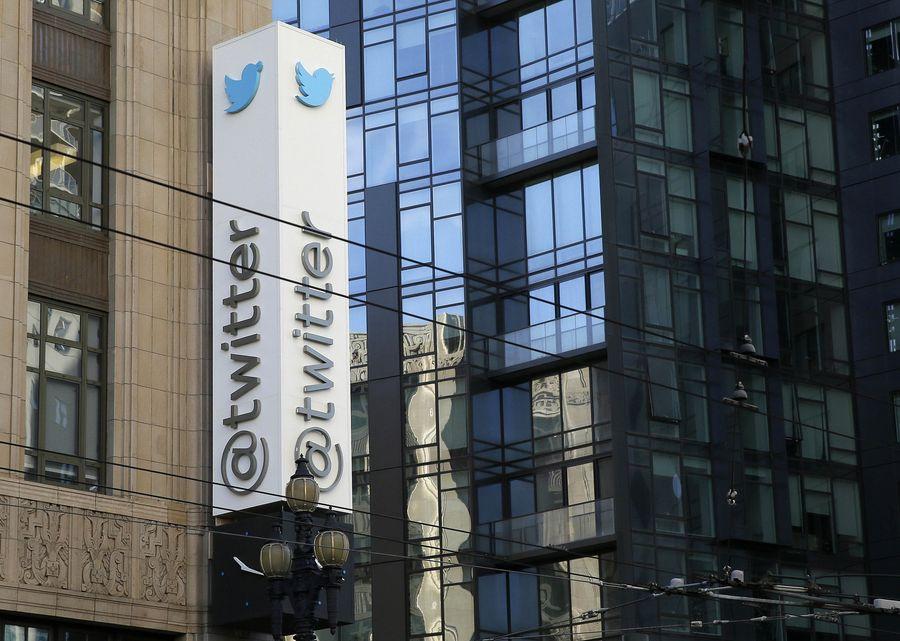
FILE - This Dec. 16, 2014, file photo shows Twitter headquarters in San Francisco. On Tuesday, Jan. 23, 2018, Twitter announced that chief operating officer Anthony Noto is leaving the social media giant to lead another company. Noto is joining Social Finance Inc., an online lender, as chief executive and a director. (AP Photo/Eric Risberg, File)
Let's Create 'First Amendment Zones' on Social Media
COMMENTARY
Published Oct. 31, 2020 • Read time: 5m
The perils of political censorship on the giant social media sites have now become obvious. But what’s the solution? One path would be to create "First Amendment zones" on each site, where political speech would be treated identically to speech in the public square. Even if no law is enacted, two Supreme Court precedents taken together -- Marsh v. Alabama and Packingham v. North Carolina -- make a strong argument that such zones already exist pursuant to the Constitution itself.
The Senate held hearings Thursday on Section 230. This 1996 rule gives sites such as Facebook, Google and Twitter two legal privileges: freedom from liability for the messages they carry, and freedom to moderate and restrict these messages.
The first notion makes sense because the sites often act like a common carrier telephone network, transmitting millions or billions of messages on behalf of others each day. The second notion, though -- the right to moderate -- can easily become censorship of free speech. Indeed, it has become censorship in numerous cases, such as Twitter’s recent restrictions on the New York Post's report on Hunter Biden's "computer from Hell," and a similar block placed against speech by the White House press secretary herself.
True, social media companies are private entities, while the First Amendment was written to restrict government action. However, the Supreme Court has long made clear that the First Amendment can be applied to private companies if the company has become the de facto "public square" itself. In Marsh, a 1946 case decided on a 5-3 vote in a decision written by First Amendment champion Hugo Black, the court found that free speech cannot be censored on the streets of a company town, even though the company owned and built those streets: "When we balance the constitutional rights of owners of property against those of the people to enjoy freedom of press and religion, as we must here, we remain mindful of the fact that the latter occupy a preferred position,” Black wrote. “As we have stated before, the right to exercise the liberties safeguarded by the First Amendment 'lies at the foundation of free government by free men.'"
When Protesters Trample Trump's Rights
Donald Trump Should Read Up on Libel Laws
The Left May Well Get Trump Nominated
Trump Foes Should Stay Off His Stage
Then, in the 2017 case of Packingham v. North Carolina, the court made clear that social media has become the preeminent "public square" of our own day.
In Packingham, the court unanimously ruled that North Carolina could not restrict registered sex offenders from the use of social media such as Facebook, because such social media had become too central to First Amendment freedoms. "A fundamental principle of the First Amendment is that all persons have access to places where they can speak and listen, and then, after reflection, speak and listen once more,” said the court in a majority opinion written by Anthony Kennedy. He continued:
“The Court has always sought to protect the right in this spatial context. ... While in the past there may have been difficulty in identifying the most important places (in a spatial sense) for the exchange of views, today the answer is clear. It is cyberspace -- the ‘vast democratic forums of the Internet’ in general and social media in particular. Seven in ten American adults use at least one Internet social networking service. ... Facebook has 1.79 billion active users. This is about three times the population of North America."
Facebook has added roughly a billion users since Justice Kennedy wrote that opinion, and Google, Twitter, and other sites have grown massively as well. It would cripple political debate in this country if only Democrats could access the giant social media sites while all Republicans were blocked, or if only Republicans had access while all Democrats were censored.
Congress should therefore amend section 230 to create "First Amendment zones" on the giant social media sites where political speech is treated identically to the way that same speech would be treated in the actual public square. In other words, if the New York Post story could be read in Central Park, then it can be read on Twitter. If President Trump's press secretary could make her remarks on a Washington, D.C., street corner, then she can make them on Facebook.
Even under the First Amendment, there are still penalties for slander, libel, child pornography, disclosure of troop movements, criminal conspiracies, incitements to violence ... and these penalties would continue to exist for speech on social media just as they do for speech in the public square. But the regulation would be done by the same laws and enforcement mechanisms as used today, not by the whims of Dorsey, Zuckerberg, a "fact checker" or anyone else.
So long as a speaker (even one using the great American tradition of a pen name) can ultimately be traced back to a known human who can be held accountable for the speech (in contrast to, say, a Russian bot), then the social sites should neither moderate that speech nor be held responsible for the speech. A walled garden of debate would be established. Free speech, the necessary predicate for our democracy, would be preserved.

Congress Doesn’t Need Another Blame Game. It Needs To Find What’s Broken
Jarrod Bernstein • RealClearPolitics
Democrats Won the Midterms. Common Sense Won, Too
Jordanne Kemper • RealClearPolitics
The 120th Congress Shapes Up
Carolina Lumetta • RealClearPolitics
Flooding GOP Primaries With Democrats
Robert Natelson • RealClearPolitics
Washington Keeps Rewarding Oracle—Veterans Keep Paying the Price
Darin Gaub • RealClearPolitics
The Seeds of Unrestricted Warfare
John Teichert • RealClearPolitics
RCP Today
Top stories on RealClearPolitics
The Takeaway
Polling intelligence and analysis delivered to your inbox
World News
Featuring the latest world news
Policy
Featuring the latest policy news
Support Our Mission
As part of RealClearPolitics, authors aim to provide balanced, non-partisan analysis by presenting top reporting and commentary from all sides of the political spectrum.
Trusted by policymakers and citizens alike since 2000