
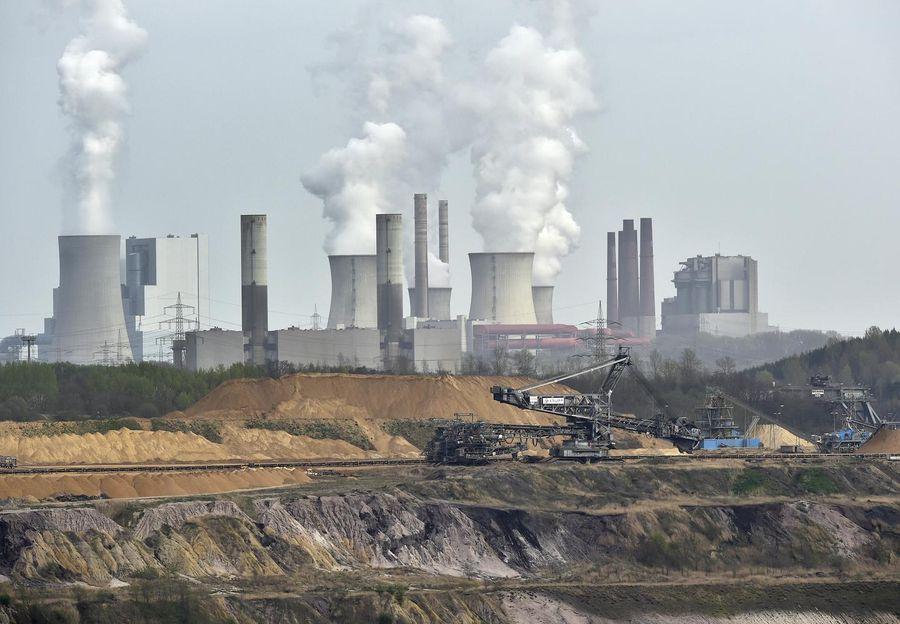
FILE - In this April 3, 2014 file photo giant machines dig for brown coal at the open-cast mining Garzweiler in front of a smoking power plant near the city of Grevenbroich in western Germany. The world is nowhere near on track to achieve the ambitious temperature goals adopted in the landmark Paris Agreement on climate change, the U.N. said Thursday Nov. 3, 2016, warning of a worldwide human tragedy unless governments step up efforts to fight global warming.  (AP Photo/Martin Meissner, File)
Trump's Election Jolts Energy and Environmental Policy
Published Nov. 10, 2016 • Read time: 4m
Donald Trump’s upset victory in the presidential election changes everything in terms of energy and climate politics in the United States.
And many of those changes can be made by the incoming president swiftly, without congressional approval.
That because so many of President Obama’s environmental regulations were based on executive action – something a President Trump will be able reverse with a stroke of a pen.
Larger items on the agenda, such as shrinking the authority of the Environmental Protection Agency, will need congressional action, but given that Republicans have retained control of both chambers of Congress, many things seem possible legislatively that had appeared impossible only two days ago.
At a bare minimum, Trump will likely follow through on his vow to scrap the Clean Power Plan, which in turn would undermine U.S. promises to cut total U.S. greenhouse gas emissions by 26 percent to 28 percent below 2005 levels by 2025. The president-elect also promised to end billions of dollars in payments to the Green Climate Fund, which allocates money to developing nations.
“It’s virtually certain that the Clean Power Plan will be revoked,” said Jeff Holmstead, an attorney with the Washington, D.C.-based Bracewell law firm and a former assistant EPA administrator. “The only question is how. How they do it will depend on how it goes in the court cases. I’m hearing from the people in the [Trump] transition that they will follow through on the promise.”
Climate Policy
Trump’s election also has upended the global near-consensus on climate policy, given his skepticism of global warming and embrace of the coal industry.
The United States has been the indispensable nation concerning global warming politics since the Kyoto Protocol in 1997. Environmentalists had hoped the Paris Agreement of December 2015 was the final nail in the coffin of climate skeptics and locked in a permanent, binding agreement curtailing emissions – and future fossil fuel development – for the rest of the century.
Enter Donald Trump. He is the only candidate to become a head of government in the past several years who rejects the scientific consensus on climate change. Between calling that science “a hoax” and actively supporting the U.S. coal industry’s recovery, his ascent could result in the U S. withdrawal from the 1992 Climate Convention Treaty, which underpins the Paris Agreement.
It’s difficult to underestimate how large a political earthquake this would be for many of the world’s left-leaning political classes. The primary focus of European industrial and foreign policy in the last 20 years has been built around climate change treaties, while China has dramatically adjusted its energy production system to come into alignment with U.S. and other developed-economy climate goals. Now, the U.S. will likely entirely reverse its stance, possibly putting China’s planned economy under duress.
Suffice to say, the environmental community is beyond unhappy about Trump’s election to the highest office in the United States. Given the stark divide in worldviews – on the risks of climate change and the value of fossil fuels – it’s likely that a Trump administration and the environmental community will have a very contentious relationship, replete with protests and perhaps even violence.
“Trump must choose whether he will be a president remembered for putting America and the world on a path to climate disaster, or for listening to the American public and keep us on a path to climate progress,” said Michael Brune, executive director of the Sierra Club.
Energy Regulations
Much of Obama’s second term has been focused on tightening carbon emissions and expanding the scope of environmental regulation of the oil and gas industry. He did most of this by executive order. Below is a short list of regulations that could be repealed or changed within the first several months of a Trump administration by a simple order from the new president:
- New source rules on new power plants
- Methane regulations on pipelines and natural gas gathering facilities
- Methane emissions from landfills
- An endangerment finding on aviation emissions
- Rules on hydraulic fracking on federal lands
The most important decision on energy and climate in Trump’s first six months will, of course, be the appointment of a new Supreme Court justice. Given the large amount of litigation directly impacting energy production, a politically similar replacement for the late Antonin Scalia, who led the charge against environmental regulation and federal agency overreach, would advance the cause of the energy industry, for sure.



RCP Today
Top stories on RealClearPolitics
The Takeaway
Polling intelligence and analysis delivered to your inbox
World News
Featuring the latest world news
Policy
Featuring the latest policy news
Support Our Mission
As part of RealClearPolitics, authors aim to provide balanced, non-partisan analysis by presenting top reporting and commentary from all sides of the political spectrum.
Trusted by policymakers and citizens alike since 2000