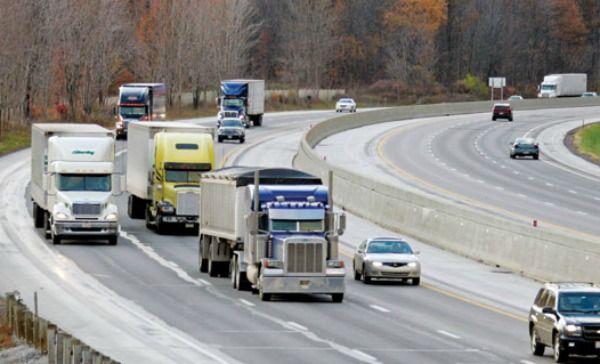
How Obama Could Lower Trucks' Fuel Use Right Away
Published Feb. 20, 2014 • Read time: 4m
OMAHA, Neb. -- Earlier this week, President Obama directed the transportation and energy-related agencies of the federal government to develop higher minimum fuel standards for medium and heavy-duty trucks -- the latest effort in the administration’s effort to reduce the oil consumption that is costly to the U.S. economy and a culprit in global warming.
“Everybody who says you can't grow the economy while bringing down pollution, it's turned out they've been wrong,” the president said. “Improving gas mileage for these trucks is going to drive down our oil imports even further. That reduces carbon pollution even more, cuts down on businesses’ fuel costs, which should pay off in lower prices for consumers. So it’s not just a win-win, it’s a win-win-win. We got three wins.”
The president made his remarks in Upper Marlboro, Md., at a Safeway distribution center while standing beside a big rig that had been re-configured to maximize fuel efficiency. But the backdrop for his announcement could have been any number of places -- including here in Nebraska, where our company, Werner Enterprises, is a leader in the movement toward sustainability and conservation.
At Werner, we rank reducing our carbon footprint as a top company priority. We are not alone. Trucking is competitive industry, and we are engaged in an arms race with other transportation firms to lower fuel consumption and emissions through measures that include idle reduction technologies, aerodynamic trucks, equipping trailers with trailer skirts, tire inflation systems, and continuing to invest in the newest diesel engine technologies.
Senate Heads Toward Approval of Keystone XL Pipeline Bill
GOP Senators Make Case for Keystone; Scott Walker Off To N.H.; FDR on Baseball
New GOP Senators Make Economic Case for Keystone
GOP Stays Stubborn About Climate Change
We also partner with local utility districts to improve the long-term outlook for the use of natural gas-powered equipment and are excited about the future of alternative fuels. Such initiatives, backed by over $850 million of capital investments in our company alone, have allowed us to save more than 85 million gallons of fuel and reduce greenhouse emissions by 1 million tons since 2007.
The federal government has encouraged such efforts: Recently, Werner was honored with an EPA SmartWay® Excellence award for our successful reduction of emissions, carbon, and other criteria pollutants. And the president’s efforts to set target dates for minimum fuel standards is a concept that we support in principle, provided the administration moves ahead in ways that are both economically achievable and technologically feasible.
We believe, however, that there are other areas that would have an even greater impact in reducing emissions of carbon and other pollutants.
Chief among them are desperately needed investments in America’s roadway infrastructure, which would lead to significant improvements in fuel burn and productivity.
Sixty-eight percent of the nation’s freight tonnage is carried by trucks, which are a critical link for all modes of freight movement -- and all of it is highly dependent on a quality highway system. Augmenting the current fuel tax system to raise additional revenues, with all funds dedicated solely to improving the highway system, would reap immediate benefits. Overcrowded roads, decaying bridges, and increased congestion further exacerbate safety, productivity, and efficiency concerns.
In addition, the latest Hours-of-Service (HOS) regulations have added substantial challenges to the nation’s fuel consumption. The newest HOS ruling limits the flexibility of the professional truck driver. As a result, more trucks are traveling during a compressed portion of the day. This requirement alone increases traffic congestion and decreases fuel efficiencies as it adds the equivalent of 70,000-75,000 trucks to an already stressed infrastructure. Revisions to this rule would positively impact fuel efficiencies and increase productivity, and allow the professional driver to rest when fatigued vs. when mandated.
The American Trucking Associations has estimated that the current HOS regulations have reduced productivity by 2 to 3 percent. A recent Wells Fargo Securities study came up with similar results. According to the Wells Fargo analysis, certain fleets may experience even larger productivity losses. These changes are affecting an industry that connects the entire global marketplace. To relieve congestion and increase the efficiency in moving the nation’s truck and intermodal freight, we urge the White House to revert back to the HOS rules that were in place prior to July 1, 2013.
Our industry is proud of our sustainability commitment and results, and applauds the president’s call to action. It is our hope that the administration continues to support efforts to fund, develop, and advance fuel efficient technologies for trucking that are attainable, economically feasible, and jointly researched.
Our industry is not afraid to stand up to challenges. We believe that working together, we can overcome any hurdle. To assist in delivering on the national goal of energy independence, we would respectfully ask that the input, guidance, and experience of the trucking industry are allowed a more active role in the conversation. Call it a “win-win.”

A RealClear Thanksgiving: Investing in a Better Future
David DesRosiers • RealClearPolitics
Trump’s Newsom Problem: Antagonist-in-Chief
Carolina Lumetta • RealClearPolitics
America’s Free Spirit
John Maxwell Hamilton • RealClearPolitics
The GOP Majority Should Go Out in Glory
Daniel McCarthy • RealClearPolitics
Republican Majorities Could Return Sooner Than Expected
J.T. Young • RealClearPolitics
The Danger Before the Attack
Leslie J. Sullivan • RealClearPolitics
RCP Today
Top stories on RealClearPolitics
The Takeaway
Polling intelligence and analysis delivered to your inbox
World News
Featuring the latest world news
Policy
Featuring the latest policy news
Support Our Mission
As part of RealClearPolitics, authors aim to provide balanced, non-partisan analysis by presenting top reporting and commentary from all sides of the political spectrum.
Trusted by policymakers and citizens alike since 2000