
Nikole Hannah-Jones: "Right-Wing Propaganda Campaign" Decided Virginia Governor's Race
Last updated 3:01 PM ET
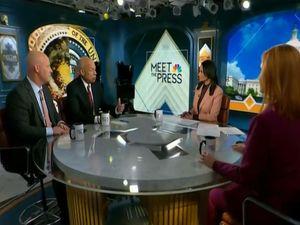
During a conversation with "Meet The Press" host Chuck Todd, Nikole Hannah-Jones, author of "The 1619 Project," said the 2021 governor's race in Virginia was decided "based on the success of a right-wing propaganda campaign" about critical race theory being taught in schools.
"I would say the governor's race in Virginia was decided based on the success of a right-wing propaganda campaign that told white parents that they needed to fight against their children being indoctrinated," she said. "But that was a propaganda campaign."
NIKOLE HANNAH-JONES: It's kind of ironic that we're seeing these bills being passed, these anti-history laws, to make it more difficult to teach about slavery and racism and our country's long history of racism, when in fact, we have educators who are struggling the opposite way. They're having -- holding mock slave auctions in their classrooms. They're having students do assignments where they have to list the pros and cons of slavery because they really don't know how to teach this very well. And that's because as a country, we have not honestly grappled with the truth about our history. And the history we learn is often about national and patriotism, but not about telling the unvarnished truth.
CHUCK TODD: Where should that come from? You know, I've thought about this and, you know, I know that if government says, "This is our history," people are going to say, "Huh, I'm not letting government historians decide what our history is." This seems to be a real challenge in an open society, is how do we get agreement on this, especially when parents want to have -- look, the Virginia's governor's race was arguably decided on the strength of how influential should parents be on the curriculum? How do we do this?
NIKOLE HANNAH-JONES: Well, I would say the governor's race in Virginia was decided based on the success of a right-wing propaganda campaign that told white parents that they needed to fight against their children being indoctrinated as race – as being called racists. But that was a propaganda campaign. And there are a lot of Black parents in Virginia. There are a lot of Latino parents in Virginia. And they were not being featured in that coverage. And what they wanted for their kids' education, which is more teaching about race, more teaching about the history of racism, seemed to have fallen on deaf ears. So I think we should frame that question properly. And I don't really understand this idea that parents should decide what's being taught. I'm not a professional educator. I don't have a degree in social studies or science. We send our children to school because we want them to be taught by people who have an expertise in the subject area. And that is not my job. When the, when the governor or the candidate said that he didn't think parents should be deciding what's being taught in school, he was panned for that. But that's just the fact. This is why we send our children to school and don't homeschool, because these are the professional educators who have the expertise to teach social studies, to teach history, to teach science, to teach literature. And I think we should leave that to the educators. Yes, we should have some say. But school is not about simply confirming our world view. Schools should teach us to question. They should teach us how to think, not what to think.
CHUCK TODD: Is there an age restriction in your mind?
NIKOLE HANNAH-JONES: About teaching what?
CHUCK TODD: Teaching sort of -- when it comes to teaching our past, you know there’s this, and I think this is coming basically through a racial lens, but there’s this, you know, -- parents are saying, "Hey, don't, don’t make my kid feel guilty." And, you know, and I know a parent of color is going, "What are you talking about? You know, I've got to teach reality." When do you do it, and how do you do it?
NIKOLE HANNAH-JONES: Well, I think you should just think a little bit about your framing. You said "parents," and then you said "parents of color." So the white... White parents are not representing -- as a matter of fact, white parents are representing fewer than half of all public school parents. And yet, they have an outsized voice in this debate.
I have a child who, just by watching the news when she was eight years old, she saw Laquan McDonald, a teenager in Chicago, get shot 16 times by police on CBS in The Morning Show. And she asked me, "Why did that -- why did they kill that boy?" So I can't wait to have these conversations with my child. And I don't think that we should be asking, "What is the appropriate age?" I think we should be asking, "What are the appropriate conversations at that age?"
But our children are being raised in a racialized society. They are noticing things. They have questions. And I don't think teaching an accurate rendering of history is about making white children feel guilty. I don’t know an educator -- I've been covering education for two decades. I've never seen a teacher of any race tell a white child, "You are responsible for what happened in the past." I just don't think that that's happening. And even all of the people who have claimed that that has happened have not been able to produce a shred of evidence that that's true. I think some students who are white probably walk away from some of these lessons feeling very uncomfortable, as we should. We should be uncomfortable with the hard parts of our past. And a master educator knows how to give those lessons without making students internalize this -- these feelings of racism.
CHUCK TODD: At the end of the day, this politicizing of this, it's clearly been weaponized. You've described it I think pretty well on the weaponization of it. Do you think simply time will get us past this? How can we get over this hump?
NIKOLE HANNAH-JONES: I don't know, honestly. I'm quite concerned about what's happening in our country because, as you know, my project, which is a work of journalism by The New York Times, is banned by name in Georgia, Florida, in Texas. There are efforts to ban the teaching of this history in Oklahoma, in South Dakota, in Tennessee. And when we think about what type of society bans books or bans ideas, that is not a free and tolerant democratic society. That is a society that is veering towards authoritarianism. So unless people who believe in free speech, who believe in our children being intellectually challenged, begin to get organized and speak up, I think we're going into a dark age of repression and suppression of the truth. And really, these laws are paving the way for the taking of other political rights like voting rights, like women's reproductive rights, like rights for LGBTQ people. So we're going to have to decide what kind of country we want to be.
Latest Videos

In The News
Hakeem Jeffries: Imagine How Angry People Will Be If Washington Fails To Do Anything About Affordability
Face the Nation
Director of National Intelligence: Putin Is "Not America's Friend" But "Entirely Appropriate" For Trump To Say He Is
This Week
Rahm Emanuel: Democratic Voters Aren't Socialists, They're Angry
Bloomberg Politics
Zelensky: Putin Needs To Understand Crimean Bridge "Will Not Stay"
World News0:27
Obama to Jeffries: "You've Got To Figure Out How To Actually Get Sh*t Done With Your Colleagues"
White House
Rubio: The Idea That The U.S., Russia, & China Should Not Engage Is Absurd
White House
Most Watched
Hemingway: Dems Are Being Transparent About Plans For "Political Payback" Against Trump Allies
FOX News ChannelObama to Jeffries: "You've Got To Figure Out How To Actually Get Sh*t Done With Your Colleagues"
White HouseRubio: The Idea That The U.S., Russia, & China Should Not Engage Is Absurd
White House
David Brooks: China-U.S. Power Shift Mirrors Germany-Britain Dynamic Before World War I
PBS NewsHour
Texas Gov.-Elect Hinojosa: I'm An "Economic Populist," "Corporate Interests Have Corrupted Both Parties"
Special Report
Musk: Zelensky Asking To Use Starlink For Offensive Military Actions
World News