
Obama to Jeffries: "You've Got To Figure Out How To Actually Get Sh*t Done With Your Colleagues"
Last updated 8:04 PM ET
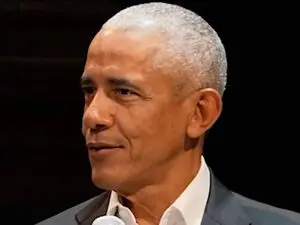
Former President Barack Obama made a surprise visit with Speaker-Designate Hakeem Jeffries, where Obama advised the incoming freshman House Democrats on how to govern.
FORMER PRESIDENT BARACK OBAMA: First of all, I just want to congratulate Hakeem and the entire leadership team. It is challenging in any circumstances to function as the leader of the majority, or of the minority. It's frustrating, particularly the way the House operates these days, unfortunately, the kind of practical problem-solving working across the aisle doesn't exist.
The way in which Hakeem and his, you know, everybody in leadership were able to stay true to a North Star, be disciplined, and then recruit as talented, as amazing a class as we've seen in a generation. You deserve a lot of credit for that. So thank you for that.
But the main thing I want to do is congratulate all of you. I could not be more excited. Now, I do have a complaint, which is that during that photo line, at least half of you talked about how, oh, you were the first person I ever voted for, or I was in junior high school when, you know, my mom told me, you know, which, you know, which kind of set a tone.
But honestly, it also just made me feel good because one of the things I've always said about politics, public service, is it's a relay race. You know, very rarely do we ever accomplish something perfectly, on our own, all at once. Progress in America, progress around the world has always been a matter of successive generations putting their shoulder against the wheel, and you move it as far as you can, and then you, somebody picks it up, and moves it a little bit further in ways that people could not have originally imagined.
And so to know that the work we did in 2007, 2008, during the presidency, that part of our goal was always, has always been to inspire a next generation of leadership. And that's what all of you represent. There is generational change coming to the Democratic Party, which is vital.
In part, because what that means is you are attuned to today's circumstances. You are right for this moment. You know the struggles that majority of people are going through right now, as opposed to the struggles that folks were going through in my generation.
It means that you are attuned to how to communicate, and effectively get a message out in ways that might not be true for old heads like me. But the values that you represent stay the same. The values of that this is a country that has to include everybody and not just some.
The contest that has always been part of this nation, does we the people really mean we everybody, or are we clinging to caste systems, and hierarchies, and privileges that survived the revolution, and continued during the Civil War, and the Civil Rights Movement, and have continued to today? Right? And so, the opportunity for this class to be part of a majority that delivers for the American people, and reimagines how both government can work, and politics can work, it is a thrilling moment for me to watch, and I want to make sure that everybody here knows I will do everything I can behind the scenes to be helpful.
Just a few other observations, and then we're just going to kick it, take a bunch of questions. It's been noted, but I want to emphasize the diversity of this class is its power, and I don't just mean, you know, ethnic diversity, or racial diversity, or religious diversity. It's also regional diversity, and ideological diversity.
You know, one of the things that always struck me, each time I did it, and I did eight of them, you go into the House chamber for the State of the Union, and on one side, just like everybody looked the same. I mean, like it's just, you know, it's like a, golf country club on one side, and then you've got on the Democratic side, you just had America. You had everybody, and that is a power, and I want to emphasize that because what that means is that there are going to be genuine differences in your caucus, and big debates, and disagreements in your caucus, and those disagreements are representative of the people in your district, and they're not going to agree on everything, and it's going to have to do with each of you bring personal experiences and truths to this thing, and they're not going to be perfectly compatible. And the key, though, is to recognize that in that diversity, if you listen, and you are extending grace to those inside your caucus that you don't agree with 100% of the time, you're going to agree on core values, and you're going to agree on a basic direction, and you're, most of the time, I said this when I was campaigning for Abdul El-Sayed in Michigan, and some people said, well, you know, he thought you were, you know, you were an idiot on XYZ, and I said, look, my wife disagrees with me, and definitely thinks I'm an idiot on a bunch of stuff.
But this is part of the progression that I described. When I was president, when I ran for president, the country was at a certain phase, and I'm pushing against, and you know, Hilda was there, I'm pushing against certain constraints that existed at that time, and then we create more space, but we didn't get everything we want, and it is right and proper for those who come after to use the space we created, than to push further, right? So, got the ACA done.
Well, which was wonderful, and I'm hopeful that you guys will get these subsidies, you know, restored, but I was very explicit at the time, this is a starter home. It is not the answer, and 50 million people have used it, and benefited from it, but there were still people, and are people now, who fall through the cracks, because of illnesses, and there are better systems than the ones we've got. ACA was jerry-rigged on top of a legacy system, and that's what we could get.
You should push further, and get more, and the same is going to be true on economic policy, right? We push, we raise taxes on the wealthy, and shifted funding to priorities here at home, but inequality hasn't gone away, so we got to push further. How we do that, there are going to be discussions.
How to be tactical about it, how to be strategic about it. Is it worthwhile to take, you know, half a loaf here, versus holding out to get more there? As long as everybody understands that you're on the same team, and that your job is to figure out how the team wins, and the American people win, then you should welcome that.
But it's important for us to keep in mind all the time that we're on the same team, particularly because we got another team that's crazy. Final point, and then I'm just going to, we'll open it up for some questions. When I arrived in the Senate, I had served in the state legislature.
By definition, if you're a state legislator, or there are mayors here, there are people who've worked at local government, by definition, you are closer to the people. There is a danger when you get here. Not so much that you get co-opted, and I'm not worried about people here selling out, and you know, all the stereotypes about Congress, or politicians generally.
What I have actually found is most people who go to the time and trouble of doing this, it's not all that glamorous. You do it because you believe in something. There is a danger, though, that you get caught up in national politics, and national debates, and, you know, your national communications, and showing up on cable shows, and you know, Instagramming to death, and all that.
And look, communications is important here. There is the danger sometimes that you forget that this really is about individual lives, regular folks, day-to-day, counting on you to help them in ways that you can. So I had the good fortune of getting a guy named Pete Rouse, who had been the chief of staff for Senate Majority Leader Tom Daschle, and was called the 101st senator, one of the most powerful people in Washington.
Tom Daschle had lost. This is a terrible election in 2004 when I came in. I was only one of two Democratic senators to win.
We were in the minority. Pete's boss had lost, and so I sat down for Pete Rouse for advice, and this guy was the most low-key, humble. At the time, he was a bachelor, had cats, didn't really like, you know, hugging people, you know.
He was kind of an introvert, but one of the kindest, smartest, best people I know. I talked to him, and I said, look, give me some advice. I'm a freshman senator.
I want to be a workhorse. And he agreed to come work for me just out of goodness and because he saw some potential, but he would spend hours, days, weeks with the most junior people in my Senate staff editing their response letters to constituents and training our office that if constituent needed something that you would get back to them within two days and go on the extra mile, and that first year, deliberately, I did not do a single piece of national press, but I had 39 town hall meetings in Illinois, and there are a bunch of folks who are, you know, have backgrounds in community organizing like I did.
You show people that although you are doing their business here that you are seeing them and paying attention to them and, you know, listening to them and responding to them. You set that baseline, and that will buy you more goodwill than anything else you can do. So most of you already know what I just said, but I can't reiterate it enough, particularly at this moment where our institutions feel so distant, and I think a lot of people's cynicism about politics is not just politics, but business and media and everything is people feel as if they have no agency, that they're not seen, not listened to, and are disempowered from the major forces that control their lives, at the very least, if their congressman knows they're there and cares about them, you know, that can help generate the kind of hope that we're going to need. Don't get complacent. Hang on to your values, your commitments, your convictions.
Push for what you believe in, but understand the job you've taken is in a democracy, you've got to figure out how to actually get sh*t done with your colleagues, and they're not all representing the same constituencies that you are, and you want them to keep winning, because that's how you stay in a majority and actually over the long-term get stuff done.
Latest Videos








In The News
Obama to Jeffries: "You've Got To Figure Out How To Actually Get Sh*t Done With Your Colleagues"
White House
Hillary Clinton: Trump Cares About Looking Like He Belongs With Xi & Putin, They "Play Him Like A Child's Guitar"
On with Kara Swisher
Texas Gov.-Elect Hinojosa: I'm An "Economic Populist," "Corporate Interests Have Corrupted Both Parties"
Special Report
Hemingway: Dems Are Being Transparent About Plans For "Political Payback" Against Trump Allies
FOX News Channel
Musk: Zelensky Is Asking To Use Starlink Commercial Satellite System For Offensive Military Actions
World News
Hakeem Jeffries: Musk And Others Behind Trump Administration "Carnage" Will Answer For Their Actions
MSNBC
Most Watched
Hemingway: Dems Are Being Transparent About Plans For "Political Payback" Against Trump Allies
FOX News Channel
Victor Davis Hanson: "Bitterness" That Trump "Has To Be Perfect To Be Good" Hurt Republicans In Midterms
Hannity
Camille Paglia on Frat Parties and Consent: "He Is Right to Think You Have Consented"
World NewsMusk: Zelensky Is Asking To Use Starlink Commercial Satellite System For Offensive Military Actions
World News
Trump to Xi: As Long As You And I Are In Charge Of Things, We Will Never Have A Problem
White House
Jennifer Welch: I Want Barron and Tiffany Trump Investigated, "I Want Them To Have Trials"
White House